#310 How to Win Over the 6 People Blocking Your FP&A Transformation Tanbir Jasimuddin Finance Transformation Consultant


FP&A transformation is often treated as a technology challenge, but its success depends just as much on whether people trust, adopt, and change how they work with new systems. In this episode, part of the quarter’s intelligent FP&A theme, FP&A transformation is often treated as a technology challenge, but success depends on whether people trust and adopt new systems. In this GrowCFO Show episode, part of the quarter’s intelligent FP&A theme, Kevin Appleby talks with finance transformation consultant Tanbir Jasimuddin about his FP&A Trends paper on managing change, and why resistance in FP&A is rational, predictable, and needs to be addressed deliberately.
Tanbir argues that little has changed in 2026: the tools are more powerful, but the challenge is still the team’s ability to absorb them. His advice is to start with the problem. Get the most from existing systems, then use traditional automation (much of what’s now called “agents”), and only then add AI on top.
He then walks through six resistance archetypes, “the dangerous animals of FP&A transformation,” as a way to tailor the response rather than box people in.
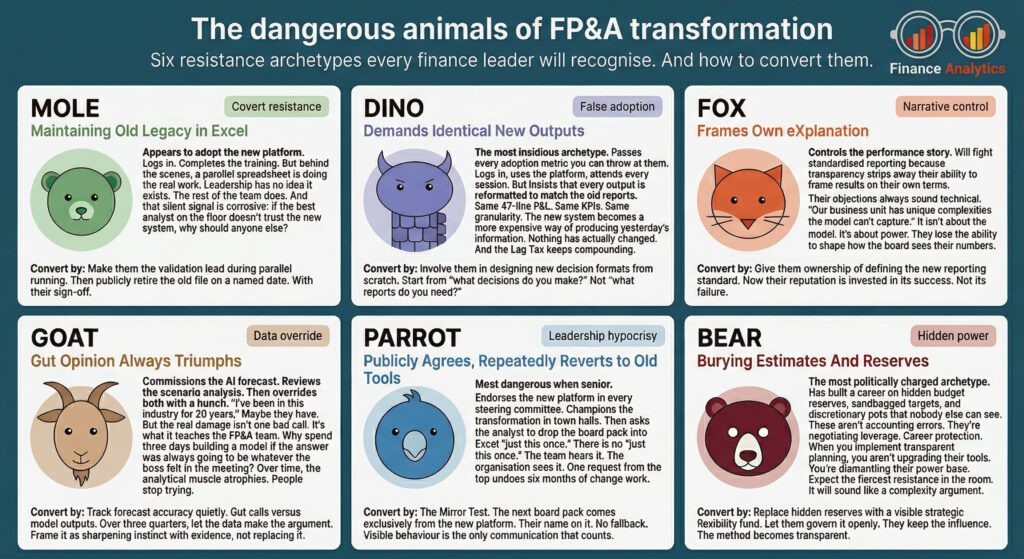
- The Mole (covert resistance): Adopts the platform on the surface while a parallel spreadsheet does the real work. Convert by making them the validation lead, then publicly retiring the old file with their sign-off.
- The Dino (false adoption): Insists the new system reproduce the old reports. Convert by designing new formats around “what decisions do you make?” rather than “what reports do you need?”
- The Fox (narrative control): Resists standardised reporting because transparency limits how they frame results. Convert by giving them ownership of the new reporting standard.
- The Goat (data override): Commissions the forecast, then overrides it with a hunch. Convert by tracking gut calls against model outputs and letting the data make the argument.
- The Parrot (leadership hypocrisy): Champions the change in public, then asks for the board pack in Excel “just this once.” Convert by making sure leaders’ behaviour matches their words, and being open about any parallel running.
- The Bear (hidden power): Relies on sandbagged targets and hidden reserves. Convert by bringing reserves into the open and letting them govern them transparently.
The common thread is bringing people into the change. A few training sessions won’t shift six different mindsets, so most of the effort belongs on the people side. And go-live is only halfway: it proves the system works, not that people are using it to deliver the benefits. For CFOs, leading change is becoming one of the defining skills of the role.
Key topics covered:
- FP&A teams may resist new platforms because they have built expertise, confidence, and credibility around existing tools such as Excel.
- The transformation should begin with the business problem; teams should first assess what existing finance systems and traditional automation can solve before adding AI.
- Employees who maintain parallel spreadsheets can undermine confidence in a new system; involving them in validation and recognizing their expertise can help bring them on board.
- People who demand old reports or outputs may need help reconsidering what decisions they need to make and what information would best support those decisions.
- Involving skeptics in the design of a solution can build ownership and adoption, even when the final design is not perfect.
- Leaders need to reinforce the new system through visible actions, while treating go-live as the midpoint of a continuing change and adoption effort.
Links
Timestamps:
- 00:02:03 — Why resistance to FP&A change can be rational, and why technology alone does not guarantee adoption.
- 00:04:46 — How organizations differ in their readiness to absorb new technology.
- 00:07:17 — A problem-first approach to finance transformation: existing systems, traditional automation, then AI.
- 00:13:17 — Introduction to the six FP&A resistance archetypes and the “mole,” who keeps legacy Excel processes alive.
- 00:16:07 — The “dinosaur” and the challenge of reproducing old outputs instead of rethinking work.
- 00:21:41 — Continuous improvement versus stepping back to redesign processes from the ground up.
- 00:21:55 — The “fox,” who may resist standardized reporting that reduces control over the performance narrative.
- 00:27:50 — The “goat,” who trusts gut opinion, and how model outputs can be tested against judgment over time.
- 00:30:28 — The risk of publicly supporting a transformation while continuing to use old tools behind the scenes.
- 00:32:53 — The “bears,” who may resist transparency around estimates and reserves.
- 00:35:36 — Why change management must continue beyond training and go-live.
- 00:37:30 — The continuing need for leaders to build organizational capability and make change a sustained practice.
Find out more about GrowCFO
If you enjoyed this podcast, you can subscribe to the GrowCFO Show with your favorite podcast app. The GrowCFO show is listed in the Apple podcast directory, Spotify and many others. Why not subscribe there today? That way, you never miss an episode.
GrowCFO is a great place to extend your professional network. Join GrowCFO as a free member today and participate in our regular networking events and webinars. Premium members can also access our extensive training center and CFO Digital Toolkit. You can enroll in our flagship Future CFO or Finance Leader programs here.
You can find out more and join today at growcfo.net
Podcast: Play in new window | Download