What Should You Be Doing Now to Prepare for Your First CFO Role?

The 4 shifts that will help you move from senior finance leader to CFO-ready
You’ve spent years building your finance experience. How do you know if you’re ready to become CFO?
But there’s an important question worth asking:
If a CFO opportunity became available tomorrow, what evidence could you provide that you’re ready to operate at that level?
Being technically excellent and having years of experience are important foundations. However, neither automatically demonstrates that you’re ready to lead the finance function at the executive level.
The real opportunity is to start building that evidence now, while you’re still in your current role.
And there are four specific shifts you can make to accelerate your readiness.
How can you accelerate your journey towards becoming a CFO?
Developing these capabilities takes more than technical finance experience. It requires deliberate practice in strategic thinking, commercial decision-making, executive leadership and influencing stakeholders.
These are areas we develop in GrowCFO’s Future CFO Program, which is designed to help ambitious finance leaders prepare for the demands of a CFO role.
If you’re working towards your first CFO position and want to understand how the program could support your development, join one of our free preview events.
Book your place at a free Future CFO Program preview event
Why is being good at finance no longer enough?
Imagine two Finance Directors seeking their first CFO role:
- The first excels in core finance, budgeting, controls, and team management, reliably running the function.
- The second matches those technical skills while also proving impact in influencing investments, challenging assumptions, growing leaders, and shaping strategy.
When evaluated by a board or CEO, the second candidate offers stronger evidence of CFO potential.
The difference isn’t necessarily experience. It’s how they’ve used their experience to influence the business.
This is where aspiring CFOs should focus their development.
What are the 4 shifts that prepare you for your first CFO role?
The 4 CFO Readiness Shifts provide a practical way to identify the capabilities you need to develop and, more importantly, how to start demonstrating them today.
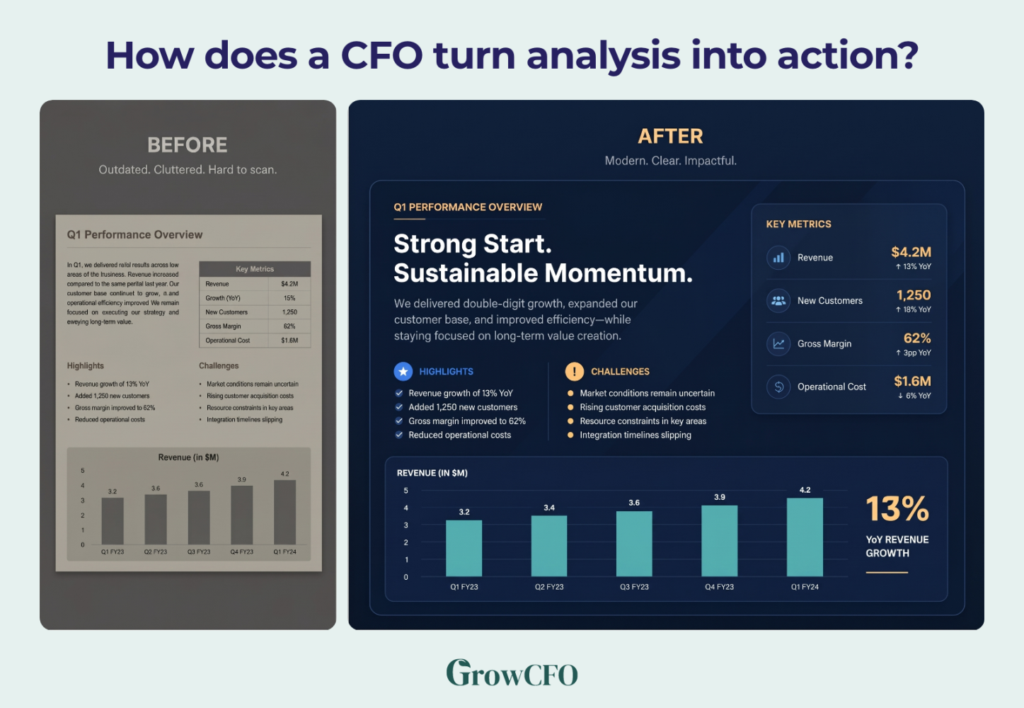
1. How can you move from reporting performance to influencing decisions?
While senior finance professionals excel at explaining past performance, like missed budgets, margin shifts, or cost pressures, CFOs must guide leadership on next steps.
For instance, if gross margin falls from 38% to 35%, traditional finance simply attributes it to discounting and supplier costs, whereas a CFO-led approach presents strategic choices.
A more CFO-oriented response would examine the available choices:
- Which customer segments are driving the margin decline?
- How much volume could the business lose if it reduced discounting?
- Which supplier contracts could be renegotiated?
- What would each option mean for profitability, cash flow and customer retention?
You could then present a recommendation that weighs the financial and commercial consequences.
Here’s how to start this week:
Take one issue from your latest management report and turn it into a decision recommendation.
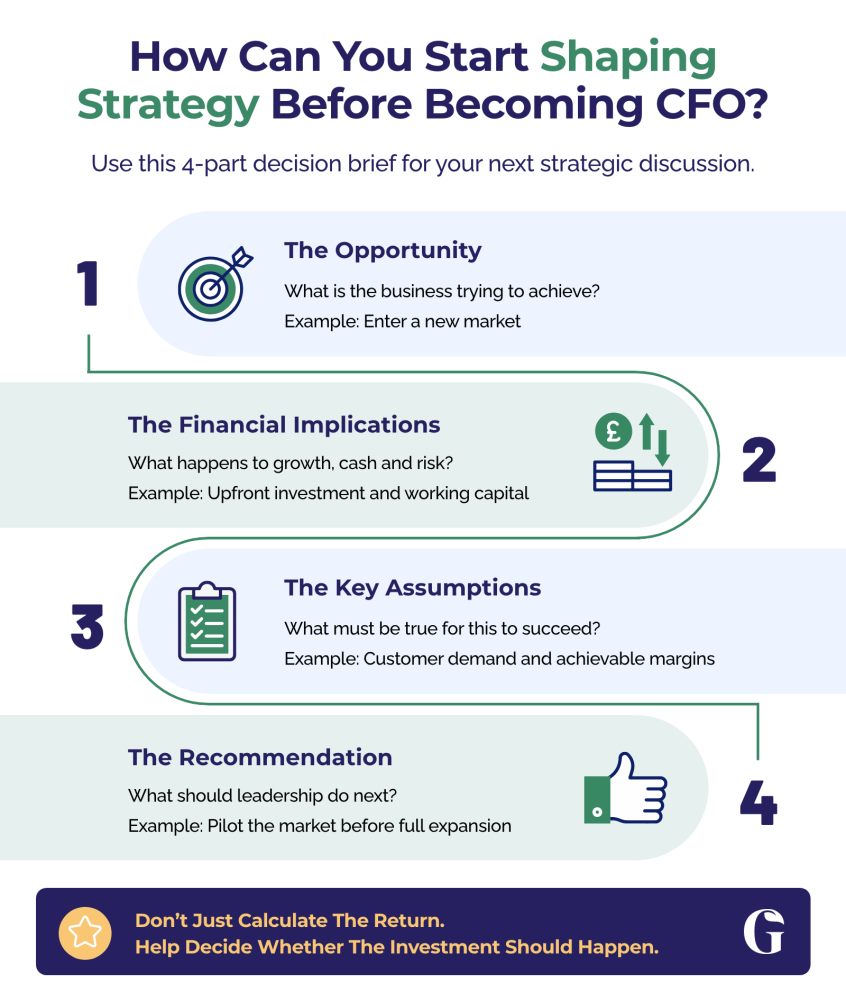
Structure your thinking around four questions:
- What has changed? Identify the financial or commercial issue.
- Why does it matter? Explain its potential impact on the business.
- What are our options? Compare two or three realistic responses.
- What should we do? Make a recommendation, including the assumptions and risks.
This is a practical way to develop the commercial judgement and decision-making influence expected of CFOs.
2. How can you move from managing finance to understanding the whole business?
While a Finance Director focuses mainly on finance function performance, a CFO must understand enterprise-wide value creation, including customers, pricing, operations, investments, competition, and strategy.
For instance, if sales proposes a 10% discount for a major deal, a typical finance response evaluates gross margin impact. A CFO-level view additionally assesses recurring revenue, operational efficiency, expansion potential, positioning, pricing precedents, and working capital impact.
Here’s how to start this week:
Arrange a 30-minute conversation with a commercial or operational leader.
Ask three questions:
- What is the biggest decision your team needs to make over the next three months?
- What commercial or operational factors make that decision difficult?
- What financial insight would help you make a better decision?
Use the answers to identify one opportunity where finance could contribute more directly to business performance.
The objective is to become someone who understands how the business works, rather than someone who only understands its financial results.
3. How can you move from delivering everything yourself to building a finance function that leads without you?
One of the less obvious challenges of preparing for a CFO role is learning to stop being the person who solves every finance problem.
Many successful finance leaders have progressed because they’re dependable, technically strong and willing to take ownership.
But those same strengths can become a constraint when every important decision, report or escalation still depends on them.
A CFO needs the capacity to focus on strategy, business performance, capital allocation and executive relationships.
That becomes difficult if they’re still personally managing every detail of the finance function.
Here’s how to start this week:
Look at your calendar from the past two weeks.
Identify three activities that regularly require your involvement but could potentially be owned by someone else in your team.
For example:
- Reviewing routine monthly reporting commentary.
- Resolving recurring budget-holder queries.
- Preparing the first draft of management presentations.
Choose one responsibility to delegate more fully.
Rather than simply transferring the task, agree what a successful outcome looks like, what decisions the individual can make independently and when an issue should be escalated.
This develops your team’s capabilities while giving you more time to work on strategic priorities.
A useful test is whether your finance function could continue operating effectively if you spent two days each week working on business strategy rather than routine finance activities.
If the answer is no, building greater leadership capacity should become part of your CFO preparation.
4. Move from supporting strategy to shaping it
Contributing to strategic decisions before securing the CFO role is one of the clearest ways to demonstrate readiness.
When evaluating options like market expansion, move beyond financial forecasts and help leadership examine the decision itself:
- What assumptions need to be true for the expansion to succeed?
- What level of investment can the business support?
- How would the expansion affect cash flow and financial resilience?
- What alternative uses of capital should be considered?
- What indicators would tell us whether to accelerate, change direction or stop?
These questions position finance as a key strategic contributor rather than a passive evaluator.
Here’s how to start this week:
This week, pick a strategic priority and share a brief decision summary (covering the opportunity, financial impact, key assumptions, and recommendation) with executive leadership.
How can you tell whether you’re becoming CFO-ready?
One useful way to assess your progress is to look at the evidence you’re accumulating.
Consider these four questions:
Decision influence: Can you describe a business decision that changed because of your financial insight?
Commercial understanding: Can you explain the main drivers of your organisation’s competitive advantage, customer profitability and cash generation?
Leadership capacity: Have you developed people who can independently lead important finance activities?
Strategic contribution: Can you demonstrate how you’ve helped evaluate or shape a significant business priority?
These questions are more useful than simply asking how many years of finance experience you have.
They also highlight where your next development opportunity might be.
If you have strong technical experience but limited evidence of strategic influence, for example, your priority should be to gain greater exposure to commercial and executive decisions.
If you’re already contributing to strategy but remain heavily involved in routine finance processes, developing your team’s independence may be the more valuable next step.
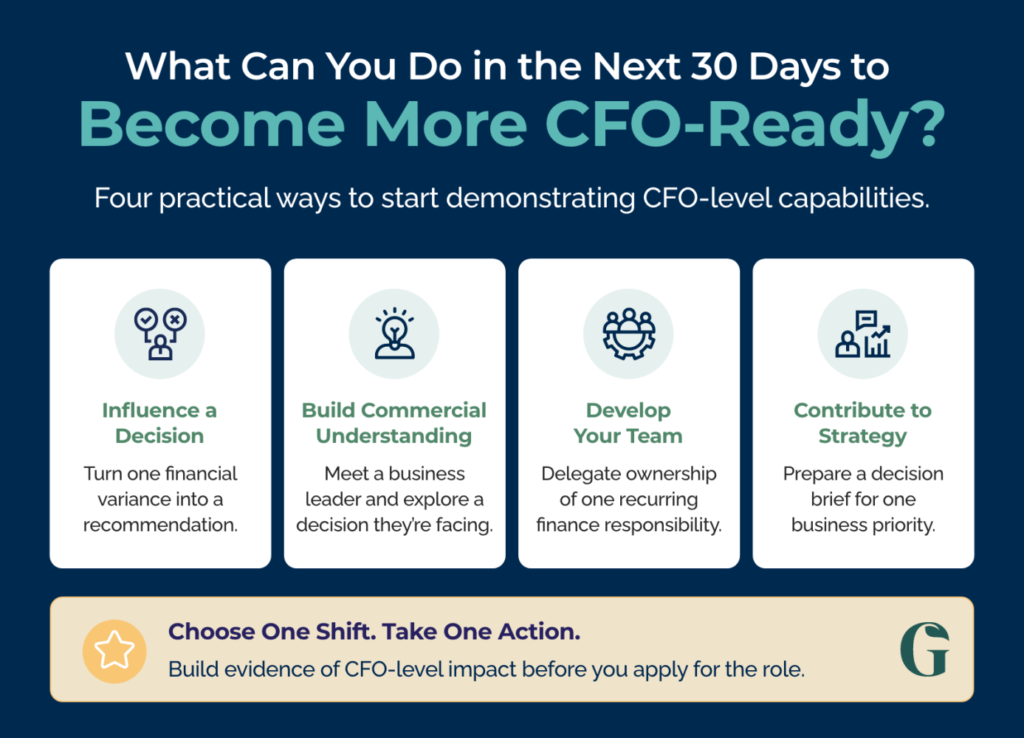
What should you do in the next 30 days?
You don’t need to make all four shifts simultaneously.
Choose the one that would make the biggest difference to your CFO readiness and commit to a visible action over the next month.
For example, you could:
- Present a recommendation alongside your next management report.
- Participate in a commercial decision outside your usual responsibilities.
- Delegate ownership of a recurring finance process.
- Contribute a financial perspective to a strategic initiative.
Keep a record of the business problem, your contribution, the decision made and the outcome.
Over time, this creates a portfolio of examples demonstrating that you’re already developing the capabilities expected of a CFO.
It also gives you stronger evidence to draw upon when discussing your readiness with your current CFO, CEO, board or a potential employer.
What’s the one thing to remember?
Don’t measure your CFO readiness by how much finance work you can do. Measure it by how much business impact you can create.
Your next career move will be easier to justify when you can demonstrate that you’re already influencing decisions, understanding commercial priorities, developing leaders and contributing to strategy.
The best time to build that evidence is before you need it.
How can GrowCFO help you prepare for your first CFO role?
If your ambition is to become a CFO, the challenge is knowing which capabilities to develop and how to build them in a structured way.
GrowCFO’s Future CFO Program focuses on helping finance leaders develop the broader strategic, commercial and leadership capabilities required to make that transition.
If you’d like to explore how the program could help you prepare for your next career move, join one of our free preview events.
Book your free Future CFO Program preview event here.