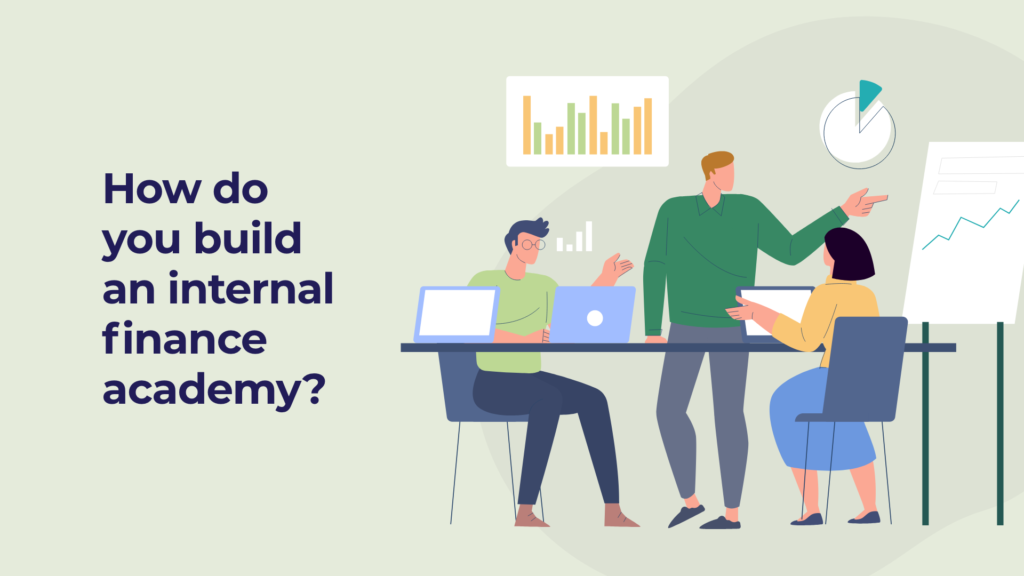
How do you build an internal finance academy?
How can finance leaders build an internal finance academy that develops the skills their organisation actually needs?
Building an internal finance academy starts with identifying the capabilities your finance function needs, creating structured learning pathways around those capabilities, and connecting development directly to real work. Rather than simply purchasing a corporate finance online course, the strongest academies create an ongoing learning environment that can reflect your organisation’s competencies, priorities, culture and brand.For larger finance functions, the challenge is rarely finding training. There is an enormous amount available. The harder question is how to turn learning into a consistent development system that helps people perform better in their roles and prepares the finance function for what comes next.
That is where an internal finance academy becomes valuable.
What is an internal finance academy?
An internal finance academy is a structured learning environment designed specifically around the skills, roles and strategic priorities of your finance function.
Instead of employees independently choosing a corporate finance online course, an academy brings development together into defined learning pathways. Those pathways might cover technical finance, FP&A, finance business partnering, leadership, commercial finance, AI, communication and other capabilities required by the organisation.
The important distinction is that an academy is not simply a library of training content.
A finance academy connects learning to the capabilities the business needs finance to demonstrate.
McKinsey describes corporate academies as integrated initiatives designed to develop and sustain capabilities aligned with corporate strategy. Its Finance Academy model similarly combines technical knowledge with thought leadership, personal impact and communication skills, while incorporating organisation-specific cases and opportunities to apply learning to day-to-day work.
That broader approach matters because expectations of finance professionals have expanded significantly beyond technical accounting and reporting.
Why build a corporate finance online course academy rather than buy individual courses?
Individual courses can solve specific development needs. They become less effective when a large finance function needs consistent capabilities across teams, roles, locations and career levels.
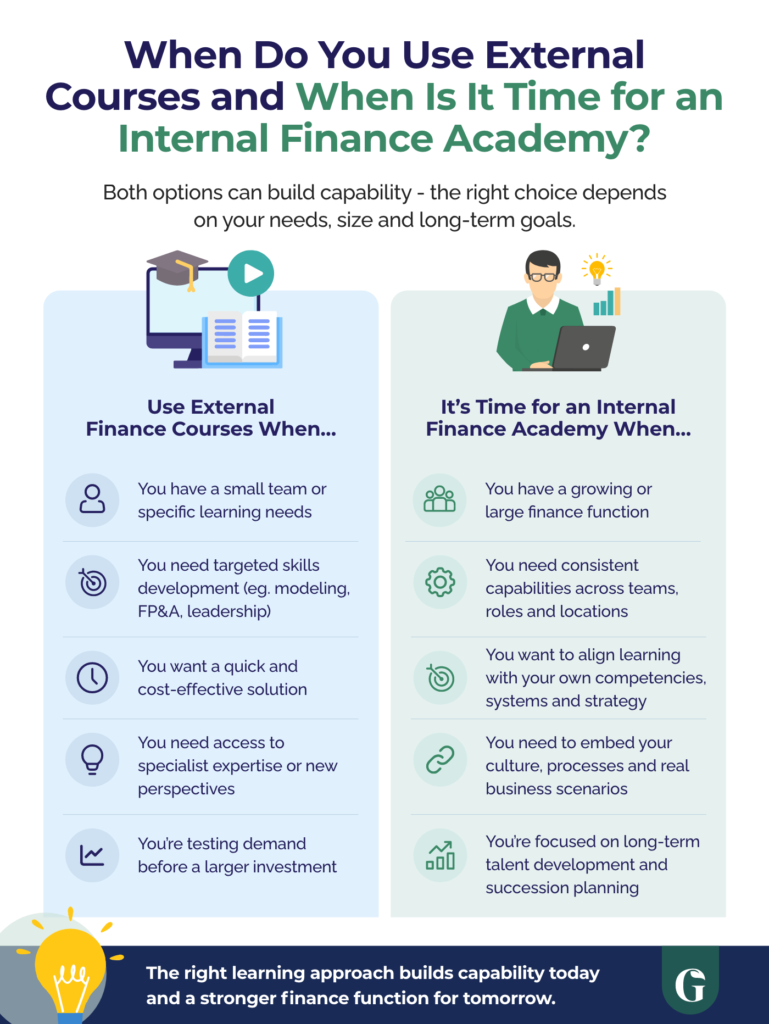
As finance teams grow, relying on managers to transfer knowledge informally can also produce inconsistent development. Structured finance training creates common standards and allows learning to be sequenced according to role and capability rather than delivered as disconnected interventions.
The capabilities expected from finance leaders are also becoming broader. Research examining the backgrounds of 4,000 S&P 2000 CFOs found a shift beyond traditional accounting-focused career paths towards greater strategic, operational and business-partnering experience. This reinforces the need for finance development to build a wider range of capabilities rather than focusing on technical knowledge alone.
An internal academy provides the structure to bring those activities together.
It can help organisations:
- establish consistent finance competencies across teams and geographies;
- create role-specific development pathways;
- accelerate onboarding and internal progression;
- combine technical, commercial, leadership and behavioural development;
- connect a corporate finance online course with workshops, practical application and peer learning;
- support succession planning and future finance leaders; and
- measure capability development rather than simply course completion.
There is also a longer-term talent consideration. Russell Reynolds Associates analysed the backgrounds of 4,000 S&P 2000 CFOs between 2012 and 2022 and highlighted the historic importance of “academy companies” with strong reputations for developing finance talent. Its research also points towards the changing mix of experience required from modern CFOs, reinforcing the need for organisations to continually rethink how they develop their finance pipeline.
How should you design a corporate finance online course academy?
Start with capabilities, not courses.
Before choosing content, define what good performance looks like across your finance function. Consider the capabilities required today as well as those that will become increasingly important as finance evolves.
For example, your framework might include:
| Capability | What development could cover |
| Technical finance | Accounting, modelling, reporting and controls |
| FP&A | Planning, forecasting, scenario analysis and performance management |
| Business partnering | Insight, influence, relationships and decision support |
| Technology and AI | Automation, data, AI tools and governance |
| Communication | Storytelling, presentations and board reporting |
| Leadership | People leadership, strategy, change and executive impact |
From there, map each role against the capabilities it requires and identify the gaps.
This allows you to create pathways rather than asking everyone to complete the same corporate finance online course. An FP&A analyst, Finance Business Partner, Financial Controller and Finance Director will have different development needs even when they sit within the same finance function.
GrowCFO’s Finance Team Assessment can provide a useful starting point for identifying strengths, weaknesses and priority development areas across a finance team.
How can you make an internal finance academy specific to your organisation?
This is where an internal academy can become significantly more valuable than generic training.
Your academy should feel like part of your organisation rather than an external training website employees occasionally visit.
For an enterprise finance function, that could mean creating a learning environment using your organisation’s branding, competency framework and development priorities, while combining established finance learning with courses and resources that are specific to your business.
For example, the academy could incorporate your own:
- finance competency framework;
- terminology and processes;
- leadership expectations;
- internal case studies;
- policies and governance;
- systems training;
- learning content; and
- career and development pathways.
The result is a corporate finance online course environment that reinforces how finance operates inside your organisation.
This also allows businesses to combine their internal knowledge with external expertise. GrowCFO can create custom corporate finance training programmes around a finance team’s experience, workflows, systems and strategic priorities, including virtual, in-person and blended delivery.
How do you make a corporate finance online course translate into better performance?
Completion should never be the end goal.
The objective is changed behaviour and stronger finance capability.
Research also supports the importance of moving beyond passive learning. A peer-reviewed study published in Psychological Science found that actively retrieving learned information produced better long-term retention than repeated studying. For finance teams, this strengthens the case for combining structured learning with opportunities to practise and apply new capabilities in real work.
One of the most important principles is therefore to connect learning with immediate opportunities to apply it. Someone completing forecasting training shortly before a planning cycle has an obvious opportunity to practise their new skills. Someone developing presentation skills ahead of board reporting can immediately turn learning into action.
This principle is supported by research on the testing effect, which shows that actively retrieving and applying knowledge can produce substantially stronger long-term retention than simply studying material repeatedly. In a widely cited study published in Psychological Science, Roediger and Karpicke found that testing produced greater delayed retention than repeated study, reinforcing the value of active application in learning.
For finance leaders, the implication is clear: learning should be designed around doing, not simply consuming content.
A strong internal academy therefore combines each corporate finance online course with opportunities to practise skills through real work, simulations, workshops, manager conversations and peer learning.
How should you measure whether your internal finance academy is working?
Course completions are useful operational data, but they do not tell you whether finance capability has improved.
Instead, define the business or behavioural outcomes you expect the academy to influence.
Depending on the learning pathway, you could monitor improvements in forecast quality, reduced rework, stronger stakeholder feedback, increased analyst independence, internal progression, onboarding speed or the ability of finance teams to support better decisions.
Managers have an important role here. Development needs to become part of regular conversations about performance rather than something that sits separately from day-to-day finance.
The most useful question is not “Did people finish the training?” but “What can they now do better because of it?”
How can you start building your internal finance academy?
You do not need to build everything at once.
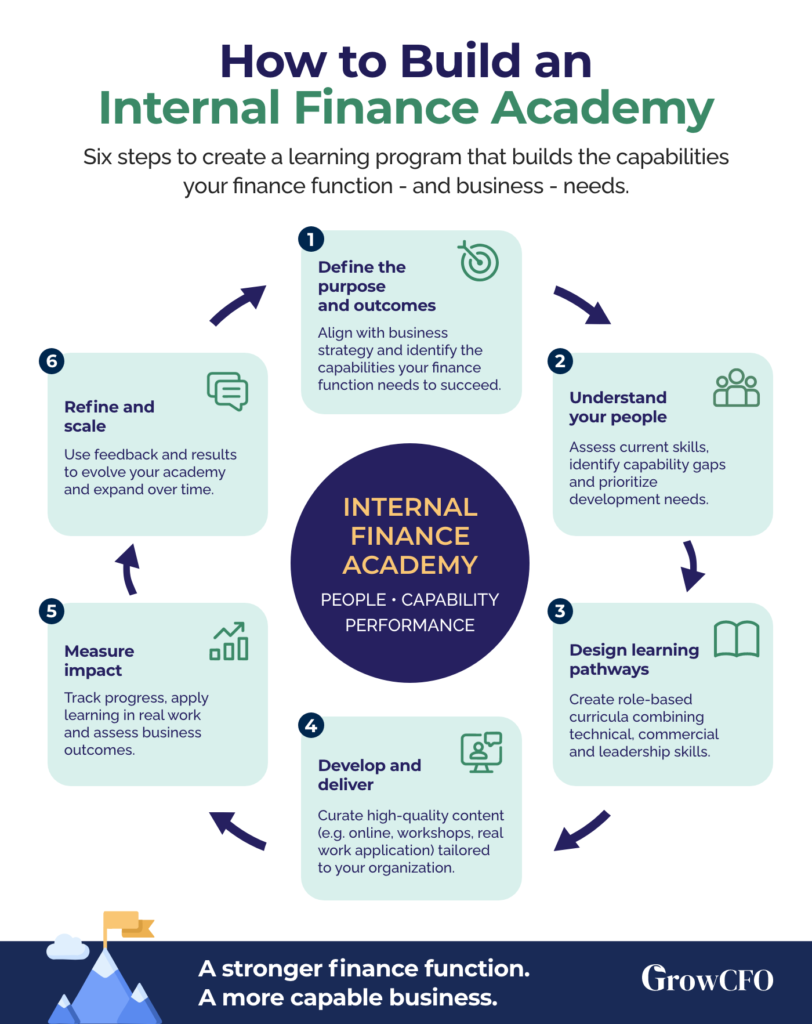
Start by defining the business outcomes you want to achieve and identifying the capabilities most important to those outcomes. Assess current capability, prioritise the most significant gaps and build an initial learning pathway around them.
You can then expand the academy over time, adding further pathways, specialist corporate finance online course content and organisation-specific learning as requirements evolve.
GrowCFO works with finance functions to build practical training around the needs of their people, systems and strategic priorities. For enterprise organisations, this can go further by creating a tailored learning environment aligned with your own branding, competencies and internal content—giving your finance team a central academy rather than another collection of disconnected courses.
Explore GrowCFO’s corporate finance training solutions to see how you can build a development programme around your finance function, or browse our finance team training courses to explore the capabilities that could form part of your academy.
Your finance academy should not simply teach people more. It should systematically build the finance capabilities your organisation needs next.