#285 How AI Is Turning Finance Into a Probability Game Jason Brisbane Founder, Finhelm
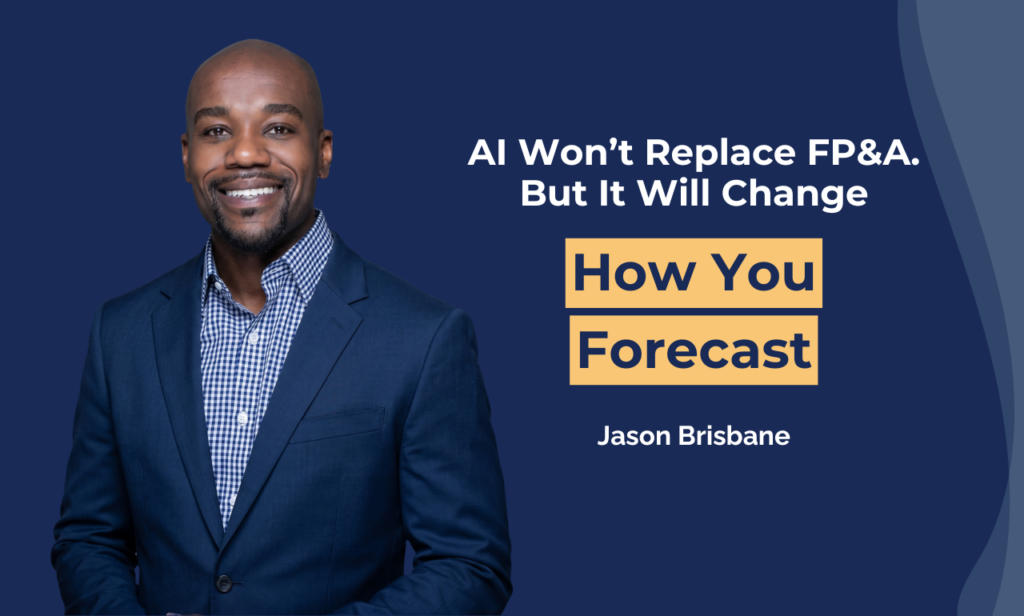

In a world of rapid disruption and volatility, finance teams can no longer rely on single‑point forecasts and rigid spreadsheets. They must understand ranges of possible outcomes, quantify risk, and communicate uncertainty in ways that enable better, faster strategic decisions, turning uncertainty from a threat into a competitive advantage.
In this episode of The GrowCFO Show, host Kevin Appleby speaks with Jason Brisbane, Founder of Finhelm, about how AI and Monte Carlo simulation are reshaping finance by replacing deterministic forecasts with probability‑driven models. Brisbane shares his journey from FP&A and treasury at Adobe to founding Finhelm, a platform that brings “computational finance” into the CFO organization and assigns an “uncertainty exposure score” to models, essentially a credit score for forecast risk.
This approach helps FP&A teams treat variances as learning signals rather than failures and move from static scenario planning to continuous simulation at scale. The discussion also explores how probabilistic modeling supports risk management and AI governance, including “nutrition labels” for AI‑enabled processes so domain experts can understand volatility, detect drift, and know when human intervention is required.
Key topics covered:
- Shift from deterministic to probabilistic finance: Brisbane explains how most organizations still rely on single‑point, deterministic forecasts, and how Monte Carlo simulation combined with AI introduces probability distributions, helping teams understand the likelihood of outcomes rather than relying on one number.
- Uncertainty Exposure Score as a “credit score” for forecasts: Finhelm applies Monte Carlo simulation to generate an “uncertainty exposure score,” giving finance leaders a clear measure of volatility and risk embedded in their models over time.
- Variances as learning, not failure: Brisbane argues that probabilistic finance allows FP&A teams to reframe forecast variances as opportunities for learning and calibration, rather than signs of failure, driving a more mature approach to performance management.
- From scenario to simulation in risk management: The discussion extends Monte Carlo beyond financial forecasting into risk, highlighting how organizations can move from simplistic low/medium/high risk grids to simulated, monetized risk impacts across portfolios and risk registers.
- AI “nutrition labels” and governance: Brisbane introduces the idea of a “nutrition label” for AI‑enabled processes, where risk scores and volatility bands help domain experts decide when it is safe for autonomous agents to operate and when human intervention is required.
- AI‑native build by a finance domain expert: As a finance professional rather than a traditional technologist, Brisbane describes how he is using AI‑native development tools to build Finhelm, demonstrating how domain experts can now create sophisticated, AI‑driven solutions without large in‑house engineering teams.
Links
Timestamps:
- 00:00 – 04:30 – Jason shares his background from Adobe’s rotation program through FP&A and product roles, and explains Finhelm’s mission: bringing computational finance and Monte Carlo simulation into the CFO organization to add probability and distribution to traditional forecasts.
- 04:30 – 08:30 – Appleby and Brisbane break down Monte Carlo as running hundreds or thousands of simulations across best/likely/worst‑case assumptions to produce a forecast with confidence bands instead of a single number, reframing how finance understands uncertainty.
- 08:30 – 13:45 – Appleby recounts a defense procurement project where Monte Carlo was used to estimate 25‑year life‑cycle costs and readiness, illustrating why probabilistic modeling is essential when multiple uncertain drivers interact over long horizons.
- 14:00 – 18:30 – Brisbane contrasts the classic “three‑tab spreadsheet” (worst/base/best) with probabilistic finance, arguing that Monte Carlo and uncertainty exposure scores allow FP&A teams to treat variance as learning data and continually recalibrate models.
- 18:30 – 22:30 – The conversation turns to risk registers and enterprise risk, discussing how organizations can move beyond low/medium/high matrices to simulated, monetary impact of risks, and how this supports more informed resource allocation and strategic decisions.
- 21:30 – 26:00 – Brisbane introduces the concept of scoring volatility to determine when AI agents can operate autonomously within “safe bands” and when domain experts must intervene, aligning probabilistic finance with AI governance and auditability requirements.
- 25:20 – 32:00 – Brisbane outlines Finhelm’s early traction in law, professional services, and healthcare, and shares his vision that within 12–18 months, FP&A teams will routinely use Monte Carlo and uncertainty scoring to answer deeper questions about risk and performance.
Find out more about GrowCFO
If you enjoyed this podcast, you can subscribe to the GrowCFO Show with your favorite podcast app. The GrowCFO show is listed in the Apple podcast directory, Spotify and many others. Why not subscribe there today? That way, you never miss an episode.
GrowCFO is a great place to extend your professional network. Join GrowCFO as a free member today and participate in our regular networking events and webinars. Premium members can also access our extensive training center and CFO Digital Toolkit. You can enroll in our flagship Future CFO or Finance Leader programs here.
You can find out more and join today at growcfo.net
Podcast: Play in new window | Download