How Can You Build CFO Experience Without Being a CFO?

How can you build CFO-level experience when you’re not in a CFO role yet?
You’ve managed budgets, improved reporting, led teams and supported senior management. But when you look at CFO job descriptions, you keep seeing requirements such as:
- Experience influencing strategic decisions
- Board-level communication
- Capital allocation and investment decisions
- Commercial leadership
- Managing business risk
The frustrating part? You’re not currently responsible for many of these activities, so how are you supposed to gain the experience?
The opportunity is to stop thinking about CFO experience as something you can only gain once you have the title.
You can start developing many of these capabilities in your current role, provided you’re deliberate about the opportunities you pursue.
What Counts as CFO-Level Experience?
CFO experience isn’t simply about managing larger budgets or taking on more financial responsibilities.
It’s about demonstrating that you can influence business outcomes, make commercially sound recommendations and operate confidently with senior stakeholders.
For example, producing a financial model for an acquisition gives you valuable technical experience.
But helping executives compare acquisition opportunities, challenge assumptions and make an investment decision gives you experience that’s much closer to what a CFO does.
The difference is the level of ownership and influence.
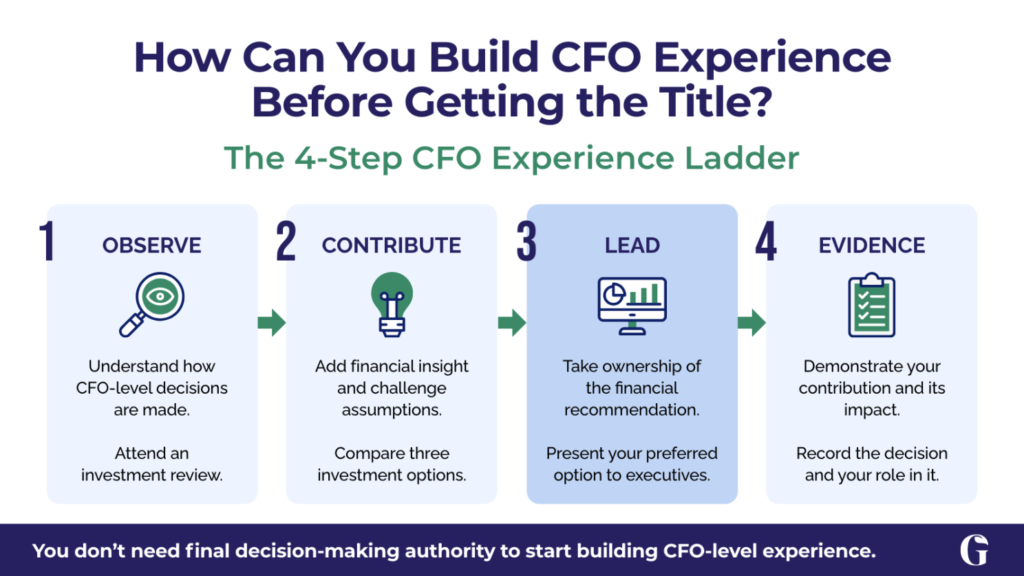
That’s why aspiring CFOs should think about their development through the CFO Experience Ladder.
How Does the CFO Experience Ladder Work?
The framework has four stages:
1. Observe → 2. Contribute → 3. Lead → 4. Evidence
You can apply these stages to almost any CFO-level capability, whether that’s strategy, investment decisions, executive influence or board communication.
1. How Can You Observe CFO-Level Decisions?
Start by gaining exposure to decisions you wouldn’t normally be involved in.
Example: Ask to attend a strategic planning meeting or observe how your CFO prepares for a board discussion.
Pay attention to how financial information is used to challenge assumptions, compare options and influence decisions.
What to do this week: Ask your CFO to involve you in one upcoming strategic discussion, even if your initial role is simply to observe.
2. How Can You Contribute Beyond Your Existing Responsibilities?
Once you understand the decision-making process, look for opportunities to contribute your own analysis and recommendations.
Example: Instead of only preparing the numbers for a capital investment proposal, evaluate alternative investments and explain the commercial trade-offs.
What to do this week: Choose one business decision and prepare a short recommendation covering the options, risks and your preferred approach.
3. How Can You Lead a CFO-Level Activity?
The next step is moving from supporting a decision to taking responsibility for part of the process.
Example: Volunteer to lead the financial evaluation of a new market opportunity, coordinate the investment case and present your recommendation to the executive team.
You may not have final decision-making authority, but you can still demonstrate ownership of the financial thinking behind the decision.
What to do this week: Identify an upcoming project where you could take responsibility for the financial recommendation rather than simply producing the analysis.
4. How Can You Evidence Your CFO-Level Experience?
Experience becomes much more valuable when you can demonstrate what you contributed and the impact it had.
Example: Rather than saying, “I supported a £2 million investment project,” explain:
“I led the financial evaluation of a proposed £2 million investment, compared three options and presented a recommendation that helped the executive team select its preferred approach.”
What to do this week: Record one example using three questions:
- What business decision were you involved in?
- What did you personally contribute or lead?
- What changed because of your involvement?
Only claim outcomes you can substantiate, and keep commercially sensitive details confidential.
Where Can You Find CFO-Level Opportunities in Your Current Role?
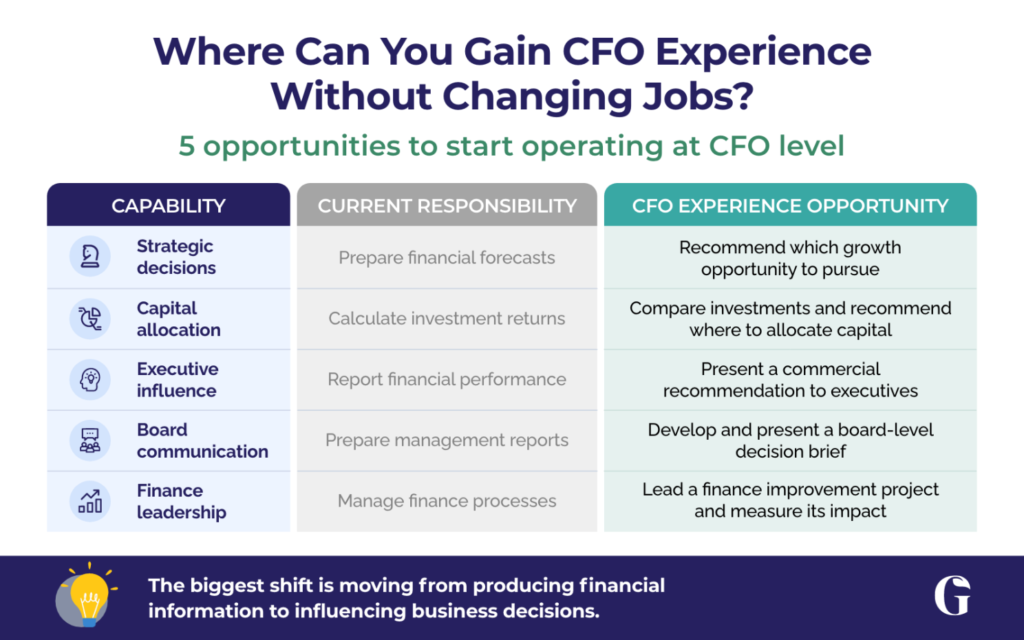
You don’t necessarily need a new job to find relevant experience.
Look for opportunities within activities your organisation is already undertaking.
Strategic planning
Move beyond preparing the financial forecast. Help evaluate strategic options and recommend where the business should focus.
Investment decisions
Offer to lead the financial assessment of a capital investment, acquisition or major commercial project.
Board reporting
Ask to contribute to a board paper or present the financial implications of a business decision.
Executive influence
Bring a recommendation to a leadership meeting rather than simply reporting financial performance.
Finance transformation
Lead an improvement that gives the business better information, strengthens controls or frees up finance capacity for strategic work.
The key is to choose an opportunity that stretches you beyond your current responsibilities.
How Can You Turn One Opportunity Into CFO Experience in 30 Days?
You don’t need to overhaul your development plan immediately.
Start with one decision.
Week 1 — Identify the opportunity
Find an upcoming strategic, commercial or investment decision where finance has an important role.
Week 2 — Build your recommendation
Understand the business objective, compare the options and identify the financial risks and trade-offs.
Week 3 — Influence the discussion
Present your recommendation to the relevant stakeholders. Ask questions, challenge assumptions and invite feedback.
Week 4 — Capture the evidence
Document your contribution, the decision reached and what you learned.
You may not control the final decision, but you can demonstrate how you helped improve the quality of the discussion.
What’s the One Thing to Remember?
You don’t need the CFO title to start gaining CFO-level experience. You need opportunities to observe, contribute to and lead the decisions CFOs are expected to influence.
And you need evidence that demonstrates what you’ve achieved.
The more deliberately you build that experience, the stronger your case becomes when the right CFO opportunity arises.
How Can GrowCFO Help You Build CFO-Level Experience?
Knowing which capabilities you need to develop is one challenge. Finding opportunities to practise them is another.
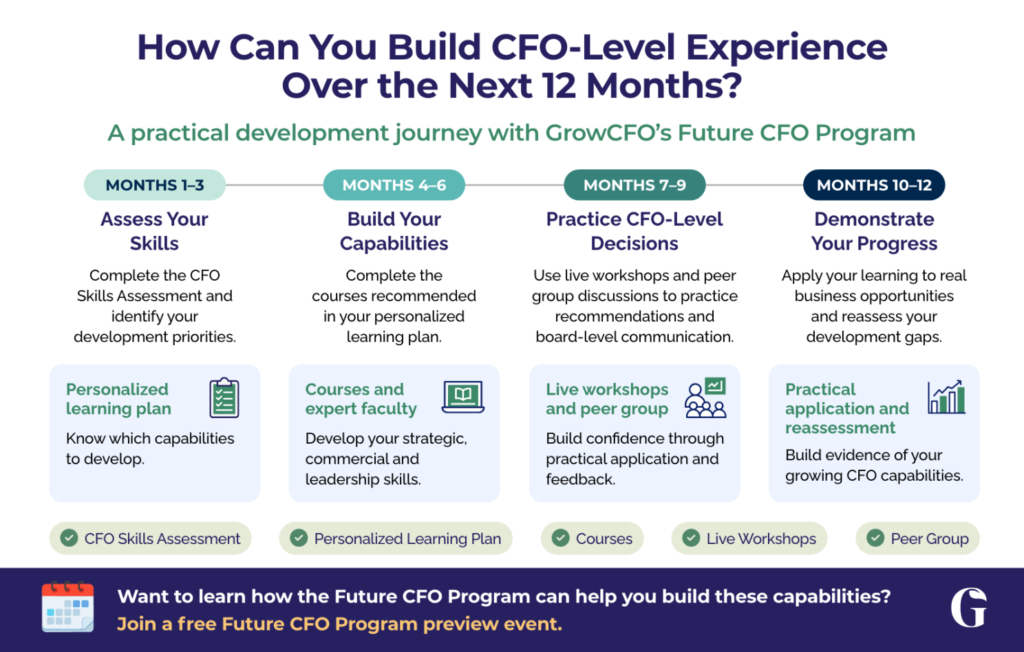
GrowCFO’s Future CFO Program helps aspiring finance leaders develop their strategic, commercial and leadership capabilities through a personalised learning plan, courses, live workshops and peer group learning.
If you’d like to learn more about building the experience and confidence needed for your first CFO role, join one of our free Future CFO Program preview events.