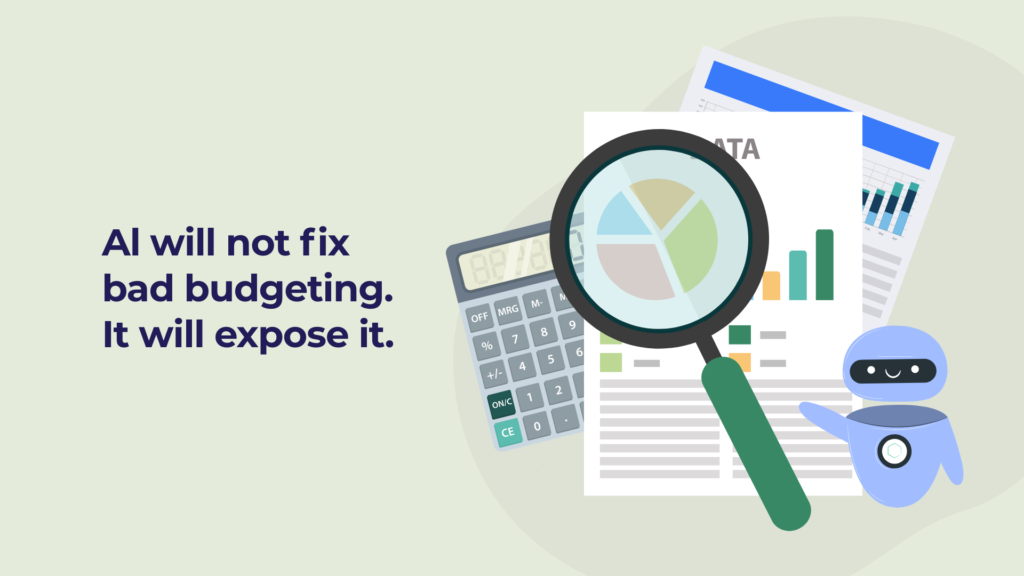
AI will not fix bad budgeting. It will expose it.
That may sound uncomfortable, but GrowCFO believes it is one of the most important implications of AI for finance leaders. For years, finance teams have been under pressure to make planning, budgeting and forecasting faster, more accurate and more relevant to the business. Finance has moved from annual budgets to rolling forecasts, from spreadsheet-heavy processes to connected planning tools, from static management packs to dashboards, and from backward-looking variance analysis to more forward-looking business partnering.
The problem is not just the process
In many organisations, the core planning process still suffers from familiar problems. Assumptions are not always clear. Forecasts are not always genuinely owned by the business. Scenario modelling is often too slow to influence the decision. Data quality issues consume too much finance time. The budget becomes a negotiation rather than a strategic plan, and the forecast becomes a number to explain rather than a tool for better decision-making.
AI changes the conversation because it can accelerate the mechanics of planning. It can help identify trends, spot anomalies, generate commentary, model scenarios, challenge assumptions and update forecasts more quickly. But that is only useful if the underlying planning discipline is strong. If the data is poor, AI will make poor data more visible. If assumptions are unclear, AI will expose the lack of logic behind the numbers. If business ownership is weak, AI will not magically create accountability. And if the process is designed around producing a budget rather than making better decisions, AI may simply help teams produce the wrong thing faster.
From forecast automation to decision intelligence
That is why GrowCFO believes the next phase of AI in Planning, Budgeting and Forecasting is not really about forecast automation. It is about decision intelligence. Can finance teams move from asking “what is the forecast?” to asking better questions: what has changed since the last forecast, which assumptions are now out of date, where are we seeing early warning signals, which scenarios should management be considering, and what decisions need to be made now?
This is the theme of the next GrowCFO Tech Innovation Report: AI in Planning, Budgeting and Forecasting. GrowCFO last covered this area in Q3 2025, and a lot has changed since then. The conversation has moved from dashboards, copilots and automated commentary toward more dynamic forecasting, scenario modelling, connected planning workflows and the early signs of AI agents supporting finance processes.
What is really happening inside finance teams?
GrowCFO is particularly interested in what is actually happening inside finance teams. Are CFOs and finance leaders using AI in forecasting today? Do they trust AI-generated analysis? Would they present an AI-supported forecast to the board? Are they seeing real value, or is adoption still experimental? What is holding teams back: data quality, integration, governance, skills, trust, security, or something else? And perhaps most importantly, is AI improving decision-making, or just speeding up existing processes?
To explore this properly, GrowCFO is running a short community survey, supported by Acterys, to understand how finance leaders are approaching AI in planning, budgeting and forecasting. The findings will shape our Q4 2026 Tech Innovation Report and help benchmark where the finance community really is, beyond the vendor messaging and beyond the AI hype.
If you are a CFO, finance leader, FP&A professional or involved in planning and forecasting, GrowCFO would really value your input. Please take a few minutes to complete the survey and share your perspective.
Because the real question is not whether AI will enter the planning process. It already is. The real question is whether finance leaders will use it to create better decisions, stronger accountability and more adaptive businesses, or simply faster versions of the same old budget cycle.
GrowCFO would be really grateful if you could complete the survey.