Why Finance Directors Get Passed Over For CFO

Many Finance Directors build a reputation for being reliable but still struggle to be seen as the next CFO.
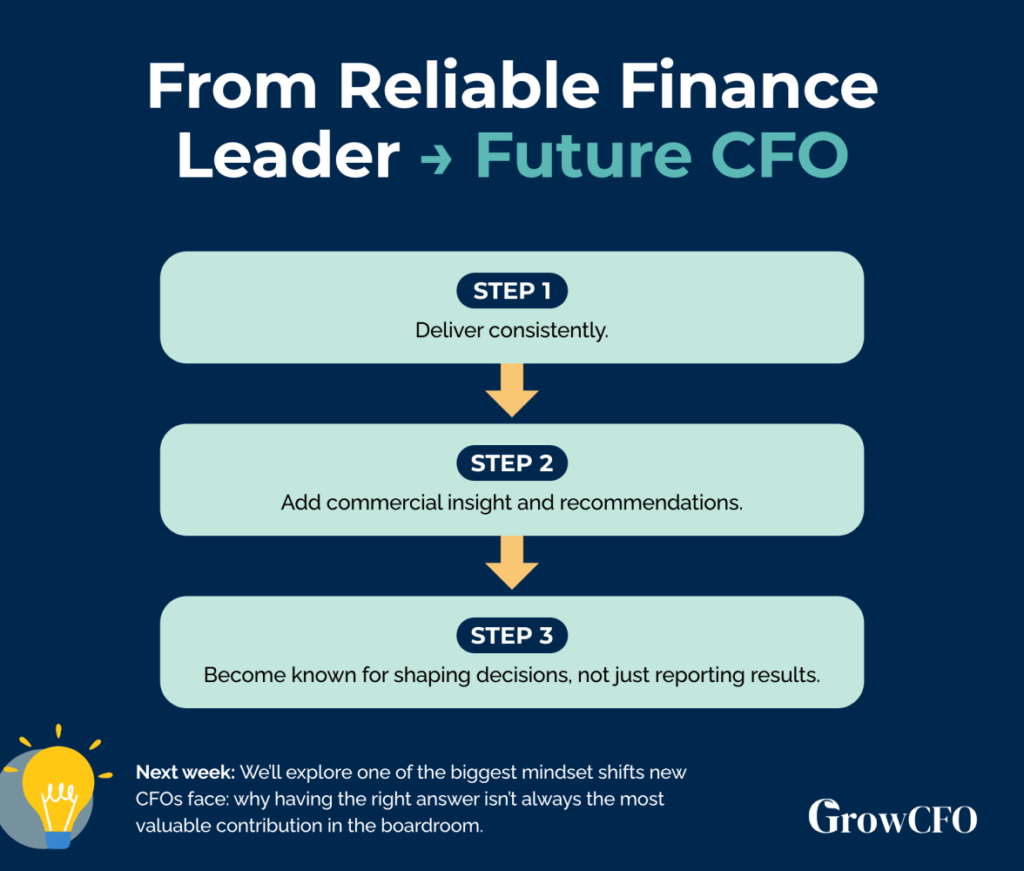
Being dependable earns credibility. Becoming a CFO requires something more: the ability to influence decisions, challenge thinking, and lead the business beyond the numbers.
For many finance professionals, reliability is what builds their career. Delivering accurate reporting, meeting deadlines, and becoming the person everyone trusts are qualities every organization values.
But as finance leaders move toward the CFO role, the expectations begin to change.
For those facing this challenge, GrowCFO explores it in greater depth during the free Future CFO Preview Event, where finance leaders can experience the GrowCFO Competency Framework, see how the programme works, and gain clarity on the capabilities that matter most for the next career step.
Five Shifts That Separate Future CFOs
Decision-making Great finance leaders explain what happened. Future CFOs recommend what should happen next.
Commercial thinking They connect financial performance to customers, operations, and growth instead of reporting numbers in isolation.
Influence They contribute confidently to discussions, even when finance isn’t the primary topic.
Communication They simplify complexity so executives can make faster, better decisions.
Leadership They build alignment across the business rather than simply delivering finance outputs.
How to Make the Shift From Reliable Finance Leader to Future CFO
Reliability is still essential. Nobody wants a CFO who misses deadlines or produces inaccurate information.
The difference is that reliability becomes the starting point, not the destination.
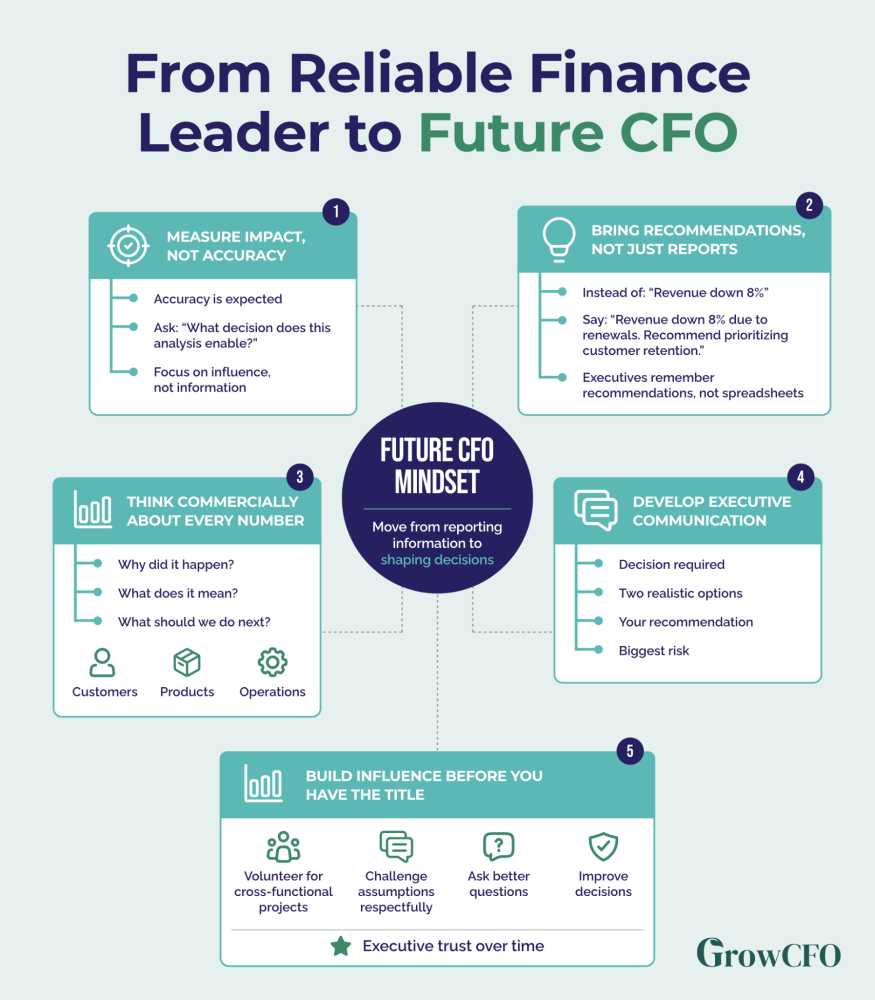
Here are five practical ways to begin making that transition.
1. Stop measuring value by accuracy alone
Accurate reporting is expected.
Instead, ask:
“What business decision becomes easier because of this analysis?”
If there is no clear answer, the work may be informative without being influential.
2. Arrive with recommendations, not just reports
Don’t finish with:
Revenue declined by 8%.
Finish with:
Revenue declined by 8%, primarily due to lower renewals. We recommend prioritizing customer retention over new acquisition this quarter because it offers the fastest route back to target.
Executives remember recommendations.
Not spreadsheets.
3. Learn the commercial story behind every number
Future CFOs spend as much time understanding customers, products, and operations as they do understanding financial statements.
Every significant variance should answer three questions:
- Why did it happen?
- What does it mean?
- What should we do next?
4. Develop executive communication
Senior leaders rarely want every detail.
They want clarity.
A simple structure works well:
- The decision required.
- Two realistic options.
- Your recommendation.
- The biggest risk.
That approach changes how people see your contribution.
5. Build influence before having the title
Influence is not authority.
It is helping others make better decisions.
Volunteer for cross-functional projects.
Challenge assumptions respectfully.
Ask better questions.
Become known as someone who improves decisions, not simply someone who produces excellent reports.
Over time, that’s what creates executive trust.
One reason the Future CFO Program is built around a 9-module curriculum is that becoming a CFO requires more than technical finance capability.
Participants explore areas such as leadership, communication, strategy, influencing skills, and commercial thinking, alongside practical tools including the GrowCFO Competency Framework, Virtual Boardroom, and peer learning experiences designed to help finance leaders identify their strengths and development opportunities.
For finance leaders who are already recognised as dependable but want to become more influential, the free Future CFO Preview Event provides a practical introduction to the frameworks, tools, and thinking behind that transition.
Frequently Asked Questions
Isn’t reliability still important?
Absolutely. Reliability builds trust. The difference is that executive leadership also requires judgment, influence, and commercial thinking.
Do I need to become more outspoken?
No. Great CFOs have different personalities. What matters is communicating clearly, asking thoughtful questions, and helping others make better decisions.
How do I know what I should develop next?
Frameworks such as the GrowCFO Competency Framework help identify your current strengths and where your development will have the greatest impact.