#292 The Reporting Change Every CFO Needs to Prepare For Paula Kensington GrowCFO Mentor

In today’s finance landscape, corporate reporting is undergoing one of the most profound shifts in decades. Boards, investors, regulators, and lenders are no longer satisfied with backward‑looking financial statements alone; they expect CFOs to explain how evolving risks, regulation, and stakeholder expectations will shape business models, capital allocation, and long-term resilience. For finance leaders, this is no longer a peripheral compliance task but a core strategic responsibility that will increasingly determine market credibility and access to capital.
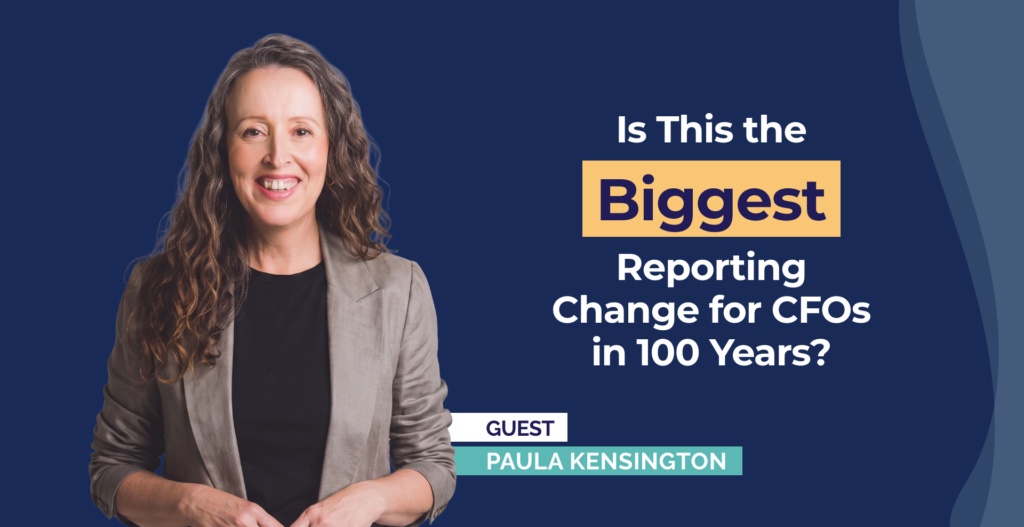
In this GrowCFO Show episode, host Kevin Appleby speaks with returning guest Paula Kensington, GrowCFO Mentor, about what she describes as a “once in 100‑year change” in corporate reporting and why CFOs must act now rather than treat it as a box‑ticking exercise. The conversation explores the new International Sustainability Standards Board (ISSB) climate and sustainability standards (S1 and S2), their adoption in markets such as Australia and across Asia, and the phased implementation by entity size that is rapidly pulling mid‑market businesses into scope.
The episode reframes so‑called “climate reporting” as a strategic exercise in business resilience, not a peripheral ESG disclosure. Paula explains how climate‑related risks and opportunities will increasingly drive strategy, governance, risk management, and metrics—and why these new disclosures may, over time, become more important to investors than traditional backward‑looking financial statements. She highlights the emerging regulatory expectations, the evolving role of assurance and audit, and the personal liability implications for directors and CFOs who underinvest or delay, emphasizing that the apparent savings from aiming for “minimum compliance” today may be dwarfed by future costs once standards, regulator expectations, and market scrutiny have fully matured.
For further information, visit Authentyx and subscribe to the newsletter to receive practical resources, including downloadable checklists and a 90-day action plan designed to support confident, effective leadership and lasting success.
Key topics covered:
- Paula positions the new ISSB climate standards (S1 and S2) as a once-in-a-century shift in corporate reporting that many CFOs are still underestimating.
- She explains the phased roll-out by company size, showing how mid‑market organizations (Group 2 and Group 3) are quickly becoming subject to these requirements and cannot rely on being “too small” to be affected.
- The discussion reframes climate reporting as forward‑looking resilience analysis, where climate scenarios and risks inform strategy and may ultimately become more critical to stakeholders than traditional P&L and balance sheet statements.
- Paula distinguishes between physical risks (e.g., assets and warehouses threatened by climate events) and transition risks (e.g., changing policies, markets, and customer expectations making existing products or models obsolete).
- She outlines how governance, risk registers, and board oversight must evolve so climate risks and opportunities actively drive decision‑making rather than sit as a static compliance document.
- The episode stresses that aiming for minimum viable compliance is a high‑risk strategy in light of director liability, potential fines, and increasing regulator and investor focus on the quality and consistency of climate disclosures.
Links
Timestamps:
- 00:00–02:30 – Introduction to Paula and framing of the topic as a major, under-appreciated change in corporate reporting.
- 02:30–04:30 – Explanation of Group 1, Group 2, and Group 3 entities and why mid‑market CFOs are now “on the hook.”
- 04:30–07:30 – Reframing climate reporting as business resilience rather than ESG box‑ticking; climate disclosures as potential primary statements.
- 09:17–11:19 – Deep dive into physical vs transition risks with practical examples (warehouses, energy, low‑cost apparel).
- 15:19–18:38 – How assurance and audit standards are evolving, and why investors will focus on climate‑driven risks and opportunities more than last year’s earnings.
- 19:47–21:25 – The four pillars of ISSB (governance, risks and opportunities, metrics and targets, strategy) and their implications for how strategy is set.
- 22:11–23:33 – Discussion on the risk register as a living, strategic tool rather than a periodic governance formality.
- 28:22–31:40 – Why only ~20% of CFOs are taking this seriously; dangers of focusing solely on AI and cyber while underplaying climate risk.
- 33:28–34:51 – Regulator expectations, linkage between prior risk disclosures and current climate scenarios, and potential fines and director liability.
- 35:09–36:54 – Global implications, including differences in US regulation and why international supply chains will still force adoption.
Find out more about GrowCFO
If you enjoyed this podcast, you can subscribe to the GrowCFO Show with your favorite podcast app. The GrowCFO show is listed in the Apple podcast directory, Spotify and many others. Why not subscribe there today? That way, you never miss an episode.
GrowCFO is a great place to extend your professional network. Join GrowCFO as a free member today and participate in our regular networking events and webinars. Premium members can also access our extensive training center and CFO Digital Toolkit. You can enroll in our flagship Future CFO or Finance Leader programs here.
You can find out more and join today at growcfo.net
Podcast: Play in new window | Download