Could You Be Ready for Your First CFO Role in 12 Months?
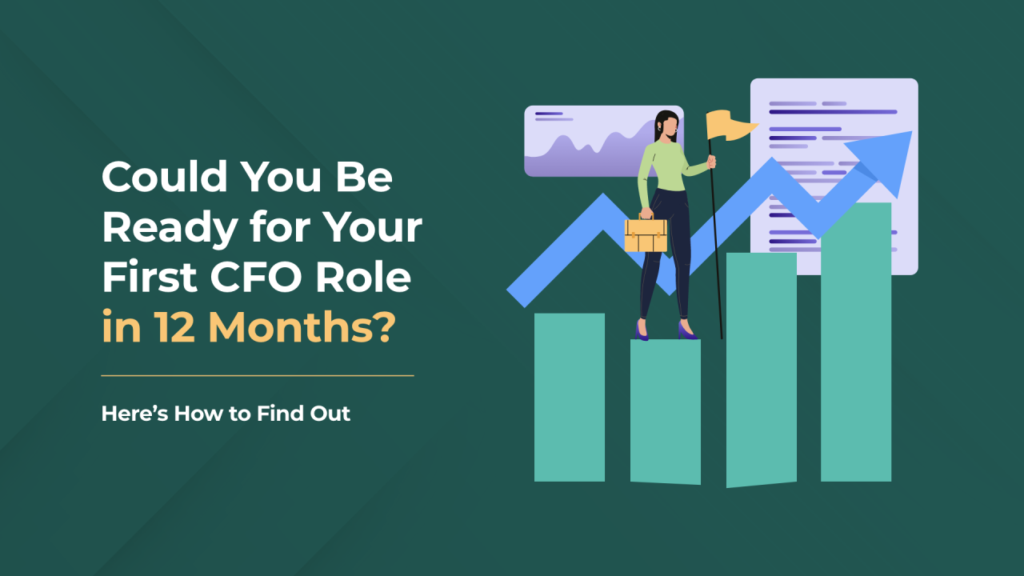
You’ve proven you can lead a finance team. How do you know if you’re ready to become CFO?
But when you ask what you need to develop, the feedback is often frustratingly vague:
- “You need more strategic experience.”
- “You need greater commercial exposure.”
- “You need to think more like a CFO.”
What does that actually mean? And how do you turn that feedback into a practical development plan?
The biggest risk isn’t that you’re lacking experience. It’s that you’re spending another 12 months developing capabilities you’ve already mastered, rather than the ones your first CFO role will require.
Here’s how to identify your biggest gaps and build a more focused development plan.
What Actually Makes Someone Ready for Their First CFO Role?
Being an excellent Finance Director doesn’t automatically mean you’re ready to become a CFO.
As a Finance Director, you might be responsible for reporting performance, managing financial operations and supporting business decisions.
As CFO, you’re increasingly expected to shape those decisions, challenge the executive team, allocate capital and help determine the organisation’s direction.
The difference is not simply seniority. It’s the level of responsibility and influence you’re able to demonstrate.
That’s where the CFO Readiness Gap Framework can help.
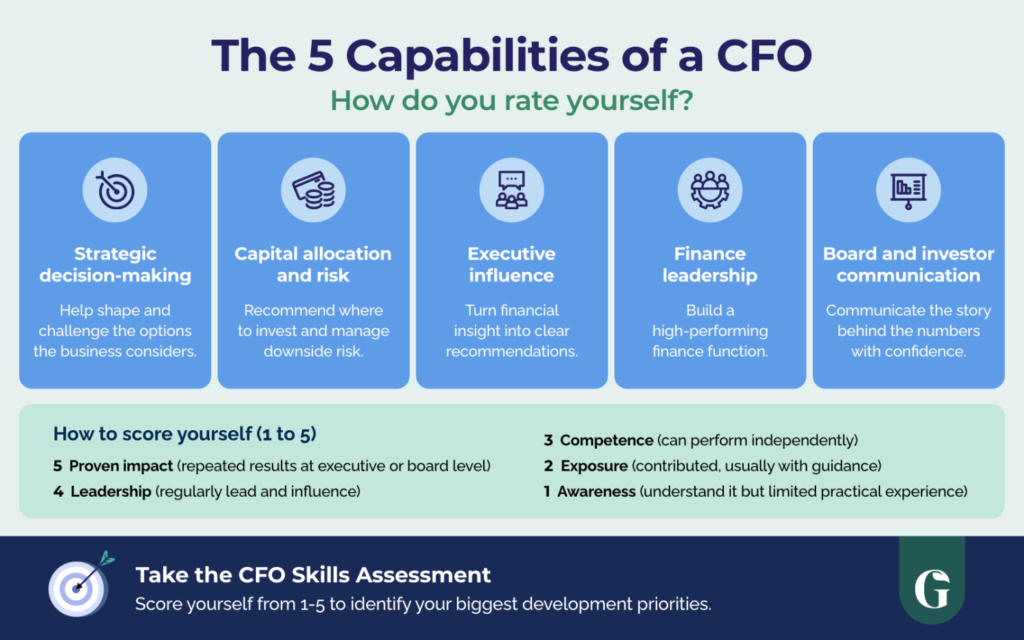
How to Assess Your CFO Readiness Across Five Capabilities
Start by rating yourself against five capabilities that are particularly important when moving towards your first CFO role.
Use this simple scoring system:
- 1/5 — Awareness: I understand it but have little practical experience.
- 2/5 — Exposure: I’ve contributed, usually with guidance.
- 3/5 — Competence: I can perform it independently.
- 4/5 — Leadership: I regularly lead and influence decisions.
- 5/5 — Proven impact: I can demonstrate repeated results at executive or board level.
Be realistic. Your score should reflect what you’ve actually demonstrated, not just what you believe you could do.
1. How Well Do You Influence Strategic Decisions?
CFOs don’t just evaluate business decisions. They help shape them.
For example, rather than simply modelling a proposed market expansion, can you challenge whether it’s the best use of the company’s resources?
Ask yourself: When did your financial insight last change a strategic decision?
How to improve: Choose an upcoming business decision and present three options, their financial implications and your recommendation.
2. How Confidently Can You Allocate Capital and Manage Risk?
CFOs need to recommend where the business should invest, not just calculate potential returns.
If your company had £5 million to invest, could you confidently recommend between an acquisition, automation or expanding capacity?
Ask yourself: Could you defend your recommendation if the CEO challenged your assumptions?
How to improve: Take one investment proposal and compare its expected return, downside risk and an alternative use of the capital.
3. How Effectively Do You Influence the Executive Team?
The CFO’s role is to turn financial information into decisions.
Consider the difference:
Finance Director: “Operating costs are 8% above budget because of recruitment and supplier inflation.”
CFO: “Recruitment is supporting growth, but supplier inflation is reducing margins. I recommend protecting recruitment while renegotiating our largest supplier contracts.”
The second statement provides a clear recommendation.
Ask yourself: Do executives involve you before important decisions, or ask you to explain the numbers afterwards?
How to improve: In your next executive meeting, replace one financial update with a recommendation and its commercial implications.
4. How Ready Are You to Lead the Entire Finance Function?
As CFO, you can’t personally oversee every financial process or solve every technical problem.
You need a team capable of delivering reliable information without depending on you for every decision.
Ask yourself: Could your finance function operate effectively for four weeks without your direct involvement?
How to improve: Identify one responsibility that depends too heavily on you. Delegate ownership and establish clear performance measures.
5. How Confidently Can You Communicate With Boards and Investors?
Boards and investors want to understand performance, future risks and the decisions management needs to make.
They don’t need another detailed management accounts presentation.
Ask yourself: Could you confidently defend your company’s financial position and strategic outlook in a board meeting?
How to improve: Turn your latest management pack into a one-page board summary covering three key messages, their implications and the decisions required.
How to Identify Your Biggest CFO Development Gap
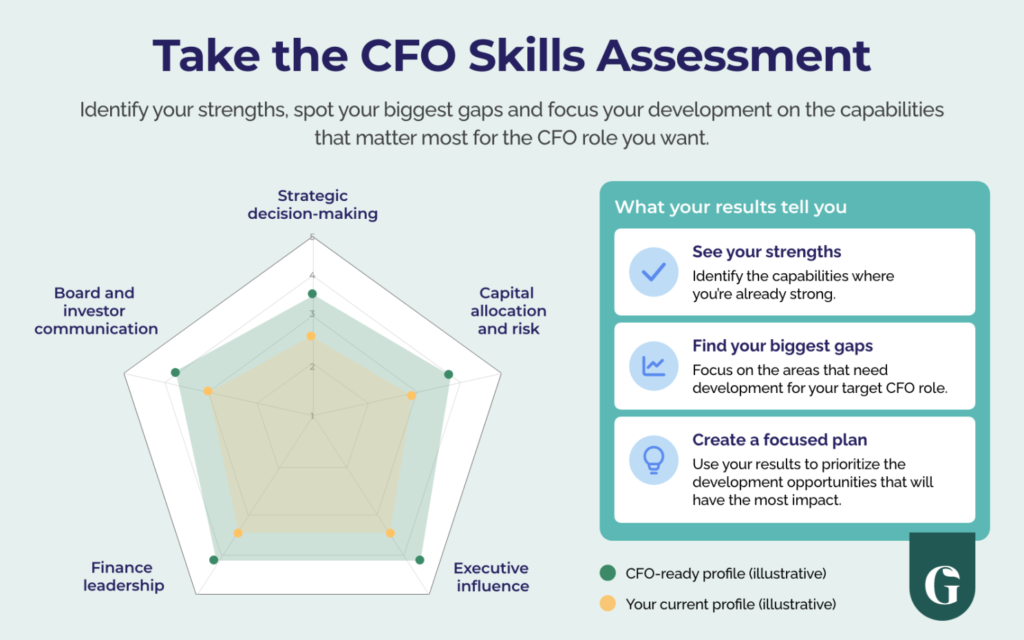
Imagine a Finance Director completes the assessment and receives these scores:
- Strategic decision-making: 2/5
- Capital allocation and risk: 3/5
- Executive influence: 2/5
- Finance leadership: 4/5
- Board communication: 2/5
Total readiness score: 13/25
This is an illustrative score, not a formal measure of CFO suitability.
The interesting part isn’t the total. It’s the pattern.
This person is already a strong finance leader, but has limited evidence of influencing strategy, advising executives and communicating with boards.
Another technical accounting qualification might not address their biggest development needs.
Leading a strategic investment proposal or presenting to the board could be much more valuable.
Your lowest scores aren’t automatically your biggest priorities. Focus on the gaps that matter most for the CFO role you’re targeting.
How to Build Your CFO Readiness Over the Next 12 Months
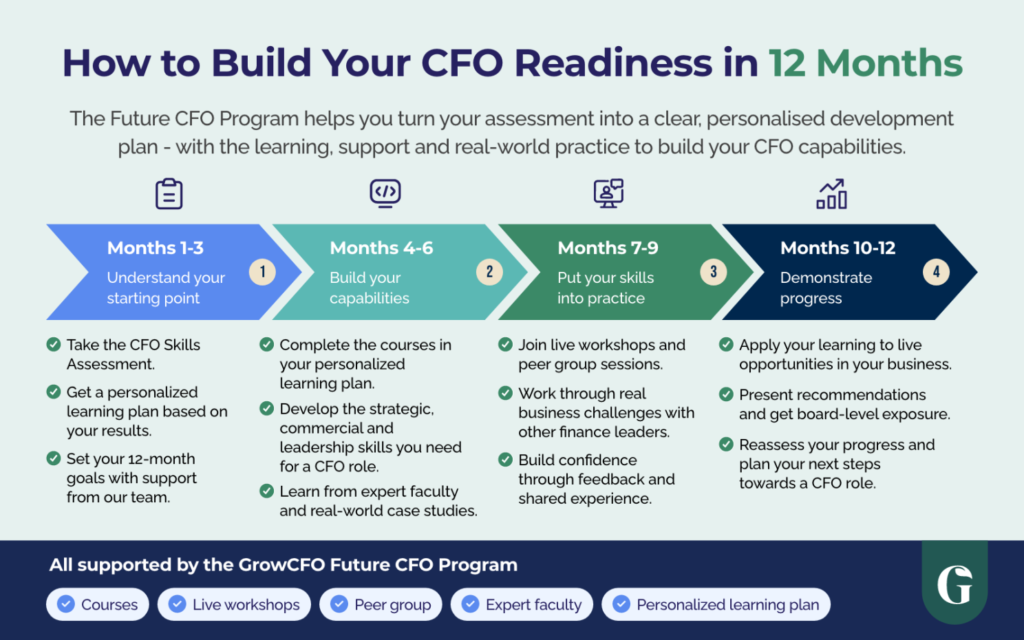
Once you’ve identified your two biggest development priorities, turn them into a practical plan.
Months 1–3: Identify your gaps
Discuss your assessment with your CFO, CEO or mentor. Agree on two opportunities that will stretch your capabilities.
Months 4–6: Gain practical experience
Take ownership of a strategic business case, investment proposal or executive recommendation.
Months 7–9: Demonstrate greater independence
Move from supporting decisions to leading the financial thinking behind them. Present recommendations and defend your assumptions.
Months 10–12: Prove your progress
Repeat your assessment and collect evidence of decisions influenced, responsibilities led and results achieved.
The goal isn’t to guarantee a CFO appointment in 12 months. It’s to make measurable progress towards being ready.
What Can You Do This Week?
Choose the capability where you have the biggest gap between your current experience and your target CFO role.
Then ask your CFO or CEO:
“I’d like to develop my ability to influence strategic decisions. Is there an upcoming project where I could take responsibility for evaluating the options and presenting a recommendation?”
This is much more effective than simply asking what you need to do to become CFO.
It gives you a specific development opportunity and demonstrates your willingness to contribute at a higher level.
The One Thing to Remember
CFO readiness isn’t about how many years you’ve spent in finance. It’s about the decisions you can influence, the responsibilities you can lead and the results you can demonstrate.
If your ambition is to become a CFO, make sure the next 12 months build evidence of your readiness, rather than simply adding another year of experience.
How Can GrowCFO Help You Prepare for Your First CFO Role?
Developing the strategic, commercial and leadership capabilities needed for a CFO role is a key focus of GrowCFO’s Future CFO Program.
If you’d like to learn more about developing these capabilities and preparing for your first CFO role, join one of GrowCFO’s free Future CFO Program preview events.