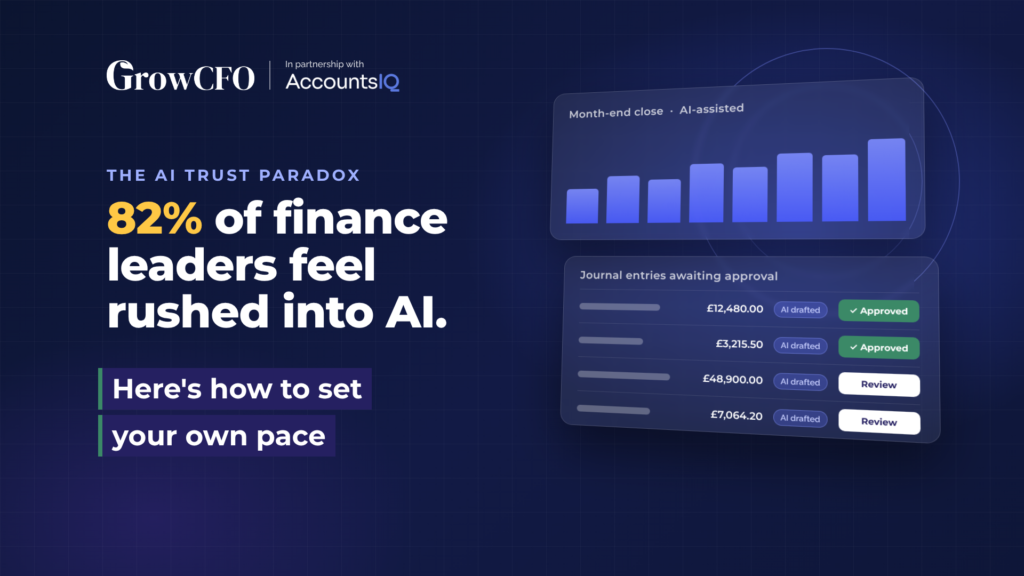
82% of finance leaders feel rushed into AI. Here’s how to set your own pace.
Every finance leader has heard the message by now: adopt AI or fall behind. Boards are asking about it, vendors are selling it, and peers are talking about it at every event. Yet many CFOs are still holding back.
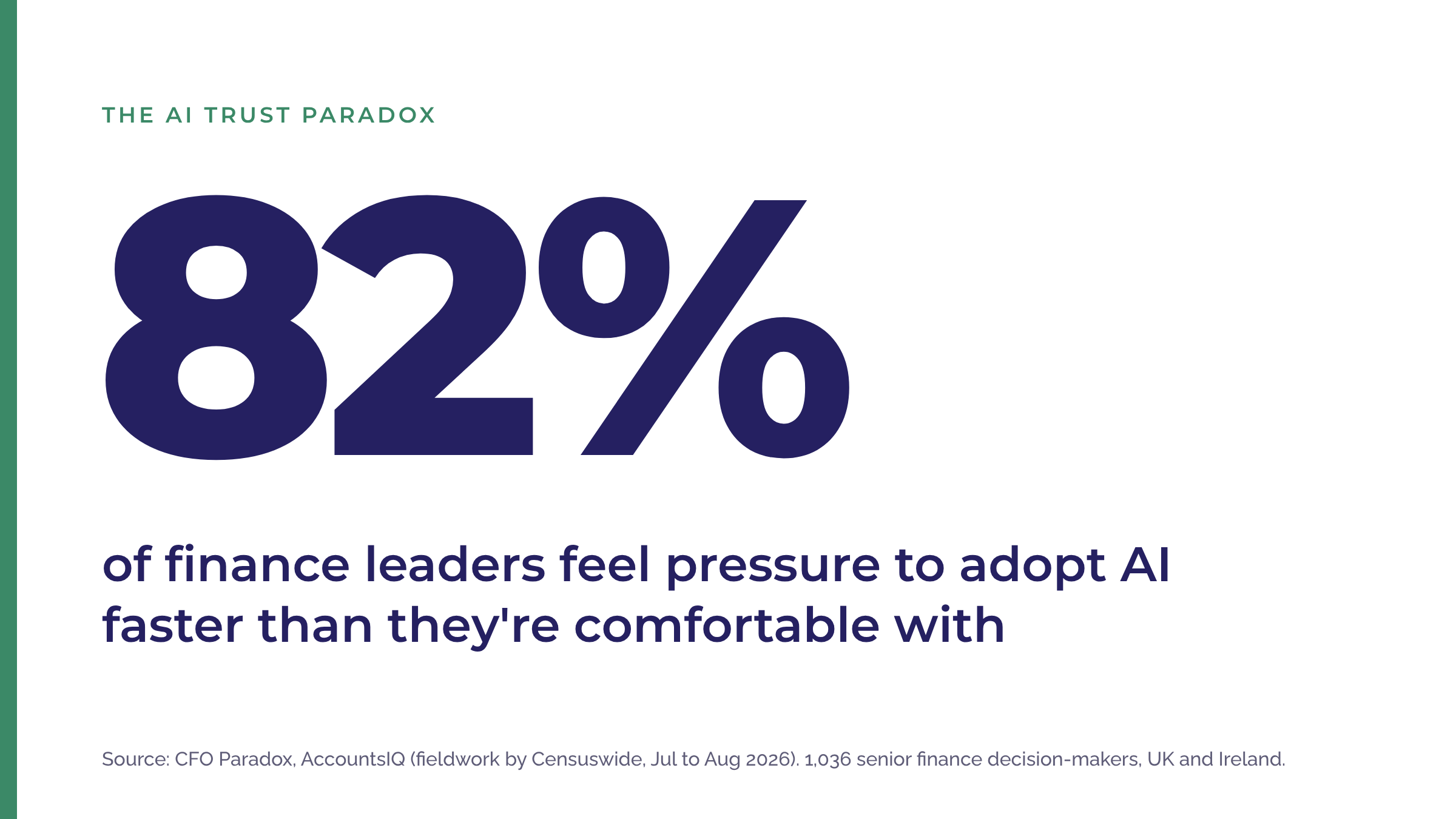
New research from AccountsIQ explains why. Its CFO Paradox report surveyed 1,036 senior finance decision-makers at companies with 20 to 500 employees across the UK and Ireland. It found that 82% of finance leaders feel pressure to adopt AI faster than they are comfortable with.
It would be easy to read that as resistance to change. The data says otherwise. The hesitation is rational, and the firms that have rushed show what it costs to ignore it.
It's not the numbers, and it's not the technology
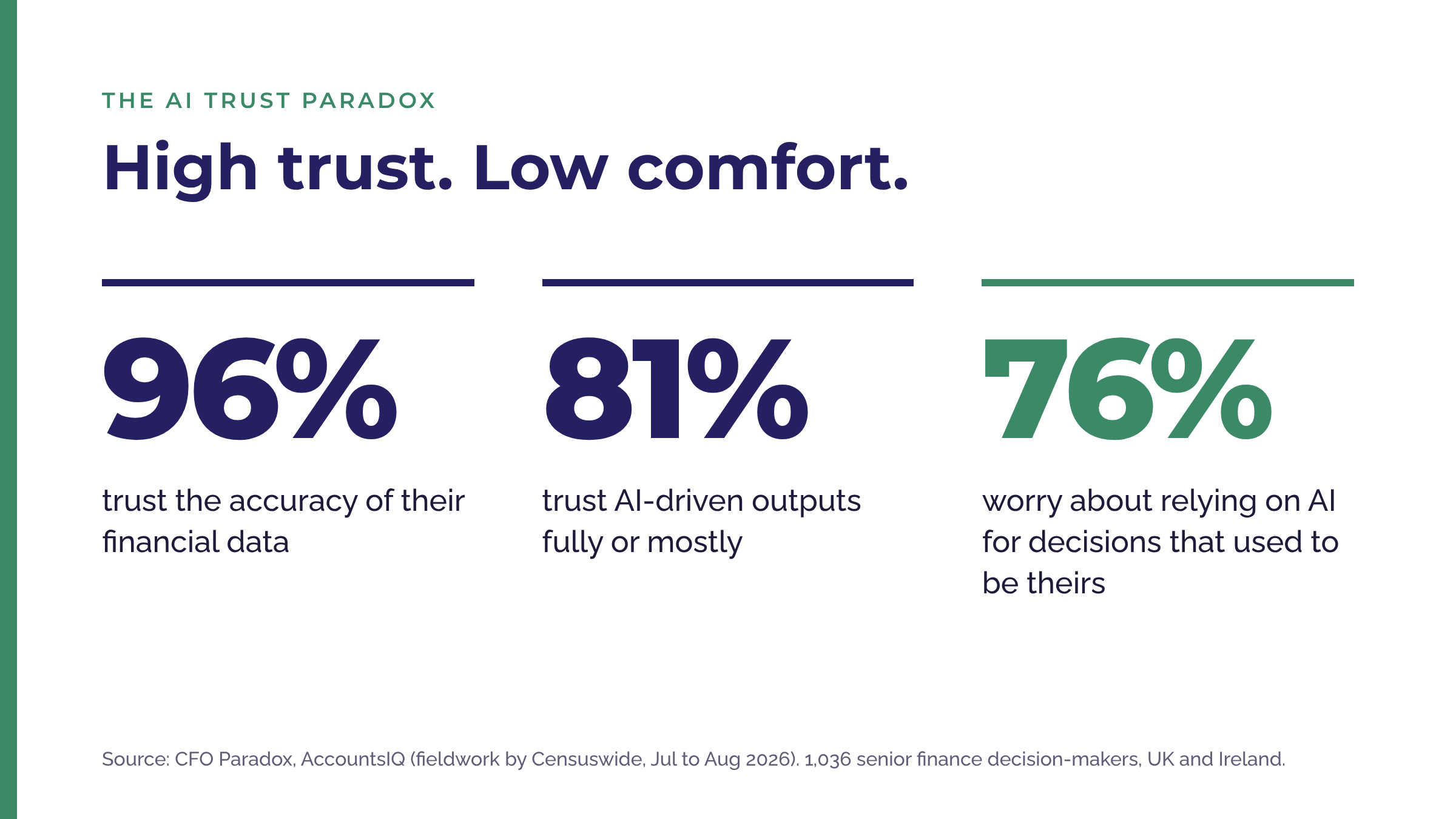
The usual explanations for slow AI adoption don’t hold up. Finance leaders are confident in their own data: 96% trust its accuracy, and 91% forecast on current, governed data.
They are not skeptical of the technology either. 81% trust AI-driven outputs fully or mostly, and fewer than 1% have no trust in AI at all. 92% say they could explain how an AI-generated output was calculated.
So this is not a group of leaders who doubt their numbers or fear the tools. That’s the paradox: high trust, but low comfort with the pace.
The real gap is clarity on how and when
What finance leaders lack is not trust. It is clarity on how and when to implement AI, and on what happens once it starts making decisions that used to be theirs.
76% worry about becoming too reliant on AI for decisions that used to be theirs. That is a fair concern for anyone accountable for the numbers. If an AI tool codes a transaction wrongly or misreads a contract, the CFO still signs the accounts.
Experience matters here too. Almost one in five (18.6%) say AI simply hasn’t been used enough yet for them to trust it fully. And 27% of UK finance teams have no AI features at all. Many leaders are being asked to move fast with tools they have barely used.
What goes wrong when you move too fast
If finance leaders trust their data and the tools, why slow down? Because AI rarely fails loudly. It produces polished, plausible work, and when nobody checks it, that work travels further and faster than a manual error would.
Polished output that nobody checked
In May 2026, EY Canada withdrew a published report on fraud in loyalty programs. Researchers at GPTZero found that 16 of its 27 cited sources were fabricated, misattributed or linked to pages that did not exist, including references attributed to McKinsey and Gartner.
It was not a finance team closing the books. But it shows the failure finance leaders worry about most: confident-looking work that went out under a trusted name without proper review.
It is already happening in finance
A September 2026 survey by Macabacus, which makes productivity software for finance teams, found that 62% of financial services professionals believe an AI-generated error reached a client or internal decision-maker in the past year. Only 23% of firms had comprehensive guardrails, such as approved tools, accuracy checks and structured review. And 36% of regular AI users worked at firms with no guardrails at all.
Four risks of rushing
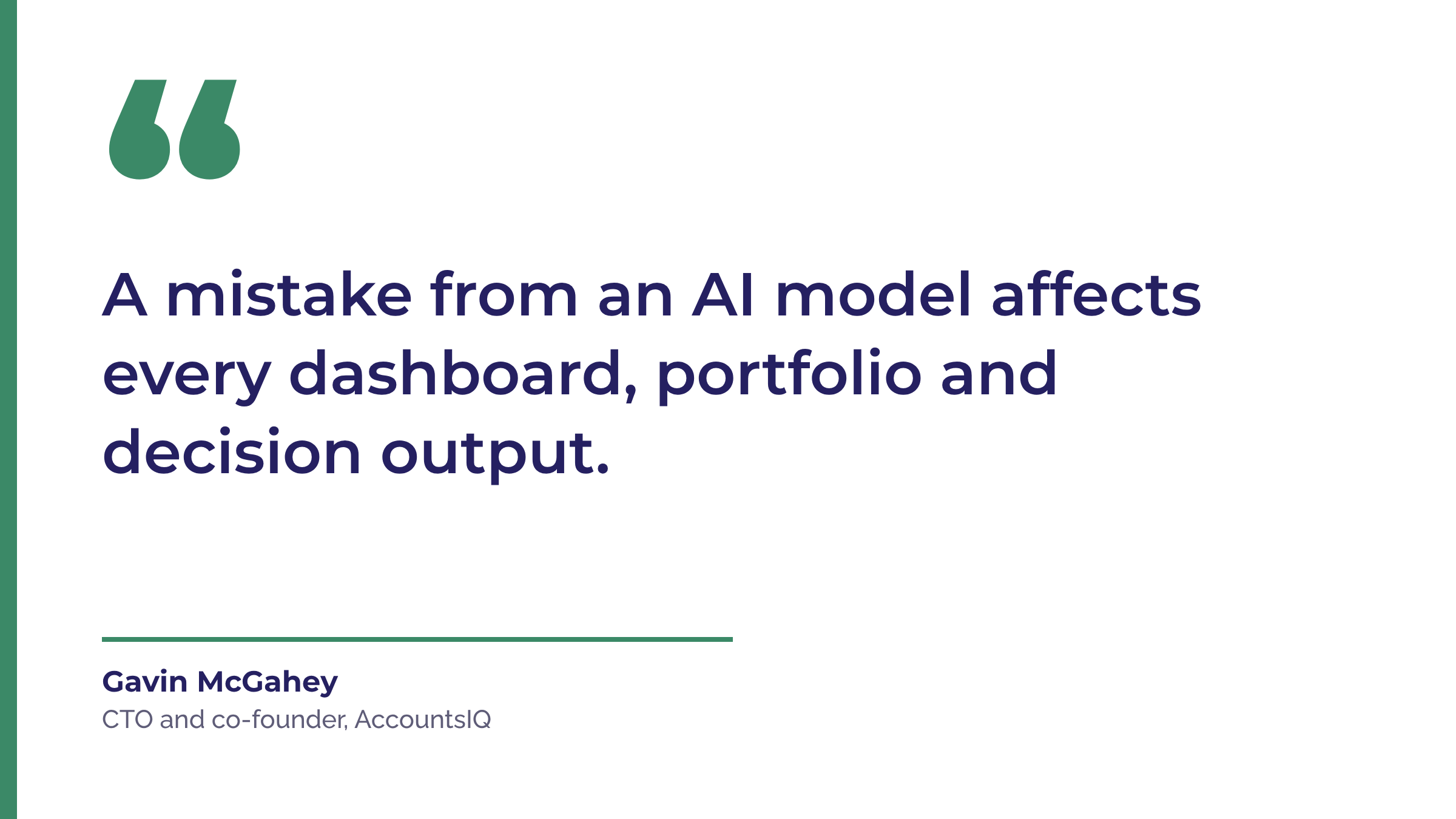
- Errors multiply. A manual mistake usually sits in one spreadsheet. A mistake in an AI process flows into every report built on it.
- Messy data gets automated. AI runs inconsistent data at speed, so errors become built into the process and are harder for the team to trace.
- Accountability stays with you. Whoever, or whatever, drafted the numbers, the CFO still signs the accounts.
- Money and momentum are wasted. MIT’s NANDA initiative found that only about 5% of the enterprise generative AI pilots it studied delivered rapid revenue gains; most stalled. The ones that worked focused on a single, well-defined problem.
Verification is the condition for adoption
The report asked finance leaders what would make them more comfortable implementing AI. None of the answers asked for less AI. All of them asked to see the workings.
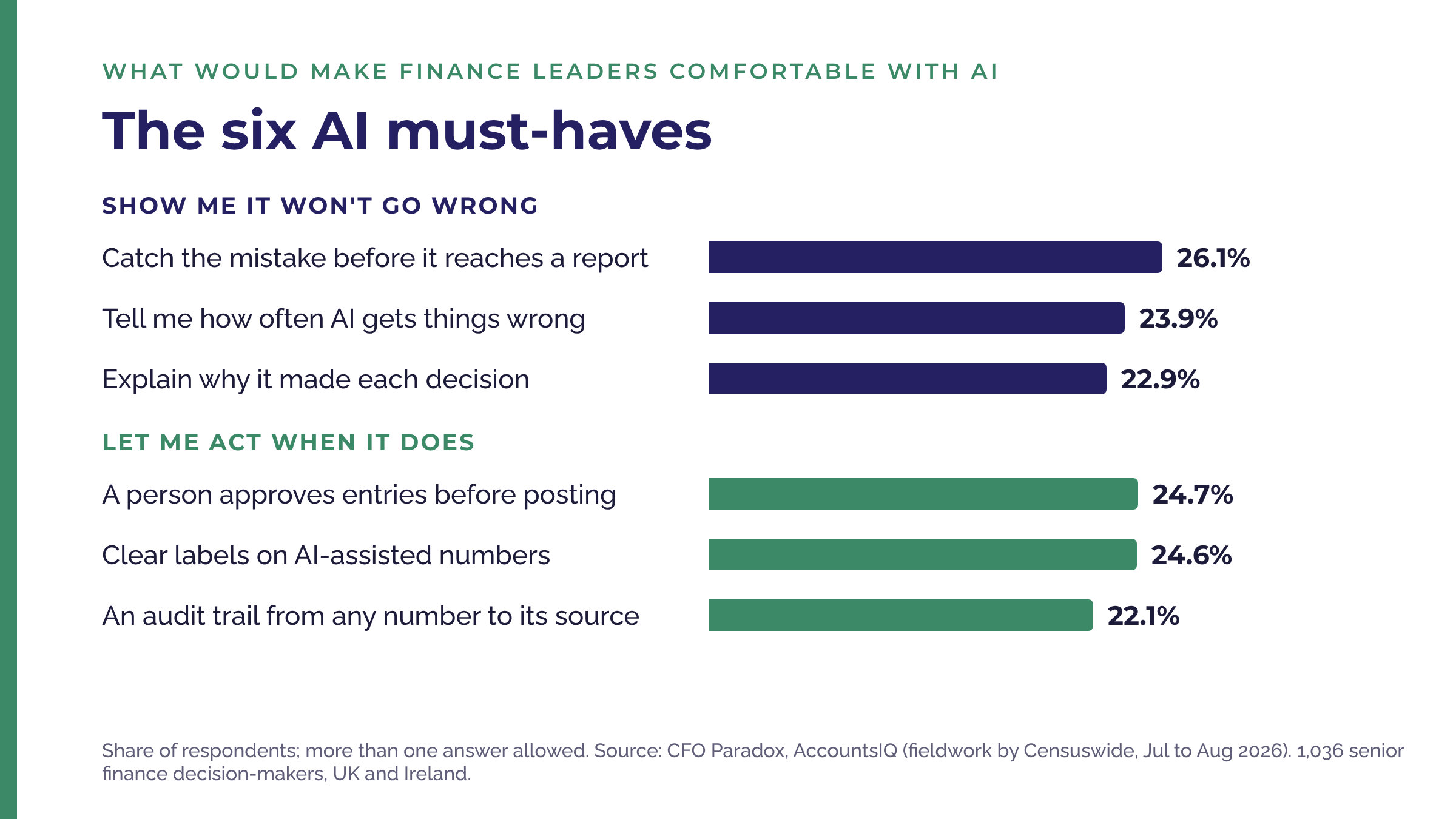
The answers fall into two groups: show me it won’t go wrong, and let me act when it does.
| Group | Must-have | What finance leaders asked for | Share |
|---|---|---|---|
| Show me it won't go wrong | Catch the mistake first | Confidence that AI mistakes are caught before they reach a report | 26.1% |
| Show me it won't go wrong | Tell me the error rate | Being told how often AI gets things wrong | 23.9% |
| Show me it won't go wrong | Explain each decision | AI explains why it made each decision | 22.9% |
| Let me act when it does | A person approves | A person approves entries before they are posted | 24.7% |
| Let me act when it does | Label what AI touched | Clear rules for labeling AI-assisted numbers | 24.6% |
| Let me act when it does | Back to source | An audit trail from any number back to its source | 22.1% |
Respondents could choose more than one answer.
The answers are spread evenly, with no single fix. Finance leaders want the full set of controls they would expect of any new team member or system: checks, sign-off and a clear audit trail.
Own the pace: start small and measurable
In practice, that means starting with contained, low-risk use cases instead of an organization-wide rollout. Good candidates include:
- Accounts payable automation, such as invoice capture and coding
- Allocations and bank reconciliations, where rules are clear and results are easy to check
- Anomaly detection, flagging unusual transactions for a person to review
Gavin McGahey, CTO and co-founder of AccountsIQ, made the same case on the GrowCFO Show. He argued for tightly scoped AI agents that remove specific bottlenecks, such as invoice coding and bank reconciliation, rather than chatbots let loose over finance data. His test for any finance AI tool is three questions: can I trust it, can I see what it’s doing, and can I audit the outcome?
Get the foundations right first
AI is only as good as the data and processes underneath it. Poorly structured data produces answers that look convincing but are wrong, and that is harder to spot than an obvious error.
The report found that 68% of finance leaders still make decisions without enough information. Accurate numbers are not enough on their own; they also need to be usable. Before adding AI, make sure your chart of accounts, entity structure and approval workflows are clean and consistent. AI will then speed up a sound process instead of automating a broken one.
Ask hard questions of your vendors
The six must-haves translate directly into questions for any software provider. Before you sign, ask:
- How is my data used, and is it used to train your models?
- Can I see the reasoning behind each AI output?
- Can I trace every number back to its source?
- What can the AI do without my approval?
- How are AI-assisted entries labeled, and how often does the AI get things wrong?
A vendor that answers these clearly is one you can build trust with. A vague answer is a warning sign.
Human-led AI is already here
Finance does not have to choose between moving fast and staying in control. Tools now exist that prepare the work but leave the decision with finance. AccountsIQ AI is one example. It prepares the work, shows its reasoning and waits for a person to approve it before anything is posted. AccountsIQ sums up the approach as “Drafted by AI. Decided by Finance.”
Four steps to take now
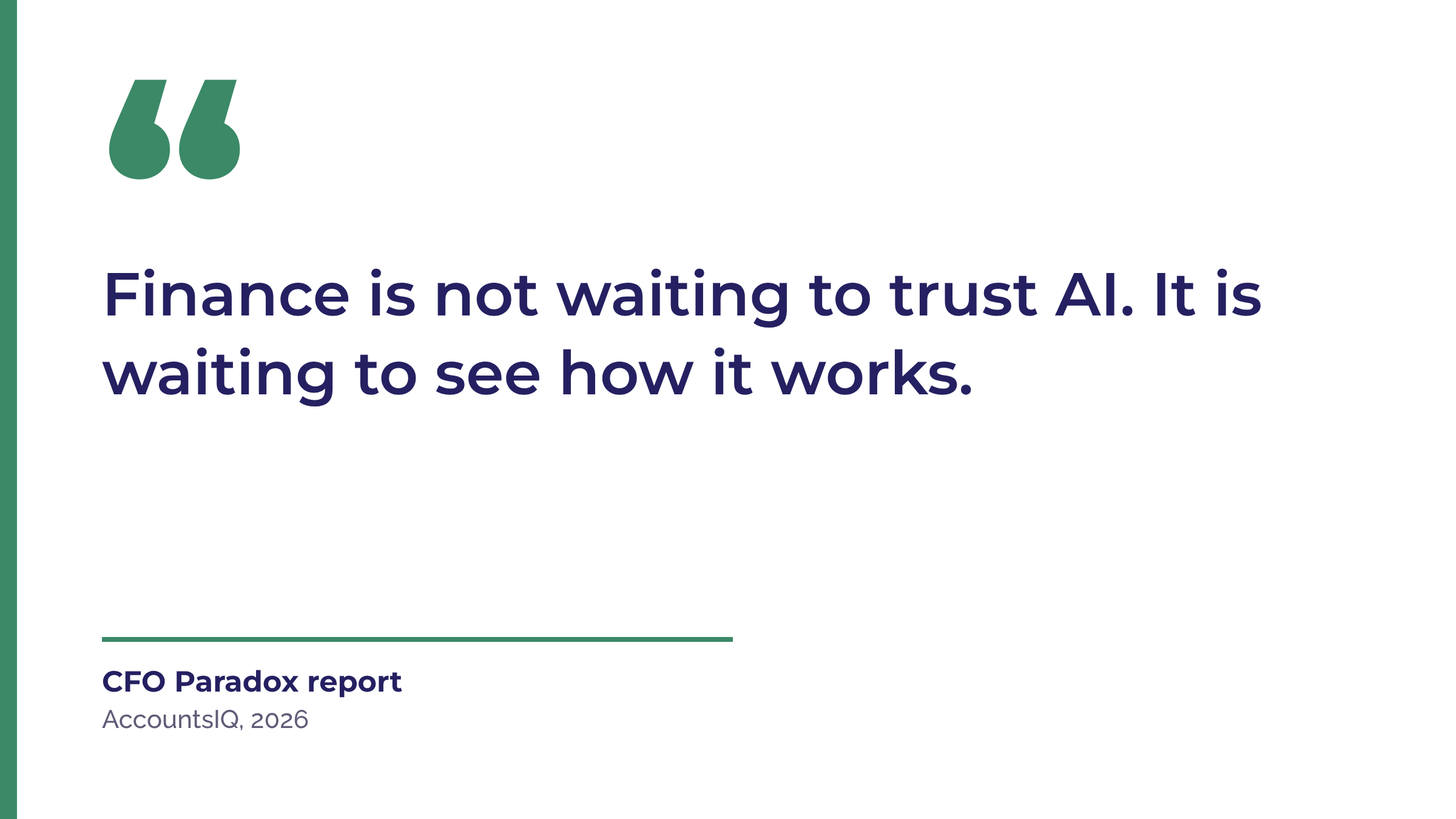
The CFO Paradox report closes with four places where finance can take the lead:
- Own the pace. Set your own AI timetable. 82% feel rushed into AI.
- Focus on the how, not the why. 81% already trust what AI produces.
- Prioritize clarity. Make the numbers usable, not just accurate. 68% still decide without enough information.
- Build verification in. Put the six must-haves in place first: error checks, error rates, explanations, human approval, labeling and audit trails.
The leaders who set their own pace, start small and insist on seeing the workings will be the ones who get real value from AI, without becoming the next cautionary tale.
Sources
- The AI trust paradox for today’s CFO, AccountsIQ. CFO Paradox, Spreckley and AccountsIQ, fieldwork by Censuswide, July to August 2026: 1,036 senior finance decision-makers (836 UK, 200 Ireland) at companies with 20 to 500 employees.
- EY cybersecurity report pulled after probe finds ‘AI hallucinations’, Computing, May 2026.
- Most finance firms have sent clients an AI-generated error, InvestmentNews, September 11, 2026 (on Macabacus’ 2026 GenAI in Financial Services report).
- The Biggest AI Mistakes Finance Leaders Are Making in 2026, Financial IT, July 22, 2026 (Gavin McGahey quote).
- MIT report: 95% of generative AI pilots at companies are failing, Fortune, August 18, 2025.
- GrowCFO Show #275: How to Choose Between AI-Native Tools and Proven Finance Platforms, Gavin McGahey, CTO and co-founder, AccountsIQ, March 2026.