
Why “Waiting for the Right Role” Is a Career Trap

You find a CFO role you’d love to apply for, but a few requirements make you question whether you’re ready.
Maybe the next role will give you more exposure. Maybe another year will make you more credible. Maybe your current CFO will eventually hand you more responsibility.
But there’s a problem with that strategy:
The role you’re waiting for often expects evidence you haven’t had the opportunity to build yet.
Waiting for a role to gain experience creates a career trap, as employers expect evidence of that experience before hiring you.
Why the “right role” is the wrong thing to wait for
There is no single perfect stepping-stone to CFO.
The CFO of a founder-led growth business can face very different demands from the CFO of a PE-backed company, listed group or mature multinational.
GrowCFO’s CFO readiness guidance makes this point explicitly: the demands of the job change with company size, lifecycle, industry, geography, culture and even the circumstances in which the new CFO is appointed.
That means career progression isn’t simply:
Finance Manager → Controller → Finance Director → CFO
A better question is:
What do I need to be able to demonstrate when the opportunity arrives?
Because you can start building some of that evidence now.
What is the Role → Rehearse → Record framework?
Instead of waiting for your next job to develop you, use your current role as a training ground for the next one.
Think in three stages:
ROLE → REHEARSE → RECORD
ROLE: Define the work you want to be trusted with.
REHEARSE: Find smaller opportunities to practise that work now.
RECORD: Capture evidence that demonstrates what you did and the business outcome.
The important shift is from asking:
“When will somebody give me the opportunity?”
to:
“What part of that opportunity can I practise before I have the title?”
Here’s how.
What does the future role actually require?
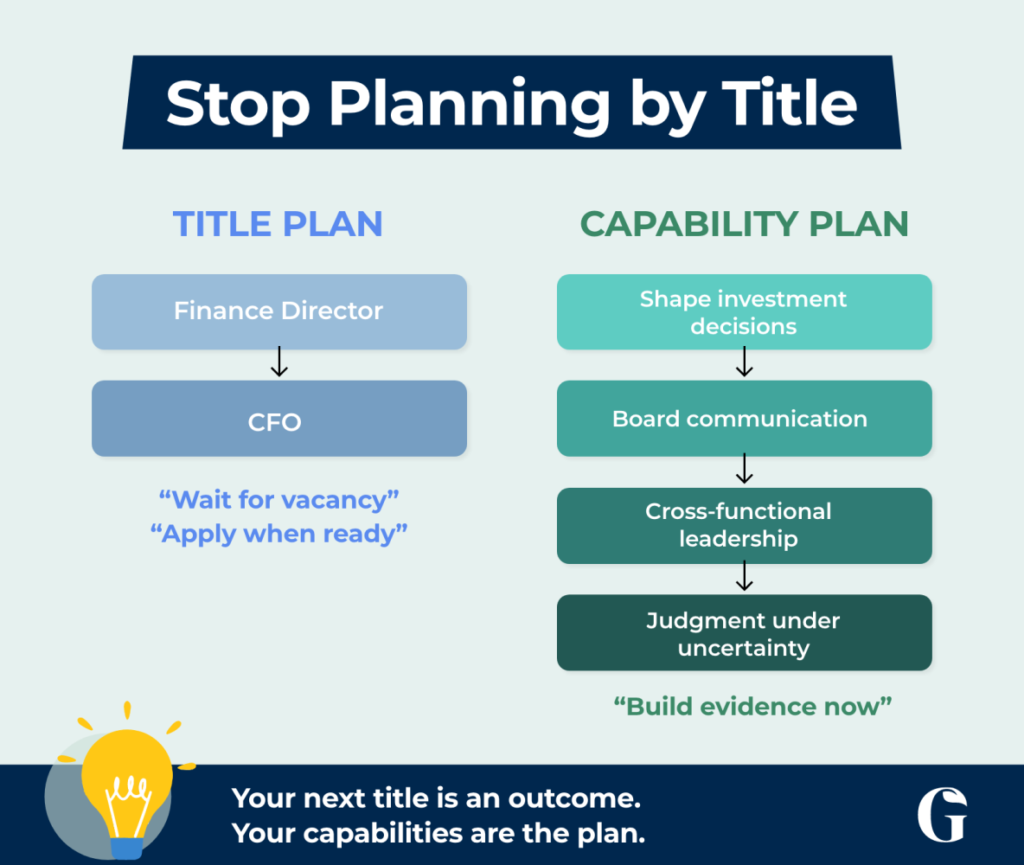
Instead of starting with a job title, begin with the work when imagining your first CFO role.
Instead of writing:
Goal: Become CFO
write down five things you expect to be trusted to do.
For example:
- Shape investment decisions
- Communicate with a board
- Lead cross-functional change
- Make recommendations with incomplete information
- Influence the CEO and executive team
Now look at your current week.
Where are you already doing these things?
Where are you only observing them?
And where have you never had the opportunity?
This immediately gives you a much more useful picture of your readiness.
How can you rehearse a job you don’t have yet?
This is where many finance leaders underestimate their current role.
You don’t necessarily need ownership of an entire CFO responsibility to start practising the underlying capability.
Suppose you need stronger board exposure.
Waiting approach:
“I need a role where I present to the board.”
Rehearsal approach:
“Can I take ownership of the commercial analysis for one board-level decision and prepare the recommendation?”
Or suppose you need M&A experience.
Waiting approach:
“My company doesn’t do enough deals.”
Rehearsal approach:
“Could I support acquisition screening, build an investment case, review due diligence findings or model integration scenarios?”
Instead of waiting for an invitation to do strategy, take a live business issue and move beyond explaining the numbers.
Try:
“Based on the three scenarios we’ve modelled, I recommend option B. It protects cash while preserving our ability to invest if demand reaches X. The biggest risk is Y, so I suggest we review the decision when Z happens.”
That is strategic judgment being rehearsed in your current role.
GrowCFO’s recent work on CFO readiness makes a similar distinction: progressing toward CFO increasingly means moving from explaining information toward making recommendations and shaping decisions.
Where should you look for rehearsal opportunities?
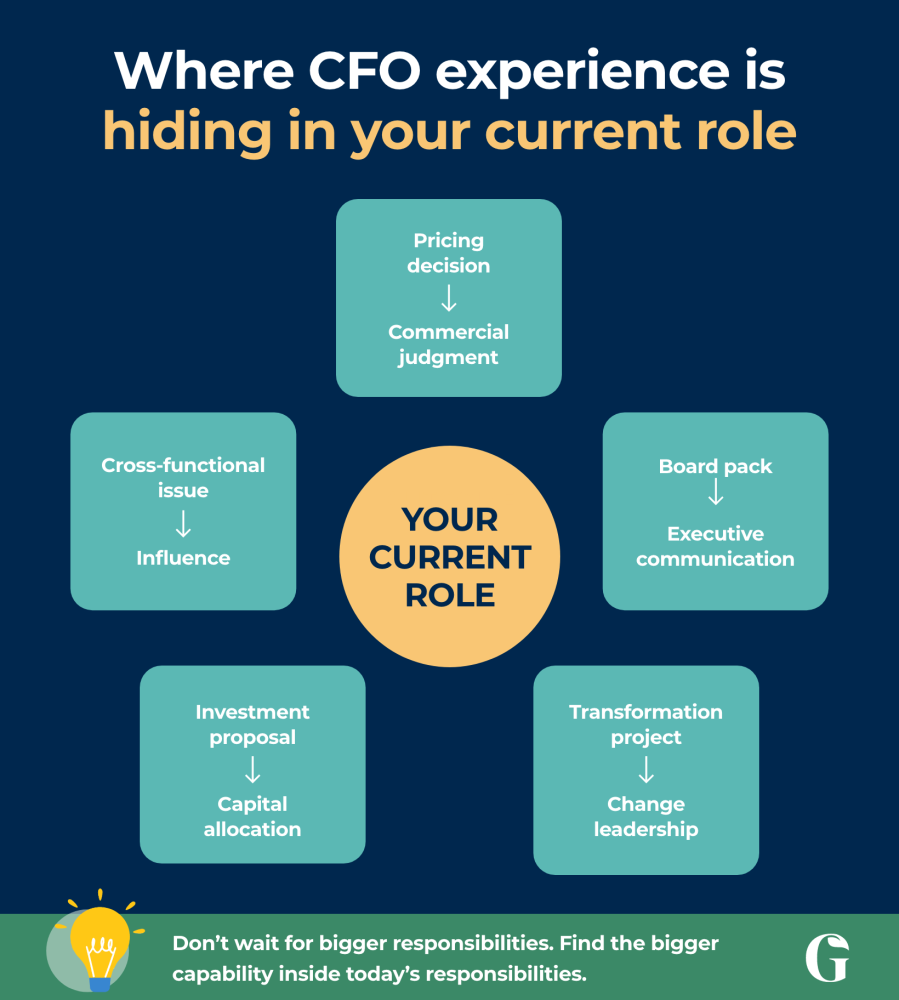
Start with work already happening around you.
Look at the next 90 days in your business.
- Is there a pricing decision coming?
- A systems implementation?
- A refinancing?
- A restructuring?
- An annual strategy process?
- A major investment?
- A difficult performance issue?
- A board discussion where finance could provide more than the monthly numbers?
Then ask:
“Which part of this could give me evidence of a capability I’ll need in my next role?”
For example:
- New market proposal (Strategic judgment): Build scenarios and recommend an option.
- Board meeting (Executive communication): Turn analysis into a one-page decision brief.
- ERP implementation (Transformation leadership): Own the business case and benefits tracking.
- Pricing review (Commercial influence): Model trade-offs and challenge assumptions.
- Cash pressure (Decision-making): Recommend explicit cash priorities and triggers.
You aren’t pretending to be the CFO; you’re deliberately expanding the level at which you operate.
Why recording the evidence matters
People often forget half of the work they did just six months later.
When an interviewer asks:
“Tell me about a time you influenced a major commercial decision.”
you give a vague answer about supporting the business.
Instead, keep a simple Career Evidence Log.
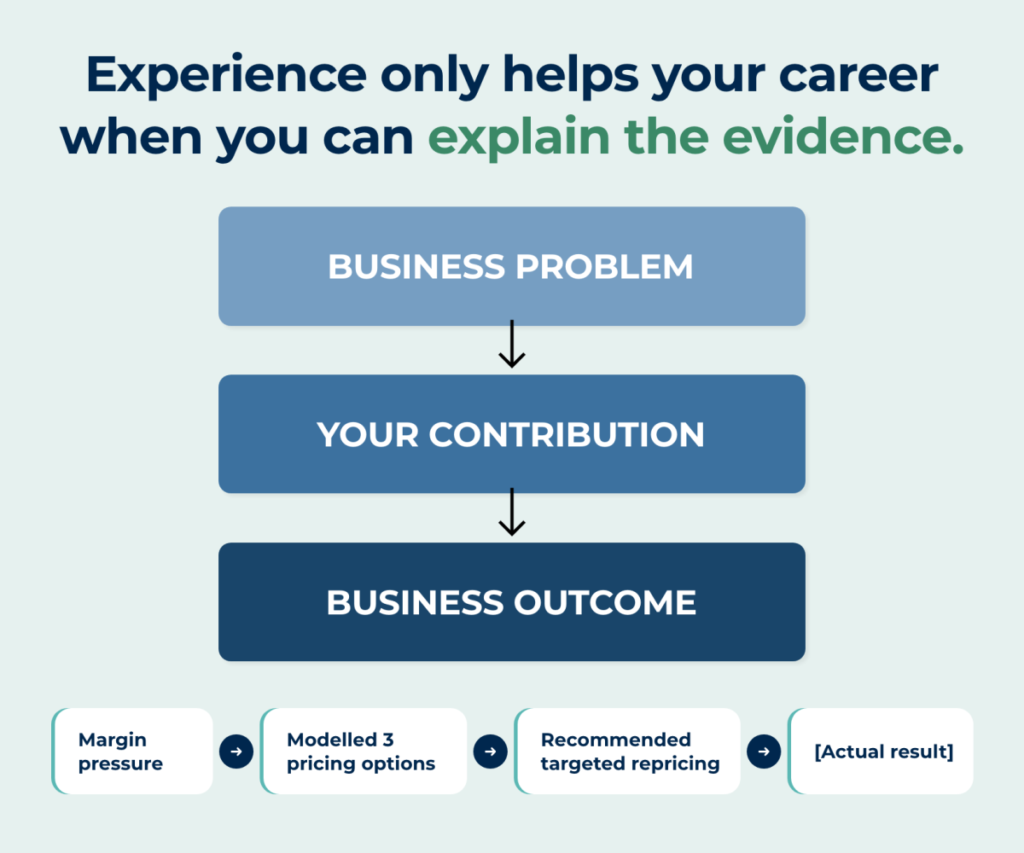
For every meaningful piece of work, capture four things:
Situation: What business problem were we facing?
Contribution: What did I personally do?
Decision: What changed because of my input?
Outcome: What happened next?
For example:
Situation: Margin was declining in one customer segment.
Contribution: I separated the impact of pricing, product mix and servicing cost, then worked with sales to model three responses.
Decision: Recommended targeted repricing rather than an across-the-board increase.
Outcome: [Insert the actual measurable business outcome.]
Do this while the details are fresh.
Within a year, you’ll have a bank of concrete examples showing how you’ve operated beyond the boundaries of your job description.
How do you start this week?
Instead of redesigning your entire career plan, spend 30 minutes selecting a target role and identifying three key capabilities you need to demonstrate for it.
Then ask:
Where could I rehearse one of those capabilities in my current business during the next 90 days?
Choose one.
Then have a much more specific development conversation with your manager.
Instead of:
“I’d like more strategic exposure.”
try:
“I want to strengthen my ability to make and communicate investment recommendations. Could I own the analysis and recommendation for the upcoming expansion decision and present it at the executive meeting?”
That’s a request someone can actually act on.
And if the opportunities genuinely don’t exist in your current organisation?
That’s useful information too.
Now you’re considering your next move because you know which capability you need an environment to provide, rather than simply hoping another title will move your career forward.
The One Thing to Remember
Don’t wait for the role to make you ready. Use the role you have to rehearse the capabilities you’ll need next.
Role → Rehearse → Record.
Define the work.
Practise it before you have the title.
Capture the evidence.
Then when the right opportunity does appear, you’re not relying on potential alone.
You have examples that show how you already operate.
The Future CFO Program develops this kind of transition: helping finance leaders understand what operating at CFO level requires and deliberately build the capabilities, judgment and leadership behaviours needed for the move.
If you want to learn more about how the Future CFO Program can help you prepare for your next finance leadership role, join a free programme preview event.
Question: What CFO-level responsibility could you start rehearsing in your current role this month?