What AI Skills Do Finance Professionals Need?
What practical AI skills do finance professionals need to succeed as AI becomes more widely used across financial services?
Finance professionals need a practical combination of AI literacy, prompting, data skills, automation, technical capability, and critical thinking to work effectively with AI in financial services. The priority is understanding how to apply AI within existing finance workflows, validate its outputs, and use the time it saves to support better business decisions.
Why Do Finance Professionals Need New Skills for AI in Financial Services?
The skills required in finance are expanding as AI in financial services becomes part of everyday workflows.
Traditional finance fundamentals remain essential. Financial knowledge, commercial understanding, accuracy, and judgment still matter, but these capabilities increasingly need to be combined with confidence using AI and modern data tools.
The skills gap is already visible. The Association for Financial Professionals reports that only 6% of finance and accounting leaders believe their teams currently have the people and skills required to deliver their priority projects, with AI literacy, automation, data analytics, and FP&A among the important capability gaps.
The priority for finance professionals is therefore not learning everything about artificial intelligence. It is developing a focused set of practical skills that improve the work they already do.
What Practical AI Skills Do Finance Professionals Need Today?
You do not need a huge AI curriculum to benefit from AI in financial services.
What matters is developing capabilities that fit directly into finance workflows and help you work more efficiently without weakening accuracy, governance, or professional judgment.
How Much Do Finance Professionals Need to Understand About AI?
Finance professionals should understand how AI behaves well enough to use it safely and effectively.
That includes knowing that an AI-generated response is not automatically a fact.
Finance professionals using AI in financial services should understand:
- How to give AI appropriate context and instructions
- How to validate the information it produces
- How to recognize incomplete or unreliable answers
- When an output needs supporting evidence
- When human review must take priority
Understanding these principles also helps finance teams collaborate more effectively with technology, data, cybersecurity, and risk colleagues.
The Association for Financial Professionals highlights how AI can support activities such as forecasting, fraud detection, data analysis, and decision support, while emphasizing the importance of data quality, transparency, risk management, and appropriate human oversight.
The practical definition of AI literacy in finance is simple: understand enough about the tool to use it confidently, challenge it appropriately, and know when not to rely on it.
Why Is Prompting a Core Skill for AI in Financial Services?
Generative AI has made prompting one of the most immediately useful skills for finance teams.
Tools such as ChatGPT, Claude, Microsoft Copilot, and other AI platforms can support a growing number of finance activities, but the quality of the output depends heavily on the instructions, context, and constraints provided.
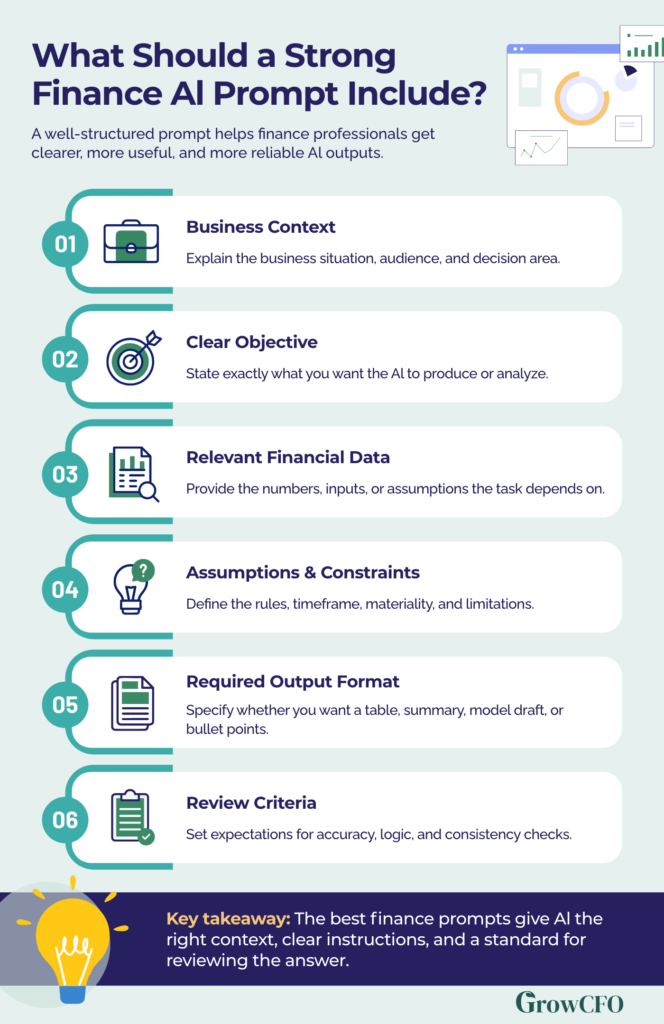
Strong prompting for AI in financial services means giving AI:
- Relevant business context
- A clear objective
- Appropriate financial data
- Assumptions and constraints
- A required output format
- Criteria for reviewing the answer
With that structure in place, finance professionals can use AI to:
- Analyze financial data
- Summarize insights
- Explain variances
- Create first drafts of financial models
- Test scenarios and assumptions
- Draft management commentary
- Challenge forecasts
- Turn detailed analysis into executive summaries
For example, Claude’s financial services guidance demonstrates how generative AI can support financial research, comparable-company analysis, due diligence, earnings analysis, and modeling.
The finance professional, however, remains responsible for checking the assumptions, calculations, and underlying data.
AI can accelerate finance work. It should not replace financial judgment.
Why Does Data Literacy Matter When Using AI in Financial Services?
AI works with the information it receives.
If the underlying data is inaccurate, incomplete, poorly structured, or misunderstood, AI in financial services can produce an answer that looks credible while being fundamentally wrong.
That makes data literacy increasingly valuable.
Finance professionals should be able to:
- Prepare data for analysis
- Identify missing or inconsistent information
- Check whether data sources are reliable
- Reconcile AI outputs against source information
- Recognize meaningful patterns and anomalies
- Understand the limitations of the dataset
These skills protect against one of the biggest risks of AI: placing confidence in an answer built on weak inputs.
Finance has always placed a premium on data quality. AI makes that discipline even more important.
Which Technical Skills Support AI in Financial Services?
Finance technology is becoming increasingly interconnected.
Excel, Power BI, ERP systems, planning tools, Google Sheets, and reporting platforms are all incorporating automation and AI capabilities.
As a result, finance professionals working with AI in financial services benefit from understanding the wider technology environment around AI.
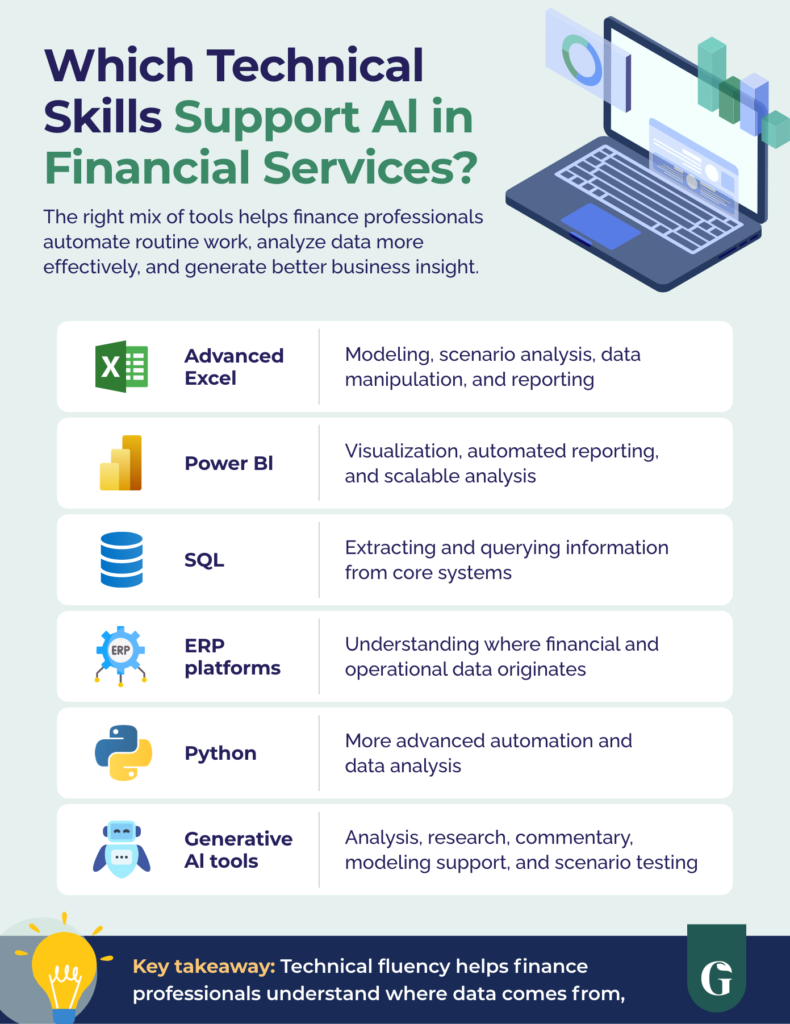
Not every finance professional needs deep expertise across every platform.
The right level depends on the role, but technical fluency helps finance professionals understand where data comes from, how systems connect, and where AI in financial services can improve an existing process.
How Can Finance Professionals Use AI to Automate Routine Work?
Finance functions contain a significant amount of repeatable work.
Reconciliations, data transformations, recurring reports, monthly close activities, forecast updates, variance analysis, and management reporting often involve predictable steps.
This makes automation one of the clearest opportunities created by AI in financial services.
The better question is not simply, “What can we automate?”
It is:
Which predictable activities can we automate so finance has more time for work that requires judgment and influence?
That additional capacity can be redirected toward:
- Business partnering
- Scenario planning
- Strategic analysis
- Commercial decision support
- Forecasting
- Risk assessment
- Challenging business assumptions
There is growing evidence that generative AI can create meaningful productivity improvements in knowledge work.
A peer-reviewed study published in Science, Experimental Evidence on the Productivity Effects of Generative Artificial Intelligence, examined 453 professionals performing realistic business tasks.
Participants using generative AI completed their tasks approximately 40% faster, while the quality of their work improved by around 18%.
The study was not limited specifically to finance, but it demonstrates the potential of AI to reduce the time required for suitable knowledge-based activities.
For finance leaders, the important question is what happens to the capacity that AI creates.
Why Is Critical Thinking the Most Important AI Skill?
Wider adoption of AI in financial services makes critical thinking more important, not less.
An AI tool can generate a forecast, identify a trend, summarize a dataset, or suggest an explanation.
The finance professional still needs to ask:
Does this actually make sense?
Strong finance professionals need to be able to:
- Spot when something feels wrong
- Challenge assumptions behind an answer
- Understand the trade-offs behind a recommendation
- Separate useful signals from noise
- Identify missing information
- Assess financial and operational risks
- Connect an insight back to business objectives
AI may increasingly provide the first draft of an answer.
Finance professionals create value by deciding whether that answer deserves to influence a business decision.
Key takeaway: The strongest finance professionals will combine finance expertise, AI capability, and commercial judgment. AI can accelerate analysis and automate routine work, but finance professionals remain responsible for challenging assumptions, validating outputs, and turning information into decisions.
Will Finance Professionals Need to Become AI Specialists?
For most finance professionals, the answer is no.
The stronger model is a combination of three capabilities:
Finance expertise + AI capability + commercial judgment
Finance expertise tells you what matters.
AI capability helps you analyze information, test ideas, and accelerate routine work.
Commercial judgment determines whether the result is credible, useful, and aligned with the goals of the business.
This combination is particularly important for finance professionals progressing toward more senior leadership roles.
For aspiring CFOs, the challenge is no longer simply producing accurate information. It is interpreting that information, challenging the business, and shaping decisions.
GrowCFO’s Future CFO Program Preview Event explores how finance leaders can build the broader skills, confidence, and strategic capability required to make that transition.
How Can Finance Professionals Start Building AI Skills?
The fastest way to develop capability in AI in financial services is through practical application.
Choose one existing finance workflow and identify where AI could improve it.
A simple approach is to:
- Identify a repetitive or analytical finance task.
- Define what a better outcome would look like.
- Use AI to support part of the workflow.
- Validate the results carefully.
- Compare the output with your existing process.
- Measure improvements in speed, accuracy, insight, or decision-making.
- Refine the approach before expanding its use.
Financial modeling is particularly useful for developing these skills because it brings several capabilities together.
You need to understand the numbers, structure the problem, provide appropriate inputs, test assumptions, evaluate scenarios, check outputs, and communicate the implications.
AI can support each stage while the finance professional remains responsible for the integrity of the model and the decisions it informs.
How Can You Build Practical AI Skills Through Financial Modeling?
At GrowCFO, we see the real opportunity from AI in financial services as helping finance professionals move beyond producing information toward interpreting, challenging, and shaping business decisions.
AI can reduce low-value activity, accelerate analysis, test scenarios more quickly, and create additional capacity for higher-value finance work.
That is why practical application matters.
GrowCFO’s Financial Modeling with AI workshop helps finance professionals explore how AI can support financial modeling, scenario analysis, assumptions, and decision-making in real finance workflows.
Rather than learning AI in isolation, you can see how these tools apply directly to the work finance teams already perform.
The goal is not simply to become faster with AI. It is to become a stronger finance professional by combining technology with better analysis, stronger judgment, and greater influence.
Learn more about Financial Modeling with AI and start turning AI capability into practical finance skills.