How Do You Create a Business Plan for Investors in the AI Age?

How should you create a business plan for investors when AI can now research, analyze, model, and draft much of the plan?
A strong business plan for investors in the AI age uses AI to accelerate research, data aggregation, scenario modeling, and drafting without outsourcing the investment thesis itself. Investors still need credible assumptions, proprietary insights, clear financial logic, and evidence that your business has an operational advantage competitors cannot easily copy.
What should a business plan for investors achieve?
A business plan for investors has a different purpose from an internal operating plan. It is not simply a description of the company or a polished document explaining what you intend to do. It needs to demonstrate why the opportunity is attractive, why your assumptions are credible, how capital will create value, and why your organization is capable of executing the strategy.
AI can make producing that plan significantly faster. It can help structure an initial plan, organize information, analyze competitors, summarize research, develop scenarios, and challenge assumptions. The U.S. Chamber of Commerce highlights AI’s ability to provide the framework and initial content for a business plan while emphasizing the need to review the output so it accurately reflects the financial model, mission, and vision.
Key takeaway: AI can accelerate the planning process, but investors are investing in the quality of the underlying business, not the quality of an AI-generated document.
How can AI improve a business plan for investors?
When used effectively, AI removes much of the manual work involved in creating a business plan for investors, giving finance leaders and founders more time to examine the decisions behind it.
For example, AI can help you:
- Aggregate market, competitor, customer, and industry information quickly.
- Develop an initial structure for the plan.
- Compare different commercial scenarios and assumptions.
- Identify gaps or inconsistencies in your reasoning.
- Summarize large amounts of qualitative information.
- Draft and refine sections for different investor audiences.
- Stress-test assumptions by generating challenging investor questions.
This is particularly useful during early research. Meta’s guidance on AI-assisted business planning recommends using AI to explore the market, analyze competitors, define the value proposition, and structure financial projections while independently verifying important market information and financial assumptions.
The bigger opportunity is therefore not asking AI to write your business plan for investors. It is using AI to make the thinking behind that plan faster and more rigorous.
What should a business plan for investors contain?
An effective business plan for investors should connect the market opportunity directly to execution and financial outcomes. Investors need to understand not only where growth could come from, but what needs to be true for that growth to happen.
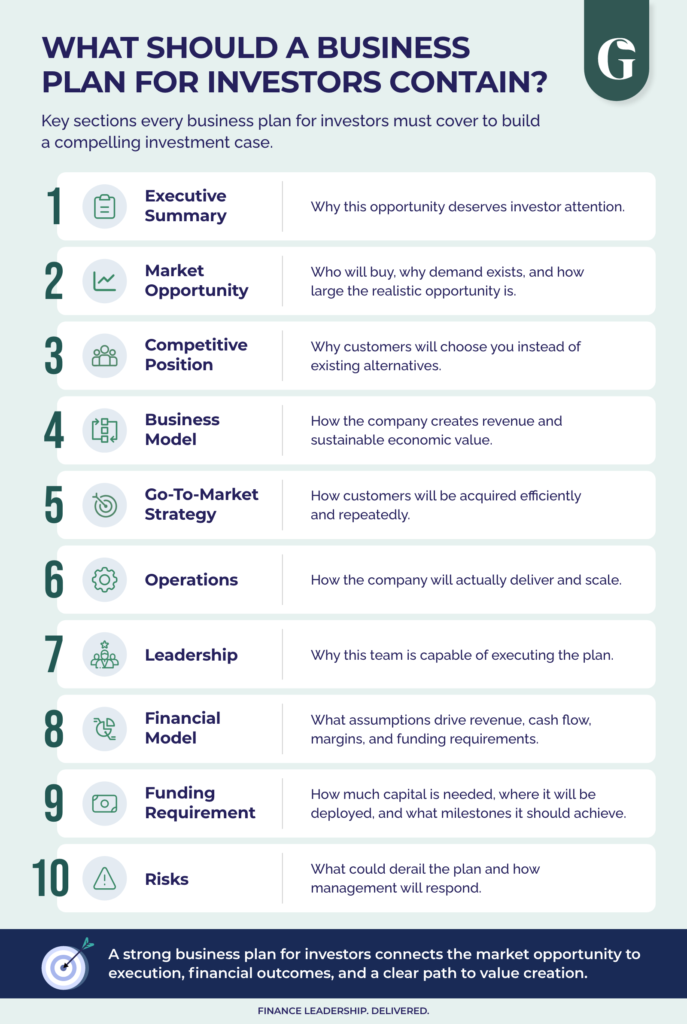
AI can support almost every section of a business plan for investors, but the underlying evidence should remain traceable. Wolters Kluwer recommends reviewing AI-generated plans for accuracy and making prompts specific to the business, industry, and market rather than accepting generic outputs.
Why does human conviction matter in a business plan for investors?
As AI-generated writing becomes commonplace, professional presentation becomes less differentiated. Almost anybody can produce a polished market analysis, strategy narrative, or financial commentary within minutes.
That changes what makes a business plan for investors compelling. Your advantage increasingly comes from information AI cannot manufacture: conversations with customers, proprietary operating data, experience within the market, validated demand, lessons from previous experiments, specialist expertise, relationships, intellectual property, and a nuanced understanding of how the economics actually work.
This is the difference between information and insight.
AI may tell you that a market is growing. Your business plan for investors should explain which segment you can realistically capture and why. AI may identify competitors, but your plan should explain why your operating model performs differently. AI may generate a revenue forecast, but your finance team should be able to defend every material assumption behind it.
Research supports the broader value of rigorous planning. A Strategic Management Journal study of 223 new ventures found evidence that business planning supports decision-making, helps balance resources with requirements, and translates abstract objectives into concrete operational actions. A subsequent meta-analysis published in the Journal of Business Venturing also found a positive relationship between business planning and performance while emphasizing the importance of combining planning with ongoing learning.
For finance leaders developing a business plan for investors, that distinction matters. The purpose of the plan is not to create false certainty about the future. It is to make the assumptions, choices, risks, and financial consequences behind the strategy explicit enough to challenge.
How do you demonstrate an operational moat in a business plan for investors?
An increasingly important part of a business plan for investors is explaining what competitors cannot simply reproduce using the same technology.
If your advantage is simply “we use AI,” the barrier to imitation may be extremely low.
Operational moat: An advantage that becomes increasingly difficult for competitors to reproduce, such as proprietary data, embedded processes, specialist expertise, distribution, customer relationships, intellectual property, or switching costs.
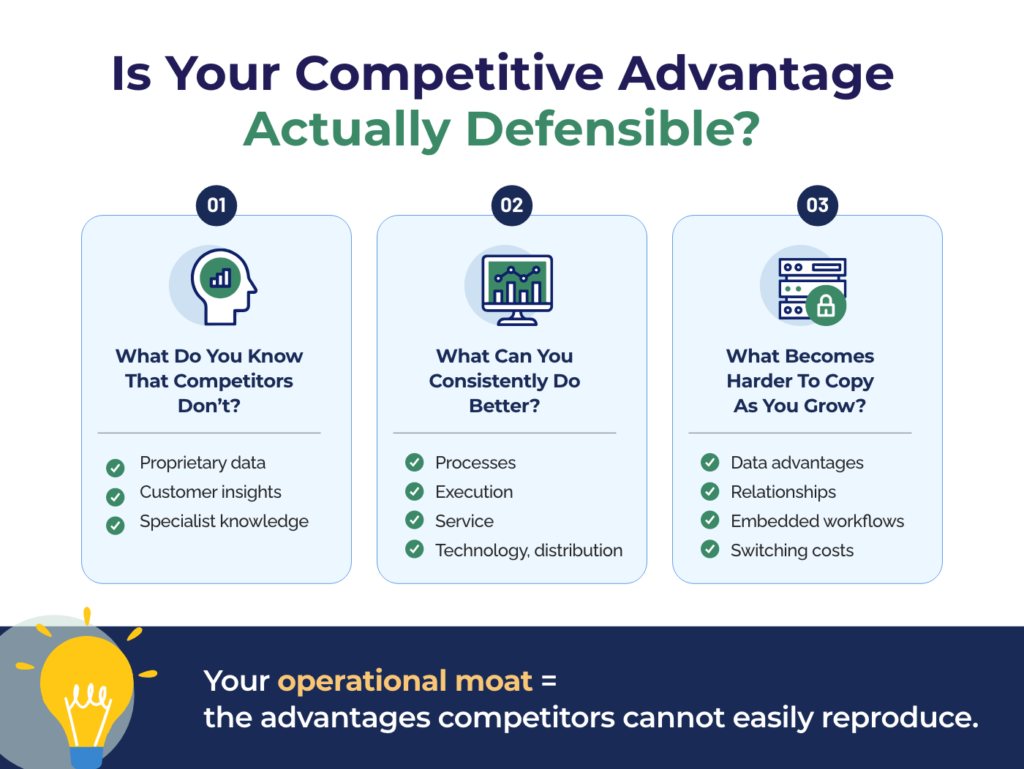
A stronger business plan for investors explains how technology combines with these harder-to-replicate assets. Ask three questions:
- What do we know that competitors do not?
- What can we consistently do better than competitors?
- What becomes harder to copy as we grow?
Those answers help identify whether the company has an advantage capable of compounding over time.
The strongest business plan for investors therefore does more than demonstrate that AI can make the company efficient. It shows how AI strengthens an advantage that competitors cannot easily reproduce.
How should finance teams validate AI-generated projections in a business plan for investors?
Financial projections are where AI assistance requires particularly strong human oversight. A business plan for investors can quickly lose credibility if impressive-looking forecasts cannot withstand questions about the assumptions underneath them.
Instead of asking AI for a five-year forecast and accepting the result, finance teams can use AI to interrogate the model. They can examine which assumptions have the greatest impact on cash requirements, model different customer acquisition costs, stress-test pricing and margins, examine downside scenarios, and compare expected growth against operational capacity.
This is where strong financial modeling capabilities become particularly valuable. Finance needs to connect commercial assumptions to cash flow, profitability, funding requirements, and different scenarios so that the business plan for investors can withstand scrutiny rather than simply present an attractive base case.
Most importantly, distinguish between AI-generated assumptions, externally validated evidence, and internal management assumptions. An investor should be able to understand where the numbers come from and why management believes they are achievable.
Key takeaway: Use AI to challenge the financial model, not to determine whether its assumptions are credible.
What makes a business plan for investors credible in the AI age?
A credible business plan for investors combines machine speed with human conviction. AI can collect and structure information, model scenarios, expose gaps, and even play the role of a skeptical investor by challenging assumptions.
What it cannot manufacture is genuine customer evidence, proprietary insight, management experience, or an operational moat.
The winning formula is straightforward: use AI for speed and scale, use evidence for credibility, and use human judgment to determine what the business should actually do.
For CFOs and finance teams, this creates a broader opportunity. Learning how to use AI effectively is no longer simply about automating routine finance tasks. It is about improving how finance analyzes information, challenges strategy, supports decisions, and creates competitive advantage.
The GrowCFO Academy’s AI in Finance courses helps finance professionals build the practical AI skills needed to work more efficiently, strengthen analysis, and support better business decision-making.
Explore AI in Finance at GrowCFO Academy and learn how to apply AI confidently and effectively across your finance role.