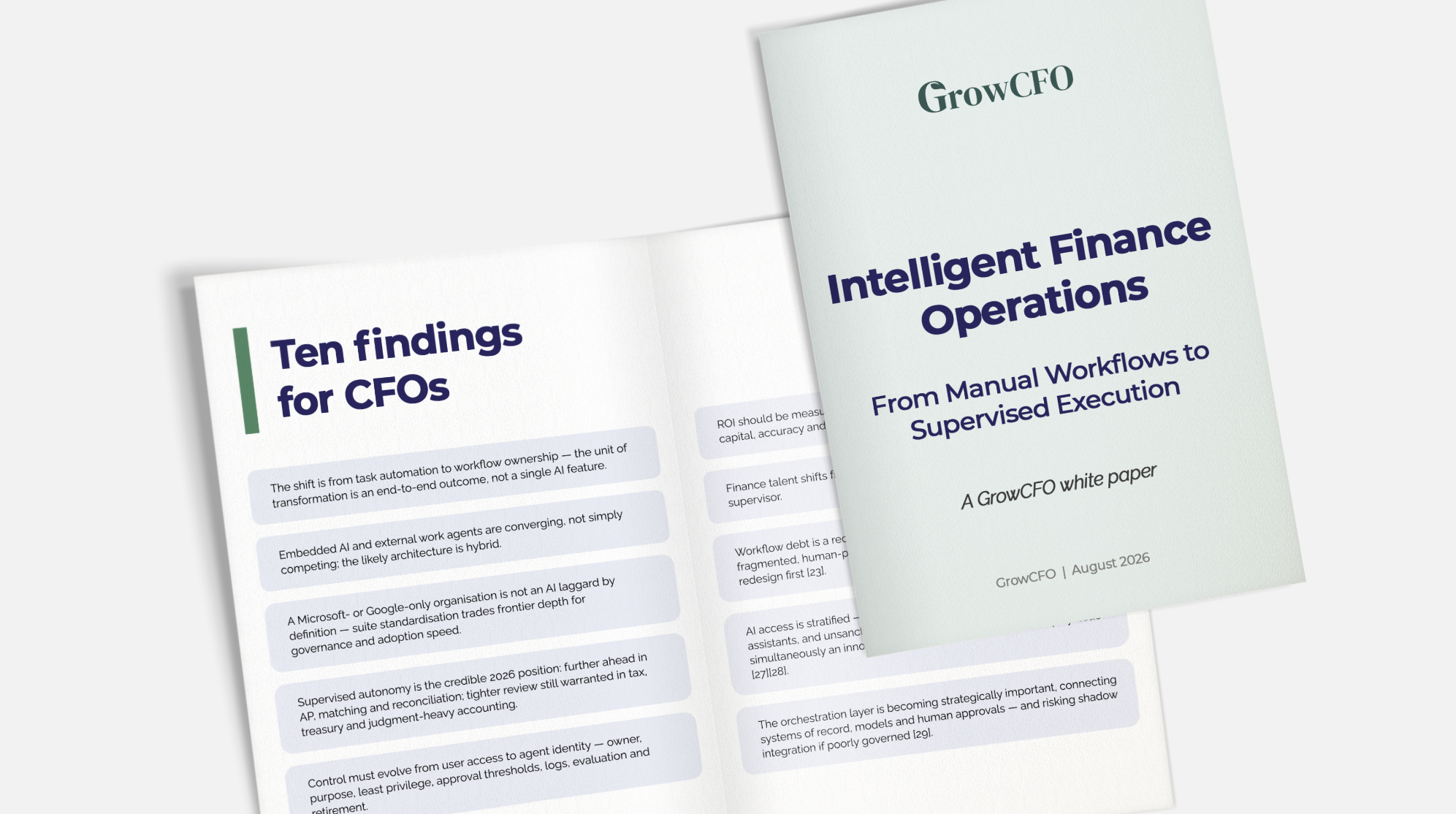
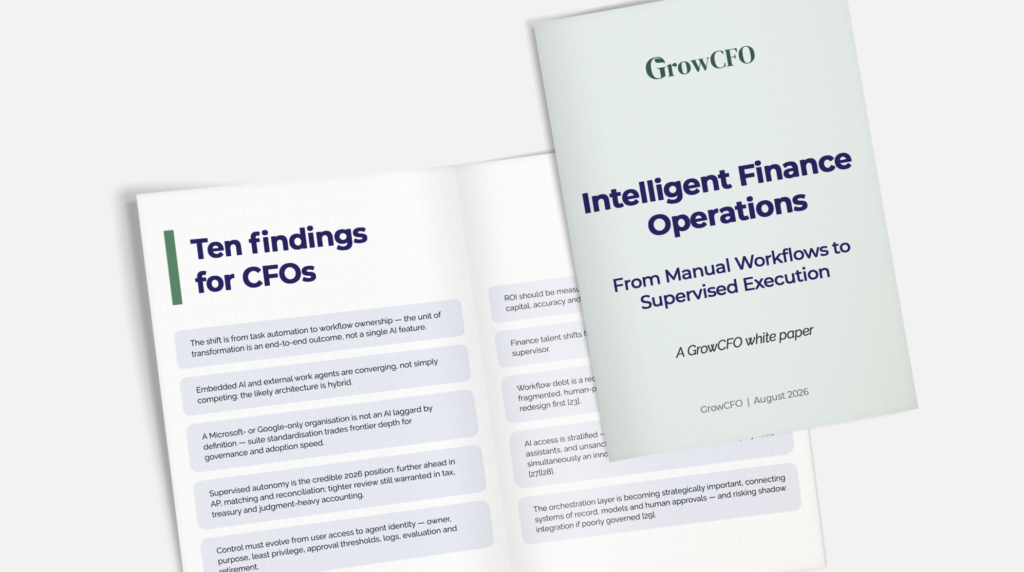
Intelligent Finance Operations: From Manual Workflows to Supervised Execution
For years, finance automation has focused on helping teams work faster.
Automate a task. Reduce manual effort. Speed up reporting. Improve accuracy.
Those benefits still matter, but finance is now moving into a different phase.
AI is beginning to do more than assist. In selected workflows, systems can monitor activity, interpret what is happening, prepare a response, and, within defined limits, take action.
The question for CFOs is no longer simply: “Where can we use AI?”
It is: “Where should intelligence sit, what should it be allowed to do, and who remains accountable when AI starts executing work?”
Why Finance Is Moving Beyond Task Automation
The first wave of finance AI focused largely on individual tasks.
Generate commentary. Analyze a spreadsheet. Categorize an invoice. Summarize a report.
The next stage is broader.
Finance teams are beginning to redesign entire workflows so that systems can handle routine activity while people focus on exceptions, judgment, and oversight.
This is the shift from task automation to workflow ownership.
Instead of asking whether AI can automate one step, finance leaders increasingly need to ask whether the whole process can be improved.
That might mean AI helping to:
- Validate transactions
- Identify and investigate exceptions
- Prepare recommended actions
- Route higher-risk decisions for approval
- Execute approved actions
- Retain evidence of what happened
The strongest opportunities today are appearing in high-volume, repeatable workflows where boundaries and controls can be clearly defined.
Where Should Intelligence Live?
One of the biggest decisions facing CFOs is where AI should operate within the finance technology environment.
The report identifies several distinct layers.
Embedded Finance AI
AI built into ERP, accounts payable, close, treasury, and other finance platforms can operate close to transaction data, permissions, and established controls.
This makes it well suited to repeatable finance processes such as matching, coding, reconciliation, cash application, and exception handling.
Enterprise-Suite AI
Tools within Microsoft or Google environments can bring AI into spreadsheets, email, documents, and everyday knowledge work.
For many organizations, this may provide the most practical route to governed, organization-wide adoption.
Cross-Application AI Agents
External agents can work across applications, files, and data sources, making them useful where finance work crosses system boundaries.
Their flexibility is powerful, but it also increases the need for clear controls around permissions, data, and accountability.
For most finance teams, the future is unlikely to be one platform replacing everything.
It is more likely to be a hybrid model, with different forms of intelligence used for different types of work.
What Does Supervised Execution Look Like?
Autonomous finance has not arrived, but supervised execution is becoming increasingly credible.
Accounts payable is one of the clearest examples.
A modern workflow could automatically capture and validate an invoice, match it against available data, identify an exception, use AI to interpret the issue, and then either escalate it or execute an approved action depending on the risk and confidence level.
Similar approaches are emerging across:
- Reconciliations
- Cash application
- Collections
- Revenue assurance
- Variance commentary
- Exception management
- Reporting workflows
The objective is not to remove human involvement.
It is to move human effort away from routine processing and toward the decisions that genuinely require judgment.
Why Workflow Redesign Comes Before Automation
AI does not automatically fix a poorly designed process.
Fragmented handoffs, duplicate controls, unclear ownership, disconnected systems, and manual queues can all limit the value of automation.
Adding an agent on top of those problems may make one step faster while leaving the overall outcome largely unchanged.
This is why finance leaders need to distinguish between automating an existing process and redesigning how the work should happen.
Before introducing more AI, teams should look at:
- Where work gets stuck
- Which approvals genuinely add value
- Where ownership is unclear
- Which handoffs can be removed
- Where exceptions occur most frequently
The best results will come from combining technology with better process design.
Why Governance Must Change as AI Takes Action
Traditional finance controls were designed mainly around people.
Who can access the system? Who can approve a payment? Who can post a journal?
As AI gains the ability to take action, finance controls need to evolve.
An AI agent operating in finance should have:
- A clearly defined purpose
- A named owner
- Approved data sources
- Appropriate permissions
- Defined action thresholds
- Human approval points
- Logging and monitoring
- Rollback procedures
The report describes this as the finance control plane.
The principle is simple: every agent should be treated as a governed identity with a defined lifecycle, not simply as another software feature.
How Is the Finance Workforce Changing?
As systems take on more transaction processing and exception handling, finance roles begin to change.
The focus shifts from processing work to designing, reviewing, and supervising it.
Skills such as these become more important:
- Process design
- Data fluency
- Control design
- Model evaluation
- Exception management
- Business judgment
This means AI adoption cannot be treated purely as a technology project.
Finance leaders also need to think about role design, training, accountability, and how employees challenge or override AI recommendations when necessary.
What Should CFOs Focus On Next?
Finance teams do not need to automate everything at once.
A more practical approach is to identify a small number of workflows where supervised execution could create measurable value while maintaining strong control.
1. Identify the Right Workflows
Focus on high-volume processes with significant manual effort, delays, or recurring exceptions.
2. Decide Where Intelligence Should Sit
Determine whether AI belongs inside the finance system, the enterprise suite, an external agent, or an orchestration layer.
3. Redesign Before Automating
Simplify the process before adding more technology.
4. Define the Autonomy Boundary
Be clear about what AI may recommend, prepare, approve, or execute.
5. Measure Operating Outcomes
Track improvements in cycle time, exception quality, working capital, accuracy, and decision speed rather than simply counting licenses or pilots.
The goal is not maximum automation.
It is better execution with stronger control.
What This Means for Finance Leaders
Intelligent finance operations are not about creating a finance function where AI does everything.
They are about deliberately deciding which work should be automated, which decisions still require human judgment, and how the two should work together.
The organizations that gain the most value will be those that combine workflow redesign, supervised execution, governance, and measurable outcomes.
Every workflow needs a deliberate home.
Every autonomous action needs an accountable owner.
And human judgment should be focused where it changes the outcome.