
Why “Best in Finance” Often Loses The CFO Role

Why do some Finance Directors get promoted to CFO while others remain stuck in the number two role?
Why do Finance Directors who consistently deliver every number still get passed over for the CFO position? And what changes when a leader starts demonstrating decision leadership instead of finance excellence alone?
GrowCFO sees a consistent pattern in senior finance careers: the people with the strongest delivery records often assume the CFO role is the next logical step.
Usually, it is not.
The reality is that they are being assessed for a different job than the one they are currently excelling in.
A Useful Lens for “Passed Over” Moments
- Delivery: Finance leaders are rewarded for accuracy, deadlines, and control. Then they are surprised when the CFO appointment is made based on trust, judgement, and enterprise leadership.
- Signals: A board pack can be technically excellent and still send the wrong message if it reports activity rather than shaping decisions.
- Risk: CFOs do not eliminate risk. They identify it, quantify it, and help the business choose it consciously alongside the CEO.
- Trade-offs: Senior leaders rarely need more analysis. They need recommendations about what to do, what not to do, and what should be monitored.
- Narrative: If updates fail to connect cash, strategy, and execution into a coherent story, finance leaders remain the “head of numbers” rather than being seen as future CFOs.
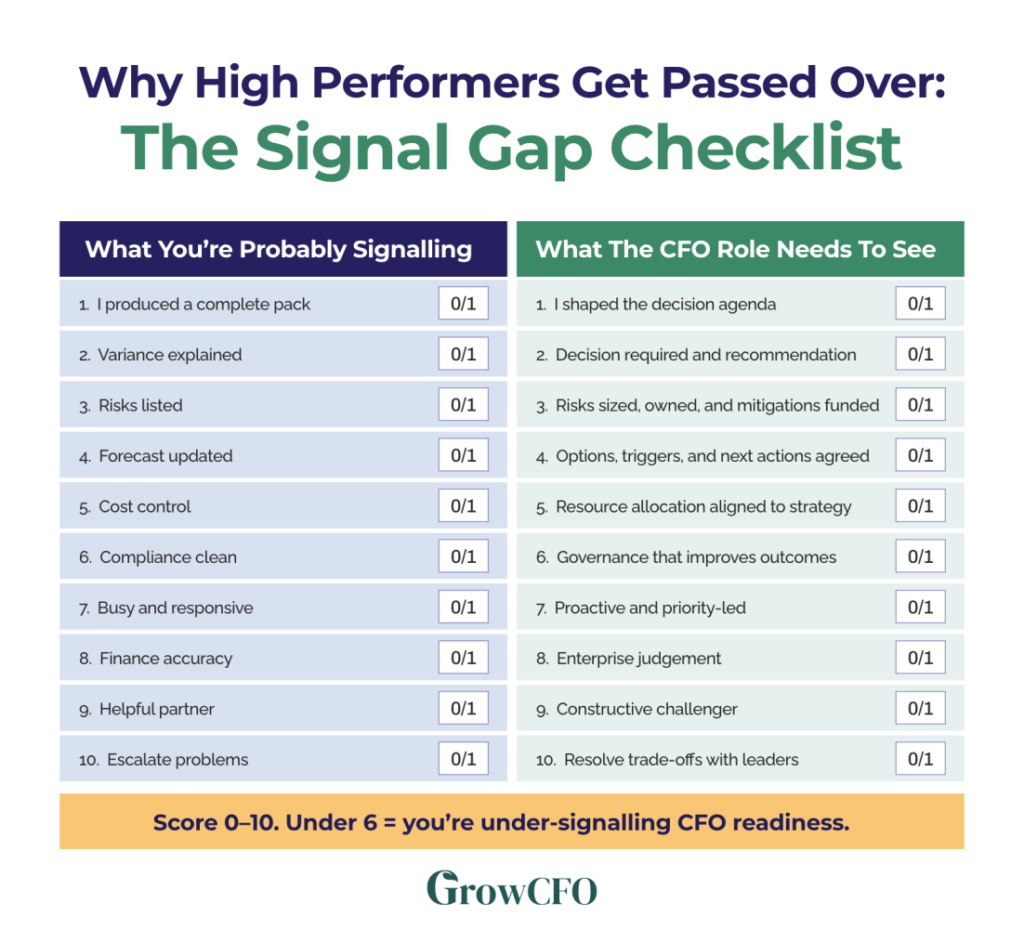
Beyond Delivery: The Six Moves to Demonstrate CFO Readiness
- Focus on Decisions Over Data: Prioritize the three most important decisions the CEO and leadership team need to address this month. Anything that does not support a decision is noise at CFO level.
- Commit to a Stance with Alternatives: CFOs avoid neutrality. They present a recommendation alongside two viable alternatives, clearly outlining the trade-offs across risk, cash, capacity, timing, and customer impact.
- Quantify Risk Operationally: Move beyond simple “high, medium, low” labels. Use impact ranges, leading indicators, named owners, and review cadences.
- Unify Cash and Strategy: Demonstrate leadership by connecting strategic goals to cash flow in a single sentence, such as explaining how an immediate investment protects future cash by mitigating churn.
- Build Trust Through Precise Communication: CFO-ready leaders communicate difficult truths without damaging relationships. They remain honest while protecting trust.
- Establish Proof Through Consistency: CFO readiness is not demonstrated once. It is proven repeatedly through sound judgement in pricing decisions, investment reviews, transformation programmes, and strategic trade-offs.
1) Start With the Decision, Not the Data
Before building the board pack, identify the three decisions the CEO and executive team need to make this month.
If the content does not help a decision get made, it probably does not belong in the pack.
2) Take a Position (With Options)
CFOs do not hide behind neutrality.
Present:
- A recommendation
- Two viable alternatives
- Clear trade-offs around time, cash, risk, customer impact, and capacity
3) Quantify Risk Like an Operator
Stop relying on “high, medium, low.”
Instead:
- Define impact ranges
- Identify leading indicators
- Assign an owner
- Set a review cadence
Connect strategic goals directly to cash flow and communicate risks in a way that is commercially meaningful.
The CFO Mindset Shift
The transition from Finance Director to CFO requires a shift from reporting what happened to shaping what happens next. The traditional finance mindset is data-first and backward-looking. The CFO mindset is decision-first and forward-looking. By focusing contributions around the critical choices facing the leadership team, finance leaders move from providing information to actively influencing outcomes.
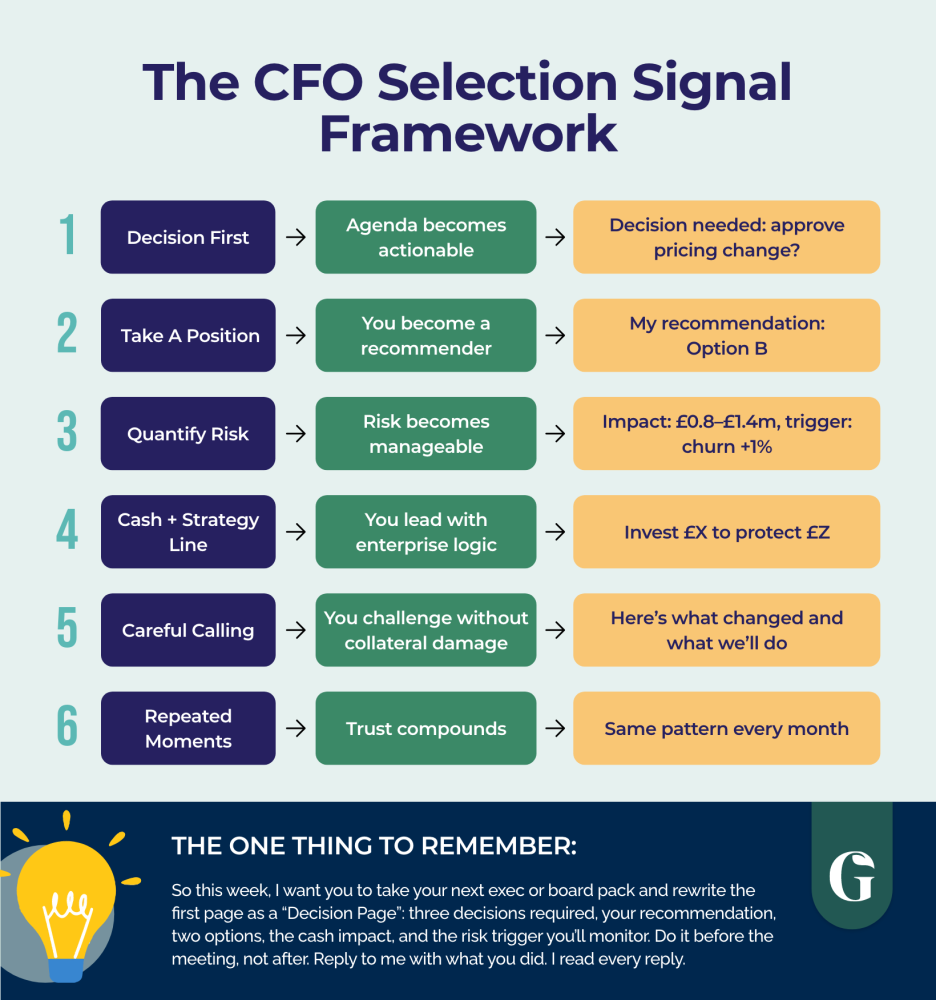
THE ONE THING TO REMEMBER
This week, take the next executive or board pack and rewrite the first page as a “Decision Page.”
Include:
- Three decisions required
- Your recommendation
- Two alternatives
- The cash impact
- The risk trigger being monitored
Do it before the meeting, not after. That is where CFO leadership starts.
The Future CFO Program is built around a practical CFO Competency Framework, business simulators, and a Virtual Boardroom experience designed to expose the capability gaps that high-performing finance leaders often cannot see themselves. The nine-module programme is specifically designed to support the transition from finance delivery to CFO leadership.
For finance leaders who want a clearer understanding of what the CFO role actually requires, and how to build those capabilities, the Future CFO Preview Event is the best place to start.
BONUS TIPS
P.S. Three quick upgrades that can be implemented immediately: (1) Replace “variance commentary” with “decision implications” in every monthly update. (2) Add a section called “What I Need From You” to executive communications. (3) Pre-wire one stakeholder before each meeting to test and strengthen the recommendation before it.