
The Hidden Skill Gap Blocking Your Move to CFO

Why are finance leaders still explaining numbers instead of driving decisions?
GrowCFO sees the same pattern repeatedly among senior finance leaders: capable, respected, and busy professionals who hesitate at the exact moment a CFO would lean in and lead.
The symptoms are familiar:
- Being viewed as safe rather than decisive
- Being asked for “one more cut” of analysis
- Leaving executive meetings feeling unheard
- Avoiding recommendations until there is certainty
- Mistaking caution for credibility
A CFO Confidence Checklist You Can Use This Week
- Stance: Say what should happen, not just what is true.
- Assumptions: Name the 2–3 assumptions driving the recommendation.
- Options: Bring choices with trade-offs, not a single “answer.”
- Risk: Separate what could go wrong from what will be monitored.
- Timebox: Set a decision deadline when data is imperfect.
- Ownership: Close meetings with a decision, an owner, and a date.
For finance leaders looking to strengthen these capabilities, GrowCFO offers a free live walk-through of the platform, simulators, and CFO Competency Framework during the Future CFO Preview Event.
Your CFO Confidence Scorecard
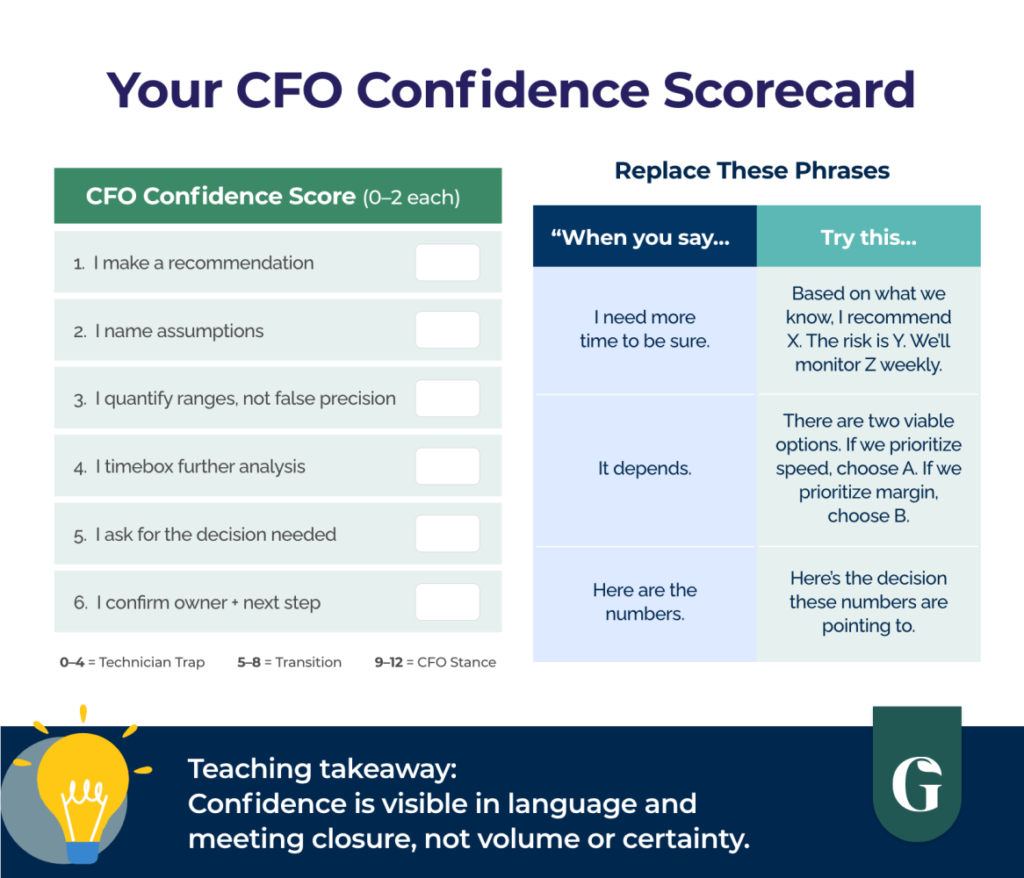
The “CFO Stance” Script: How To Speak With Confidence Without Bluffing
1) Open with the decision the business actually needs
This prevents defaulting into reporting mode.
Micro-prompt:
“The decision today is: do we approve X, delay X, or change scope?”
2) State what you believe, plainly, in one sentence
Confidence is not about being louder. It is about being clearer.
Technique: write the recommendation before the meeting and deliver it early.
Example:
“I recommend proceeding with the price increase in July, supported by a targeted customer-by-customer implementation plan.”
3) Give a range and the driver, not fake precision
CFO-level confidence accepts uncertainty and still moves forward.
Technique: share best-case, base-case, and worst-case outcomes, with one key driver for each.
Micro-prompt:
“Base case assumes 60% retention. Downside assumes 45% retention driven by churn in Segment B.”
4) Name assumptions explicitly
Most finance leaders hide assumptions in the model. CFOs bring them into the discussion.
Micro-prompt:
“This recommendation relies on three assumptions: stable demand, consistent sales capacity, and no further deterioration in supplier lead times.”
5) Present options with trade-offs, not a data dump
The objective is to make decisions easier, not presentations longer.
Technique: present only two or three options, each with:
- Impact
- Risk
- Operational requirement
Micro-prompt:
“Option A improves cash flow within 90 days but increases pressure on service levels. Option B protects service quality but takes six months to deliver results.”
6) Timebox further analysis
One of the biggest confidence traps is accepting endless analysis requests without challenge.
Technique: ask what information would actually change the decision, then set a deadline.
Micro-prompt:
“What additional information would materially change the recommendation? I can provide that within 48 hours.”
7) Close with a decision, an owner, and a date
This is where finance support becomes finance leadership.
Micro-prompt:
“We are proceeding with Option B. Sam owns implementation. Progress will be reviewed at next Thursday’s executive meeting.”
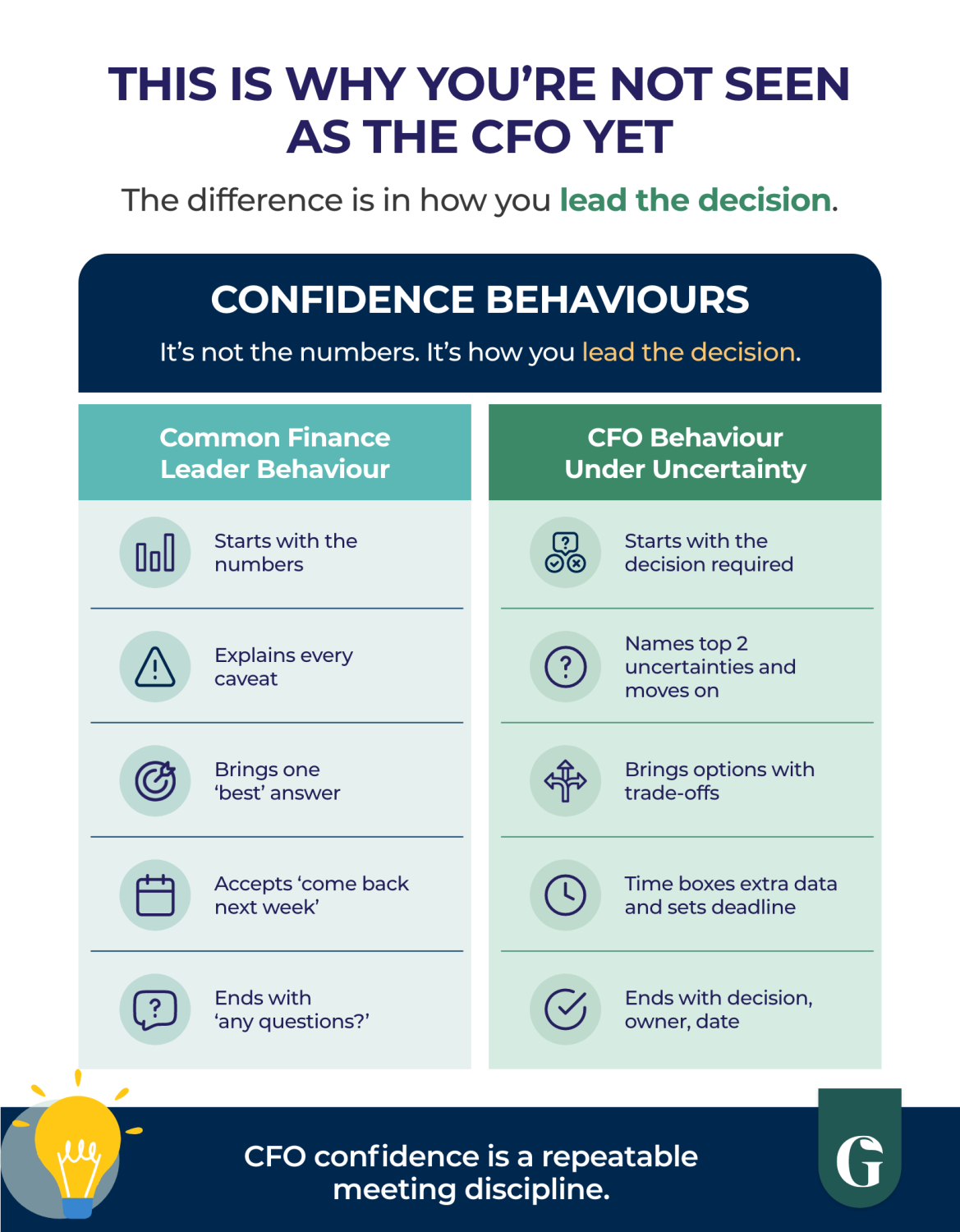
The 10-Minute “Recommendation One-Pager” Drill
If the goal is to build CFO-level confidence quickly, the answer is not more spreadsheet tabs. It is more clarity.
Do this before the next executive meeting.
Step 1: Write the Decision Needed
Template:
“Today we need to decide: A / B / C by 2026.”
Example:
“Today we need to decide whether to hire six engineers, hire three engineers, or pause hiring until Q3.”
Step 2: Write the Recommendation
Template:
“I recommend [option], because [one driver].”
Example:
“I recommend hiring three engineers because it protects delivery commitments without materially reducing cash runway.”
Step 3: Add Three Bullets Only
Range
Base, upside, and downside outcomes in plain language.
Assumptions
The two or three factors that must be true for the recommendation to succeed.
Triggers
What will be monitored, the threshold for action, and the response if that threshold is reached.
Here is the rule:
If it cannot fit on one page, the recommendation is not ready.
At that point, the work is still analysis rather than leadership.
The Future CFO Program is built around nine development modules and supported by tools within the GrowCFO platform, including practical simulators and the CFO Competency Framework. These tools help finance leaders identify where confidence gaps appear in real CFO behaviours and provide structured ways to close them.
For professionals looking to move from “I know the work” to “I can lead the room,” the Future CFO Preview Event provides a practical overview of how the programme supports that transition.
P.S. Before the next executive meeting, write a one-sentence recommendation, list the two assumptions underneath it, and define the trigger that would change your mind. Bring that to the meeting, not another spreadsheet tab.