What Finance Tasks Can AI Automate?
What finance tasks can AI automate in modern organizations?
AI applications in finance can automate a wide range of operational, analytical, and reporting tasks, from accounts payable and commission calculations to forecasting and continuous auditing. Modern AI applications in finance reduce manual workload, improve accuracy, and increasingly generate real-time insights and strategic recommendations. For CFOs, the opportunity is not just efficiency but a structural shift toward autonomous finance operations.
What operational finance tasks can AI automate today?
AI applications in finance are already automating high-volume, rules-based processes across transactional workflows. These include:
- Accounts payable invoice capture and coding through intelligent document processing
- Cash application and reconciliation matching
- Expense management and anomaly detection
- Journal entry suggestions and validation
- Payment processing and exception routing
According to IBM, intelligent automation in finance combines AI, machine learning, and workflow orchestration to streamline processes such as accounts payable, financial planning, and risk management, reducing manual effort and cycle times.
Cloud AI providers further highlight automated document extraction, fraud detection, and financial close acceleration as high-impact use cases.
The value of these AI applications in finance is measurable. A McKinsey Global Institute study estimated that about 50 percent of current work activities could be automated using existing technologies, with finance and accounting among the most automatable functions.
For CFOs, this is no longer theoretical. The month-end close, reconciliations, and payables workflows are prime candidates for immediate automation pilots.
How can AI applications in finance automate commission calculations?
Commission calculation is one of the most complex and error-prone finance processes, making it a strong candidate for AI applications in finance. A typical commission management process includes:
- Configuring a commissioning plan
- Recovering sales rep data from CRM
- Checking commission amounts
- Inter-user communication
- Sharing information
- Managing the commission plan
- Data analysis and processing
- Payment of commissions
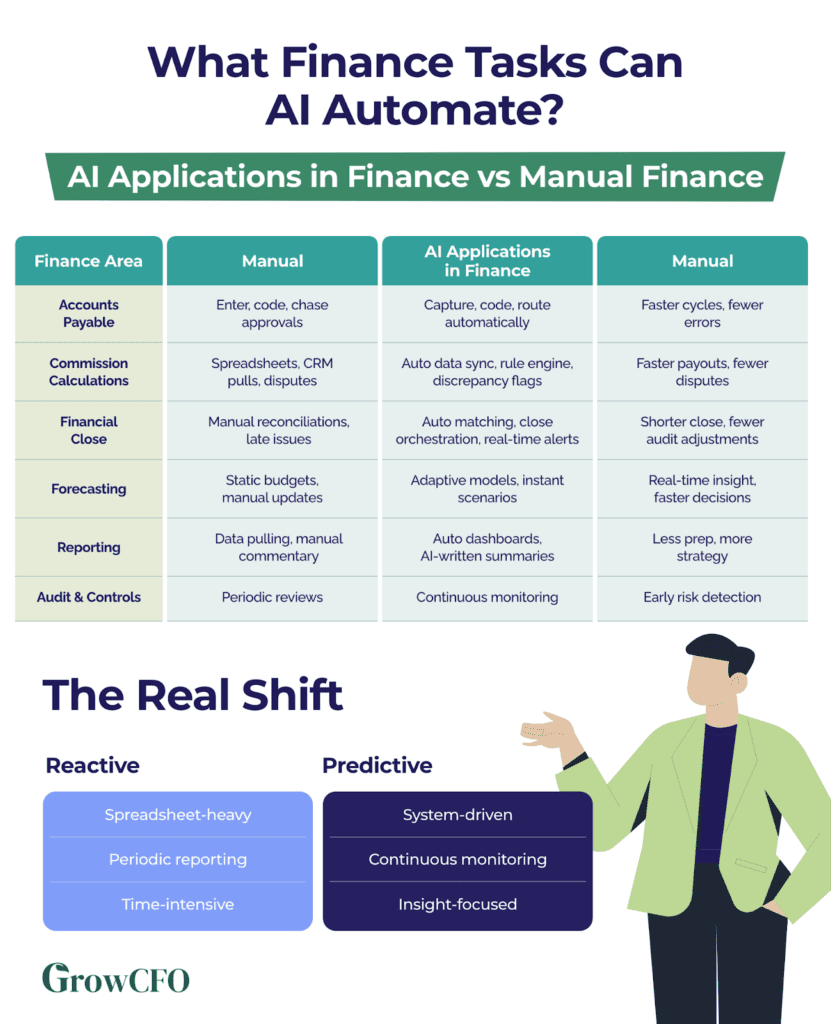
AI applications in finance can automate each stage. Machine learning models can extract sales data directly from CRM systems, apply complex commission rules dynamically, flag discrepancies, and calculate payments at scale.
Natural language tools can automate communication by generating individualized commission statements and explanations for sales teams. Predictive models can simulate how plan changes will impact future payouts, supporting more strategic commission design.
The result is faster calculation cycles, fewer disputes, and improved trust between finance and sales. More importantly, AI applications in finance transform commissions from a back-office burden into a data-driven performance lever.
Can AI automate financial reporting and analysis?
Yes, and this is where AI applications in finance are evolving most rapidly. Generative AI systems can now produce narrative financial analysis in natural language, automatically drafting management reports and commentary on performance variances.
AI-powered financial tools can:
- Generate first-draft board reports
- Create variance analysis commentary
- Produce scenario modeling outputs with narrative explanations
- Summarize key KPIs and trends
Industry experts predict that by 2027, over 75 percent of financial planning will be augmented or automated by AI. This reflects a shift from manual spreadsheet modeling to AI-driven adaptive forecasting and prescriptive recommendations.
Instead of simply predicting outcomes, advanced AI applications in finance now recommend actions. For example, predictive models may forecast revenue decline and suggest pricing adjustments or cost reallocations to optimize margins.
For senior finance leaders, this means less time producing reports and more time challenging assumptions, shaping strategy, and advising the executive team.
What is the difference between automation, augmentation, and autonomous finance?
To understand the trajectory of AI applications in finance, it helps to distinguish three stages:
| Stage | Description | Example in Finance |
| Automation | AI handles repetitive tasks | Invoice coding and reconciliation matching |
| Augmentation | AI supports human decision-making | Forecast scenario modeling with recommended actions |
| Autonomous Operations | AI manages end-to-end processes with minimal oversight | Fully automated month-end close workflow |
Automation focuses on efficiency. Augmentation enhances decision quality. Autonomous finance represents a structural transformation where AI systems manage workflows such as accounts payable, reporting, and elements of the financial close with minimal human intervention.
Continuous auditing is another emerging capability. AI applications in finance can monitor transactions in real time, flagging irregularities before they escalate into compliance or fraud issues. This moves finance from reactive control to proactive risk management.
How will AI applications in finance reshape forecasting and planning?
Adaptive forecasting is becoming a defining capability of modern AI applications in finance. Instead of static annual budgets, AI models continuously update projections based on real-time data inputs.
Emerging trends include:
- Models that automatically adjust assumptions when market conditions shift
- Natural language interfaces that allow CFOs to query forecasts conversationally
- Cross-functional optimization that identifies trade-offs between departments
- Prescriptive analytics that recommend specific cost or investment actions
These AI applications in finance enable a shift from periodic planning cycles to continuous performance management. Finance teams become orchestrators of strategic insight rather than compilers of historical data.
How should CFOs implement AI applications in finance?
Successful adoption of AI applications in finance requires a deliberate roadmap. The most effective approach includes:
- Identifying high-value, high-friction processes such as commissions or payables
- Launching a focused pilot in one finance area
- Measuring impact on cycle time, accuracy, and cost
- Scaling gradually while investing in capability development
Change management is as important as technology selection. Finance professionals must see AI applications in finance as role enhancement rather than replacement. When positioned correctly, AI removes repetitive workload and elevates finance into a strategic advisory function.
Finance leaders should also prioritize governance, data quality, and internal capability building. AI is only as effective as the data and controls surrounding it.
What does this mean for the future finance leader?
AI applications in finance are transforming the CFO role. As operational processes become automated, the competitive advantage shifts toward interpretation, judgment, and strategic leadership.
Finance teams that embrace AI now will gain structural efficiency, real-time insight, and improved decision support. Those that delay risk being trapped in manual reporting cycles while competitors move toward autonomous operations.
The question is no longer whether AI can automate finance tasks. It is whether finance leaders are ready to redesign their function around AI-enabled capabilities.
If you want to understand how to lead this transition confidently, explore the GrowCFO AI Finance Program. It is designed to equip finance professionals with the strategic, technical, and leadership skills needed to implement AI applications in finance responsibly and effectively. Learn more here.