
What Are the 4 Skills That Actually Make You CFO-Ready?

Why being excellent at finance is only the first layer of becoming a strategic CFO.
You’ve spent years building your technical finance expertise. You can explain the numbers, manage reporting deadlines, challenge budgets and make sure the business understands its financial performance.
Yet when you sit in a leadership meeting, you notice something frustrating.
You present a detailed analysis of declining margins. Everyone agrees it’s useful. The conversation then moves to pricing, customer strategy and operational priorities, and the CEO and commercial leaders make the decisions.
You contributed the financial information, but you didn’t necessarily shape the outcome.
This is one of the most important distinctions for finance leaders aspiring to become CFOs.
Technical expertise earns you credibility. Your ability to turn that expertise into better business decisions earns you influence.
The challenge is that finance professionals are rarely shown how the different capabilities fit together.
What Is the CFO Skill Stack?
GrowCFO recommends viewing CFO capability as four connected layers.
Layer 1: Financial Credibility — Can people trust your numbers?
Layer 2: Commercial Understanding — Can you explain what is driving those numbers?
Layer 3: Decision Influence — Can you help leaders choose what to do next?
Layer 4: Strategic Leadership — Can you help shape where the business goes?
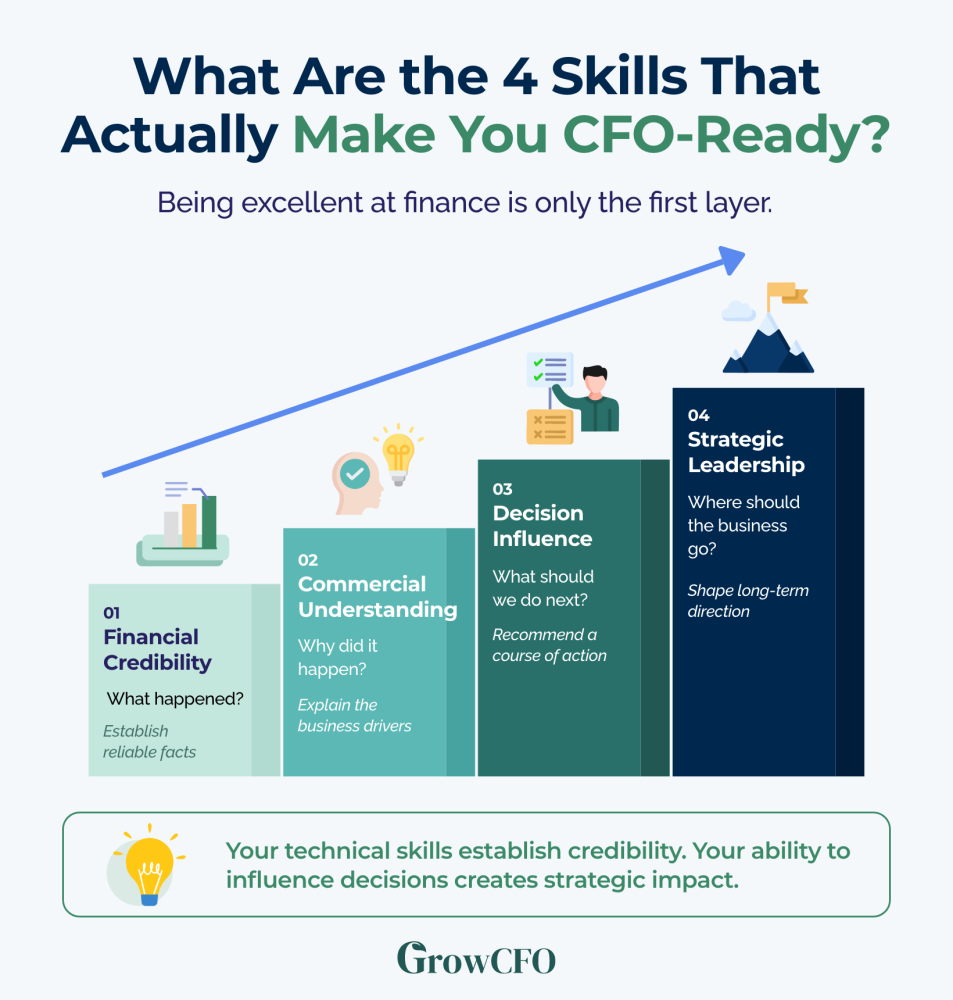
These capabilities build on one another, but progression isn’t automatic.
You can be excellent at financial reporting without understanding the commercial drivers behind performance. You can understand the business without being able to influence a difficult decision. And you can influence individual decisions without yet helping to shape the organisation’s longer-term direction.
The key is to identify which layer needs the most development.
How Does Each Layer Change the Value You Bring?
Let’s use one example throughout.
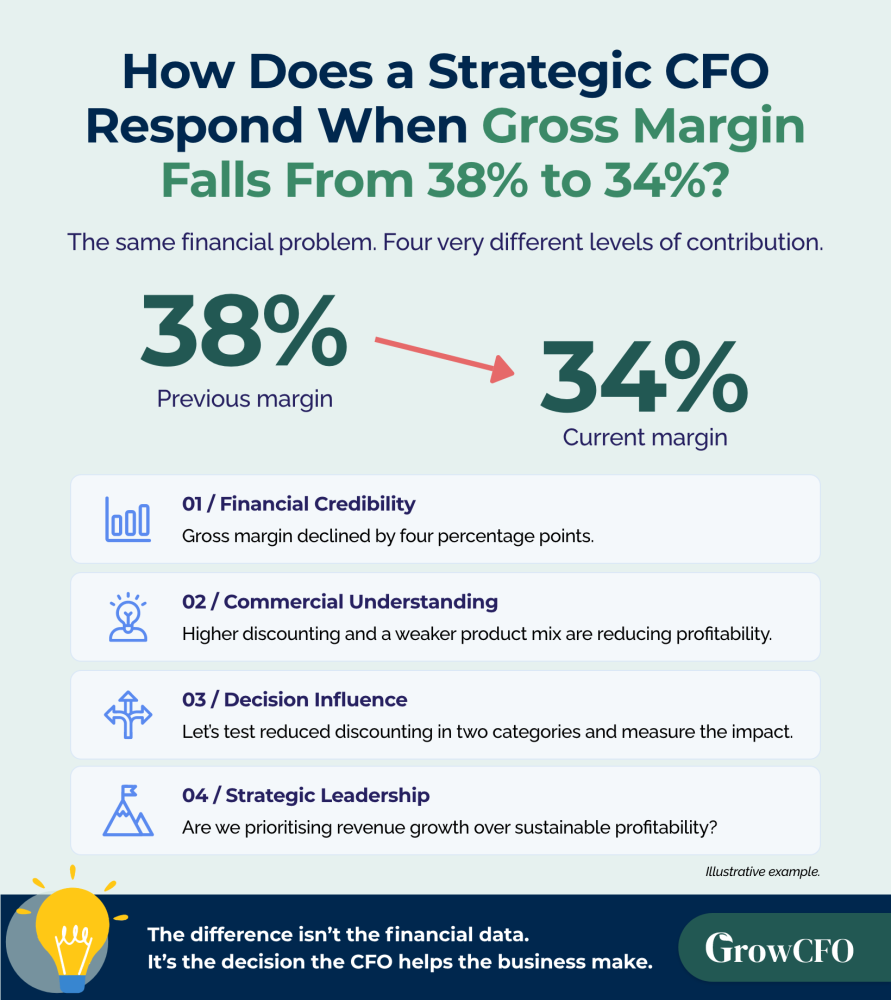
Imagine your company has reported a decline in gross margin from 38% to 34%.
Layer 1: Financial Credibility
Your responsibility is to establish what happened and make the information reliable.
You reconcile the results, investigate variances and identify where the margin deterioration occurred.
Your contribution might be:
“Gross margin declined by four percentage points this quarter, primarily due to higher input costs and increased discounting.”
This is essential work. Without reliable financial information, the business cannot make informed decisions.
But explaining the result is only the starting point.
Layer 2: Commercial Understanding
Your responsibility is to understand why performance changed and what it means for the business.
Rather than stopping at the financial variance, you investigate the underlying commercial activity.
You speak with sales about discounting, operations about production costs and procurement about supplier pricing.
You discover that the sales team has been offering larger discounts to win new customers, while some lower-margin products are consuming disproportionate operational capacity.
Your contribution becomes:
“Our discounting strategy is increasing sales volume, but the additional revenue is coming from products with weaker contribution margins. We’re growing revenue without generating the expected profit.”
You’ve moved from describing financial performance to explaining business performance.
That creates a much more useful conversation.
Layer 3: Decision Influence
Your responsibility is to help management evaluate options and make better decisions.
Understanding the problem isn’t enough if the leadership team doesn’t know what to do about it.
You develop three commercially realistic options:
- Maintain the current discounting strategy and accept lower margins in exchange for volume growth.
- Reduce discounting on selected products, accepting some potential volume loss to improve profitability.
- Change the sales incentive structure to reward contribution margin rather than revenue alone.
You quantify the potential impact, highlight the risks and make a recommendation.
Your contribution becomes:
“I recommend testing reduced discounting across two product categories before changing the wider pricing strategy. We can monitor conversion rates, volume and contribution margin over the next four weeks.”
Now finance is helping the business choose a course of action rather than simply reporting the problem.
Layer 4: Strategic Leadership
Your responsibility is to connect today’s decisions to the future direction of the organisation.
You recognise that the margin issue may be a symptom of a wider strategic challenge.
Perhaps the business has been prioritising revenue growth without sufficiently considering customer profitability, product mix or operational capacity.
You work with the CEO and leadership team to explore whether the existing growth strategy is creating sustainable value.
Your contribution becomes:
“Our current growth strategy rewards volume, but our capacity constraints mean that not all growth is equally valuable. We should reconsider which customer segments and products we prioritise over the next 12 months.”
This is where the CFO starts influencing not just how the business performs, but what the business chooses to become.
Why Do Finance Leaders Get Stuck Between the Layers?
One reason is that organisations often reward finance professionals for being dependable.
If you’re excellent at producing accurate reports, you’re given more reporting responsibilities. If you’re good at budgeting, you may be asked to manage a larger budgeting process.
These opportunities can strengthen your technical expertise, but they don’t automatically develop your commercial judgement or strategic influence.
There is also a confidence challenge.
It’s relatively comfortable to explain a financial variance when the analysis is robust. It’s harder to recommend a commercial decision when the outcome is uncertain and different stakeholders have competing priorities.
Yet this is precisely the capability that senior finance leaders need to develop.
The next stage of your career may require you to become better at making recommendations, rather than simply becoming better at producing analysis.
How Can You Identify Your Weakest Layer?
Here’s a simple diagnostic you can use before your next leadership meeting.
Think about the last three significant business decisions where finance was involved.
For each decision, ask yourself four questions:
1. Financial Credibility: Did I provide reliable information that helped establish the facts?
2. Commercial Understanding: Did I explain the underlying business drivers, not just the financial results?
3. Decision Influence: Did I present realistic options and recommend a course of action?
4. Strategic Leadership: Did I connect the decision to the organisation’s longer-term priorities?
Give yourself a score from 1 to 5 for each capability, based on what you actually contributed.
A score of 1 means you rarely demonstrated the capability. A score of 5 means you demonstrated it consistently and effectively.
This isn’t a scientific assessment or a formal measure of CFO readiness. It’s a practical way to recognise patterns in your current contribution.
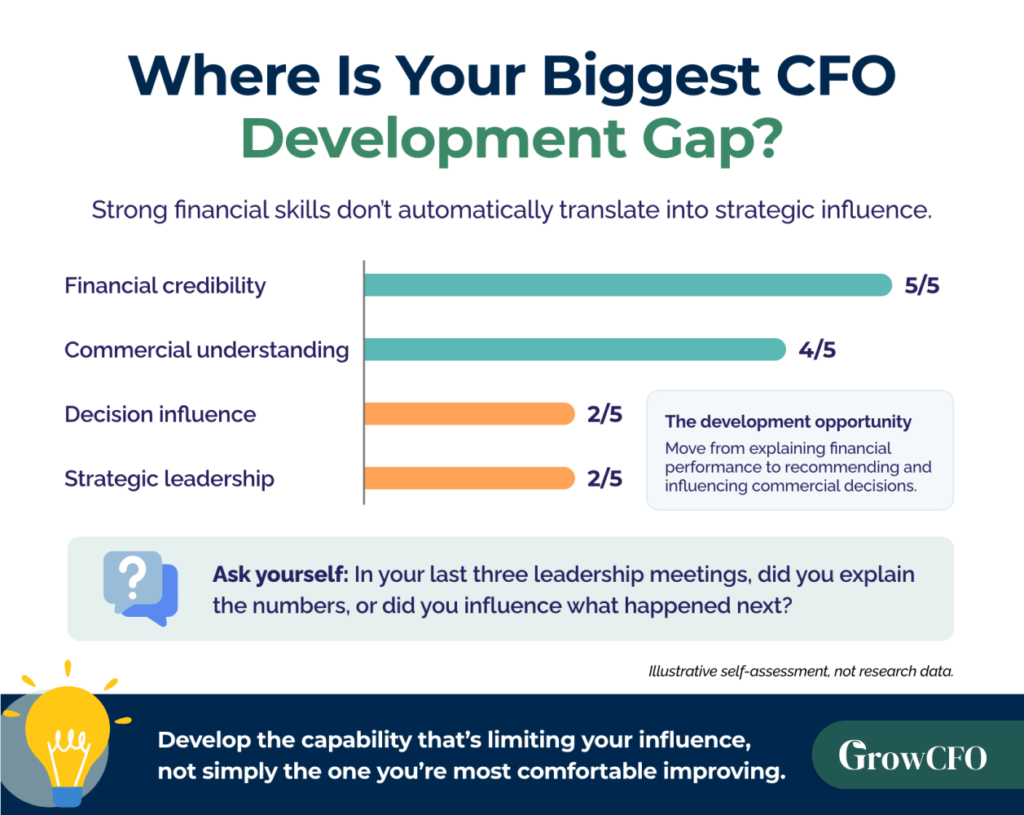
If you’re consistently scoring highly on financial credibility but lower on decision influence, you have a useful development priority.
You don’t necessarily need another technical qualification. You may need more opportunities to make and defend commercially sound recommendations.
How Can You Strengthen Your CFO Skill Stack This Week?
Here’s how to start.
Choose one upcoming management discussion where finance will present performance information or evaluate a business issue.
Before the meeting, prepare a short decision brief with five elements:
1. The issue: What is happening, and why does it matter commercially?
2. The drivers: Which two or three factors explain the situation?
3. The options: What realistic choices are available?
4. The recommendation: Which option would you choose, and why?
5. The decision: What specifically do you need the leadership team to agree?
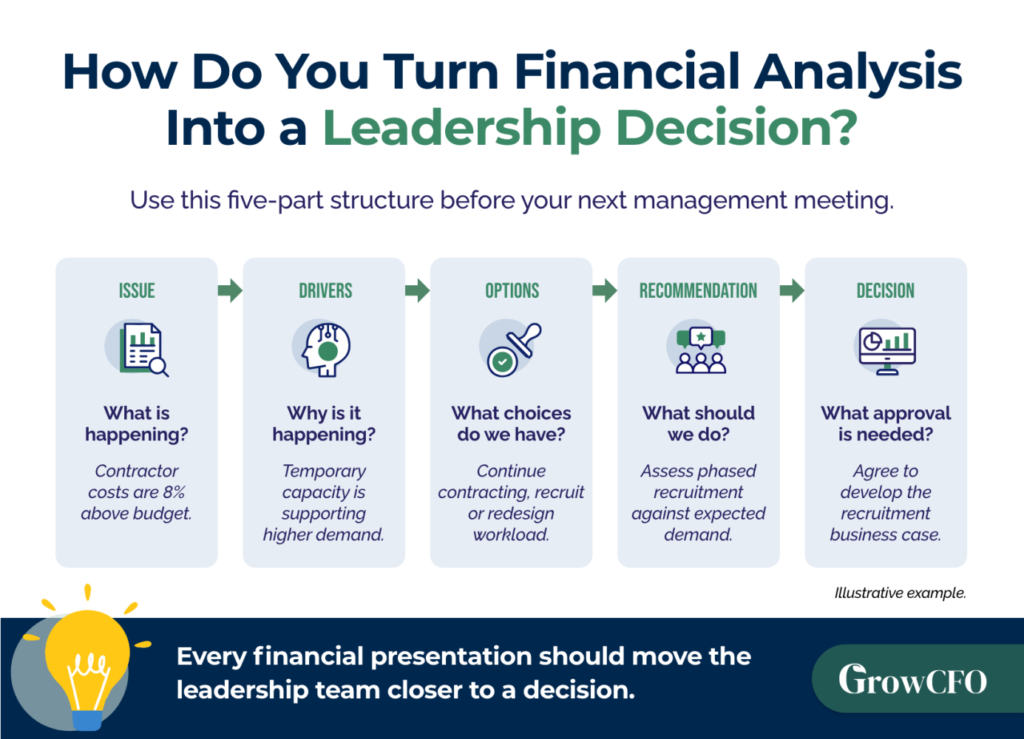
For example, instead of presenting:
“Operating costs are 8% above budget due to increased contractor spending.”
Try:
“Contractor spending is 8% above budget because we’re using temporary resources to meet customer demand. We can continue with the current approach, recruit permanent employees or redesign the workload. Based on expected demand and cost flexibility, I recommend assessing a phased recruitment plan. I’d like agreement to develop the business case before the next management meeting.”
The difference isn’t necessarily the sophistication of the financial analysis.
It’s that you’ve used the analysis to move the conversation towards a decision.
And that’s something you can practise immediately, regardless of whether you currently hold a CFO title.
What’s the One Thing to Remember?
Your CFO development priority is not always the skill you’re weakest at. It’s the capability that’s currently limiting your ability to influence business decisions.
Financial credibility gives you the foundation. Commercial understanding gives you context. Decision influence helps you create impact. Strategic leadership helps you shape the future.
The goal is to strengthen the connection between all four.
How Can You Develop These Capabilities Further?
Developing from a technically strong finance leader into a strategic CFO requires deliberate practice across commercial understanding, decision-making, influence and leadership.
These are the types of capabilities we focus on developing through GrowCFO’s Future CFO Program.
If you’d like to learn more about how the program can support your development towards a strategic CFO role, join one of our free Future CFO Program preview events.