How to Spot Your Biggest CFO Skill Gap in 10 Minutes

You leave a leadership meeting knowing you contributed useful numbers, answered the questions and explained the variance.
But on reflection, there is a more uncomfortable question:
Did your contribution actually change a decision?
For many finance leaders, development starts with a long list of capabilities they think they should improve: strategic thinking, communication, commercial awareness, influencing, leadership, technology, forecasting.
The problem is that almost every capability can look important.
A more useful question is:
What is the one capability currently putting the biggest constraint on my impact as a finance leader?
You can get surprisingly close to the answer in 10 minutes.
What is the CFO Bottleneck Test?
Think about your effectiveness as a chain:
Insight → Influence → Decision → Action
Your biggest growth opportunity lies wherever that chain repeatedly breaks.
Instead of asking what skills you are missing, ask: “Where does my contribution stop creating value?”
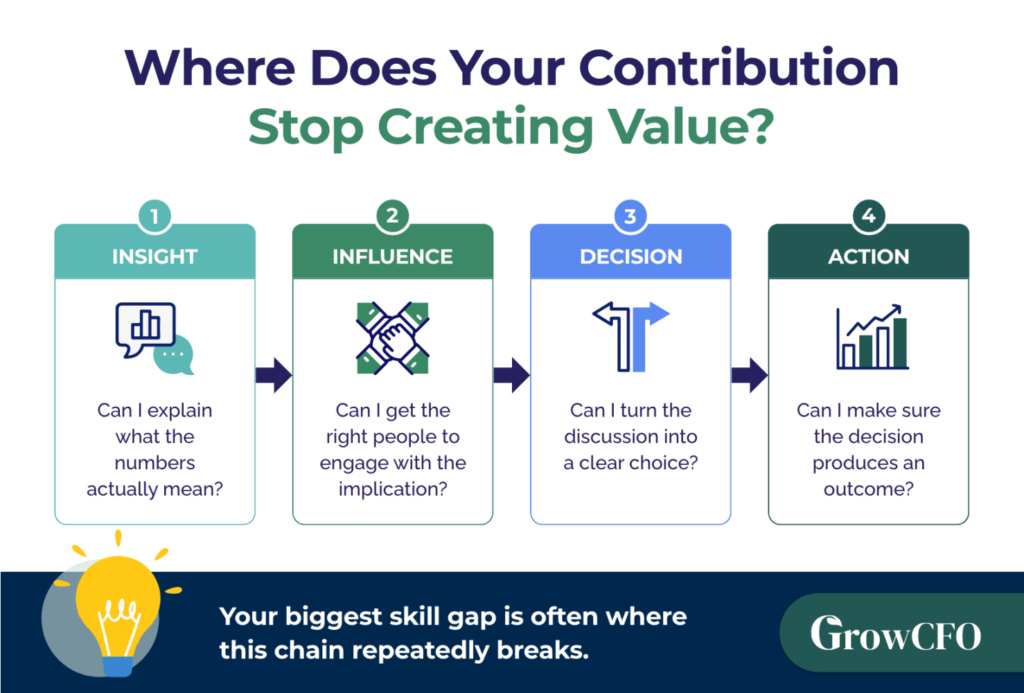
Where does your contribution usually stop?
Take the last three significant business decisions you were involved in.
Choose real decisions rather than routine finance activity: an investment, pricing decision, hiring plan, cost reduction, acquisition, product decision or strategic trade-off.
For each one, mentally trace what happened through the four stages.
1. Insight: Did I explain what really mattered?
This is more than producing accurate information.
Could you separate the signal from the noise and explain the commercial issue underneath the numbers?
For example, there is a significant difference between:
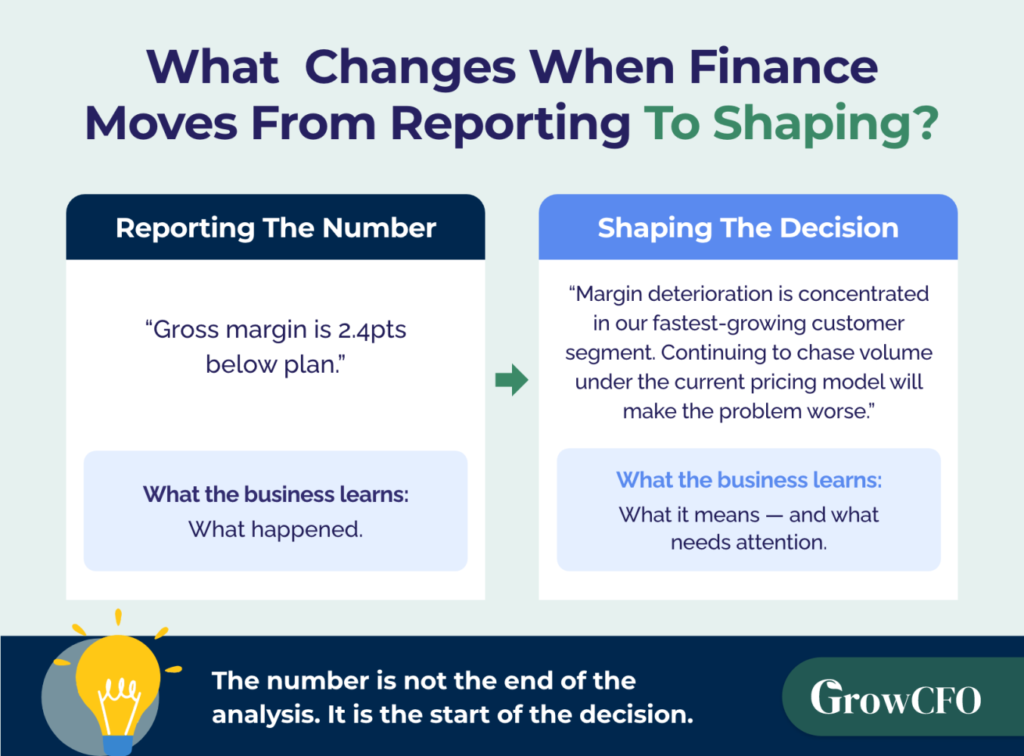
“Gross margin is 2.4 percentage points below plan.”
and:
“Margin deterioration is concentrated in our fastest-growing customer segment, so continuing to pursue volume under the current pricing model will make the problem worse.”
The first reports a result, the second creates insight.
If your contribution frequently stops at reporting what happened, your bottleneck may be commercial interpretation.
2. Influence: Could I get people to engage with the implication?
Knowing the answer does not automatically mean people will act on it.
Think about what happened when your recommendation challenged an established plan, a powerful stakeholder or an optimistic assumption.
Did you adapt your message to the audience?
Did you understand what mattered to the CEO, sales leader or operations leader?
Did you frame the financial issue around the business outcome they cared about?
If your analysis is strong but frequently fails to gain traction, your bottleneck may be influence rather than technical capability.
3. Decision: Did I help turn discussion into a choice?
Finance leaders can add enormous value by creating decision clarity.
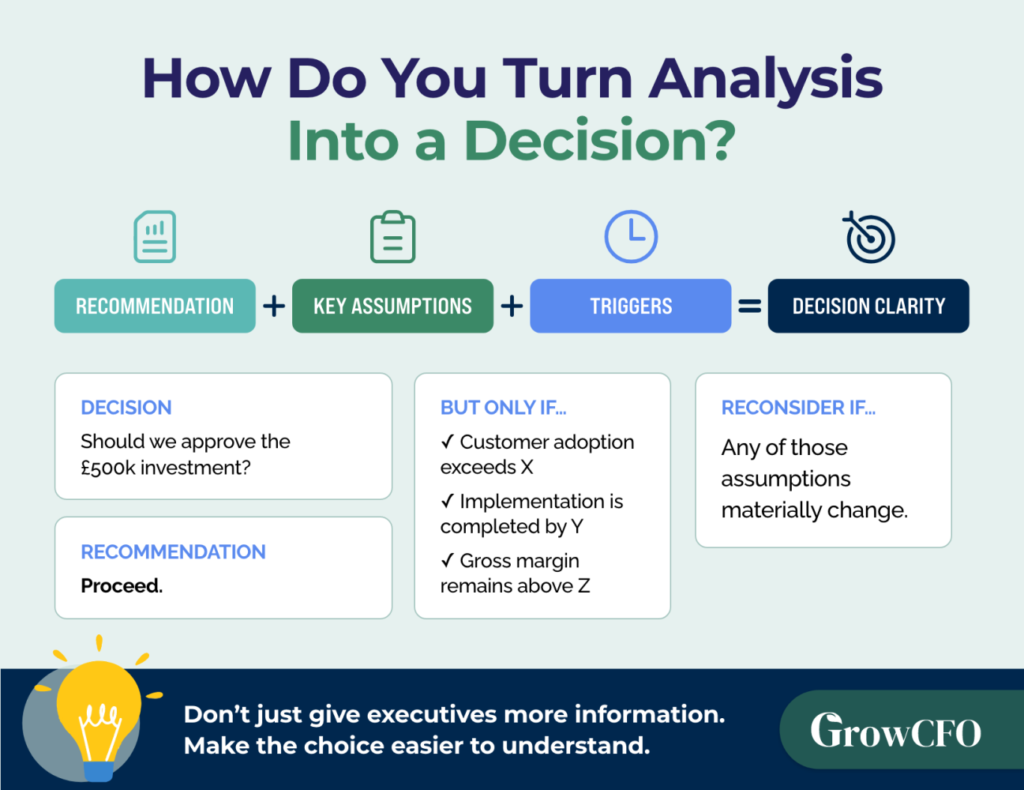
Imagine the executive team is discussing whether to make a £500,000 investment.
A reporting-focused contribution might explain the budget impact, expected return and forecast.
A decision-focused contribution goes further:
“There are three assumptions that determine whether this investment creates value. Customer adoption needs to exceed X, implementation cannot slip beyond Y, and gross margin must remain above Z. If we agree those assumptions are credible, I recommend proceeding. If we cannot, we should delay.”
You have turned analysis into a decision structure.
If meetings regularly end with “we need more analysis” despite plenty of information already being available, your bottleneck may be decision leadership.
4. Action: Did the decision produce a measurable result?
Strategic finance leadership extends beyond the meeting room by establishing clear ownership, tracking key assumptions, and actively monitoring whether decisions deliver their intended outcomes.
For example:
Decision: Launch the new pricing model. Assumption: Churn remains below 4%. Owner: Commercial Director. Review: 30 days after launch. Trigger: Revisit the decision if churn exceeds 4%.
If decisions are being made but expected value repeatedly fails to materialise, your bottleneck may be execution and accountability.
A 10-Minute Guide to Identifying Your Primary Bottleneck
Pinpointing your primary CFO skill gap doesn’t require a lengthy assessment; you can easily uncover the bottleneck constraining your impact by following these simple steps:
- List Recent Decisions: Spend two minutes writing down three significant business decisions from the past 90 days.
- Evaluate Your Contribution: Take two minutes per decision to analyze where your impact began to diminish.
- Identify Patterns: Spend the final two minutes looking for recurring trends across all three examples.
Instead of attempting a perfect skill evaluation, focus on identifying the single constraint that repeatedly limits your effectiveness.
Depending on where your contribution breaks down, focus your development on the corresponding stage:
- Insight: If your contributions stall at translating numbers into commercial meaning, prioritize commercial interpretation over presentation skills.
- Influence: If your analysis is sound but fails to gain traction with key stakeholders, focus on persuasive communication rather than technical modeling.
- Decision: If discussions end without clear resolution, practice converting complex analysis into explicit choices and actionable recommendations.
Action: If decisions are made but fail to deliver expected value, strengthen execution through clear ownership, decision tracking, and post-implementation reviews.
Why should you diagnose the bottleneck before choosing the development?
Senior finance development can easily become additive.
Another course. Another framework. Another technical capability. Another book.
But becoming a stronger CFO isn’t simply about accumulating more knowledge. It is about increasing the value you create in the moments that matter.
That means your development should begin with the constraint.
Insight → Influence → Decision → Action
Find where the chain repeatedly breaks and work there first.
What should you practise next?
Once you’ve identified the bottleneck, choose one behaviour to practise immediately.
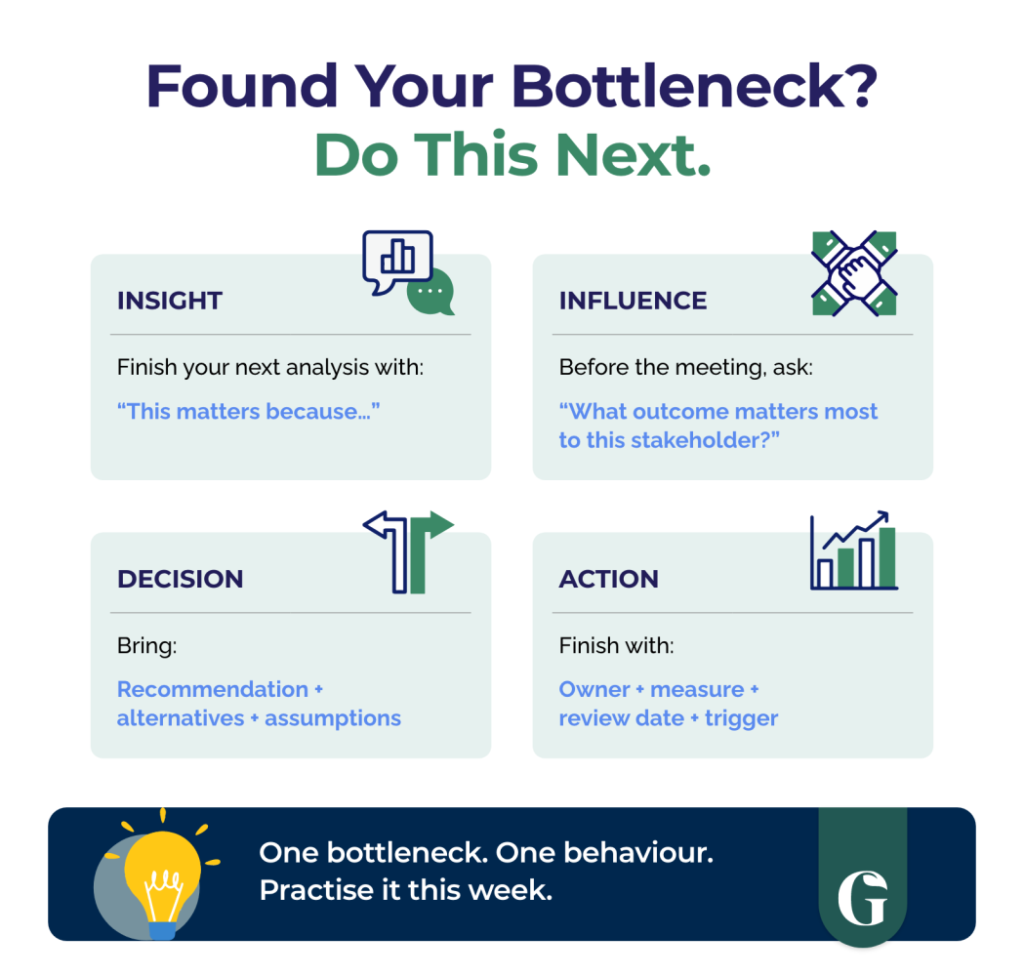
If it is Insight, take your next piece of analysis and force yourself to finish the sentence: “This matters because…”
If it is Influence, identify the stakeholder you most need to bring with you and frame the issue around their commercial priorities.
If it is Decision, go into your next meeting with a recommendation, alternatives and the assumptions that would change your recommendation.
If it is Action, finish the next significant decision with an owner, measure, review date and trigger for intervention.
Better insight still needs better decisions
Technology can give finance teams faster analysis, but it doesn’t remove the need to interpret that information and turn it into a clear recommendation.
In GrowCFO and Acterys survey of 273 finance leaders, 52.7% identified scenario planning as an area where AI could add value, while 78.4% would only present an AI-generated forecast to the board when finance has reviewed it or the underlying inputs are transparent.
The implication is clear: as finance gains access to faster analysis, the ability to apply judgment, challenge assumptions and shape decisions becomes even more important.
See what finance leaders told us about the changing role of AI in planning, budgeting and forecasting.
Read the AI in Planning, Budgeting and Forecasting Survey 2026 →
What is the one thing to remember?
Your biggest CFO skill gap isn’t necessarily the capability you’re weakest at. It is the capability currently putting the biggest constraint on your ability to shape decisions and outcomes.
For finance leaders looking to develop the capabilities that help them move beyond reporting results and play a bigger role in shaping decisions, the Future CFO Programme covers this.
To learn more about the programme, join one of GrowCFO’s free preview events.
Where does your contribution most often get stuck today: Insight, Influence, Decision or Action?