Why Great Controllers Can Get Stuck, and How to Make the Move Towards CFO
You’re trusted to get the numbers right, but you’re still not being considered for the CFO role.
The better you become at managing numbers, the more the organization relies on you for that task. Meanwhile, key CFO-level experiences, like influencing decisions, allocating resources, and guiding strategy, remain with others.
That is the risk of becoming a “Career Controller.”
Not because Financial Controller is a role you need to escape from. It becomes a problem only when your ambition is to become a CFO, but your experience keeps getting deeper in control rather than broader into decision-making.
Why technical excellence alone doesn’t demonstrate CFO readiness:
A strong controller answers questions such as:
- Are the numbers right? What happened? Why did it happen?
A CFO still needs those answers, but their responsibility extends much further:
- What does this mean for the business? What should we do about it? Where should we invest? What risk should we accept? What needs to change?
This distinction matters because career progression is not simply about taking on more senior versions of your existing responsibilities.
You need evidence that you can operate differently.
A useful way to think about that transition is through three levels:
REPORT → INTERPRET → SHAPE
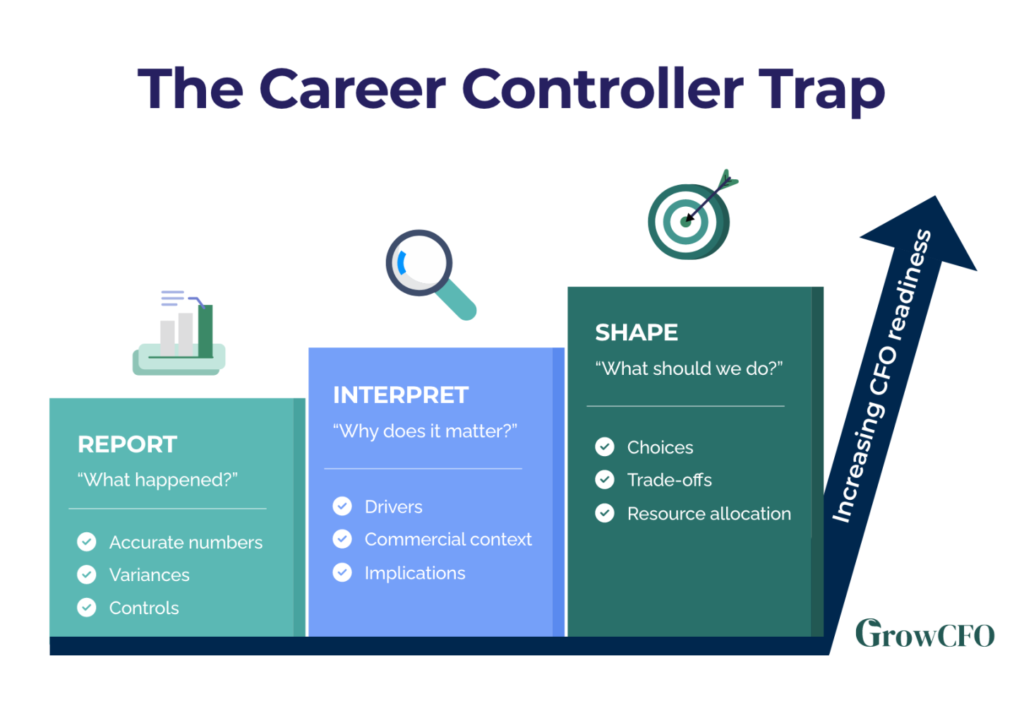
Your goal isn’t to stop doing the first two. It is to deliberately increase the amount of time, visibility and responsibility you have at the third.
What Level 1 looks like: REPORT
This is where many strong Financial Controllers build their reputation.
You report revenue against budget, produce monthly management accounts, explain variances, maintain controls, and ensure management has accurate information.
Imagine revenue is 8% below budget.
At the Report level, you might tell the leadership team:
“Revenue is 8% below budget, primarily due to weaker performance in the enterprise segment.”
However, this doesn’t help anyone decide on a course of action.
The career risk arises when reporting becomes the end of your contribution rather than the starting point.
Why Level 2 changes your value: INTERPRET
Interpretation connects financial data to business realities.
Instead of stopping at the variance, you investigate what is driving it.
For instance, enterprise revenue might not be down due to a weak market. The pipeline could be strong, but sales cycles have stretched from 60 to 85 days, shifting several major deals into the next quarter.
Now your contribution becomes:
“Revenue is 8% below budget, but pipeline value hasn’t deteriorated. The bigger issue is conversion timing: enterprise sales cycles have increased by 25 days, pushing several larger deals into next quarter.”
That changes the conversation.
You are no longer simply describing the financial outcome. You are helping management understand the business mechanics behind it.
But there is still another step.
How Level 3 demonstrates CFO capability: SHAPE
Shaping means using financial and commercial insight to improve a decision.
Take the same revenue problem.
Rather than ending with an explanation, you might say:
“Our analysis suggests the constraint is late-stage conversion rather than pipeline creation. Before increasing acquisition spend, I’d test whether reallocating resource towards enterprise deal support improves conversion speed. We should track sales-cycle length and late-stage conversion over the next six weeks before committing additional budget.”
Notice what changed.
You haven’t merely supplied information. You have:
- identified the commercial issue;
- challenged a possible response;
- suggested an alternative;
- connected resources to an outcome;
- proposed how management should test the decision.
That is much closer to how CFOs create value.
And you can start doing it before CFO appears in your job title.
Where to start: upgrade one recurring finance conversation
You don’t need a new role to practise this.
Start with one meeting, report or process you already own.
Choose something recurring — perhaps the monthly management meeting, forecast review, board-pack preparation or business-unit performance review.
Then force yourself to move through all three levels.
REPORT: What happened?
INTERPRET: What is really driving it?
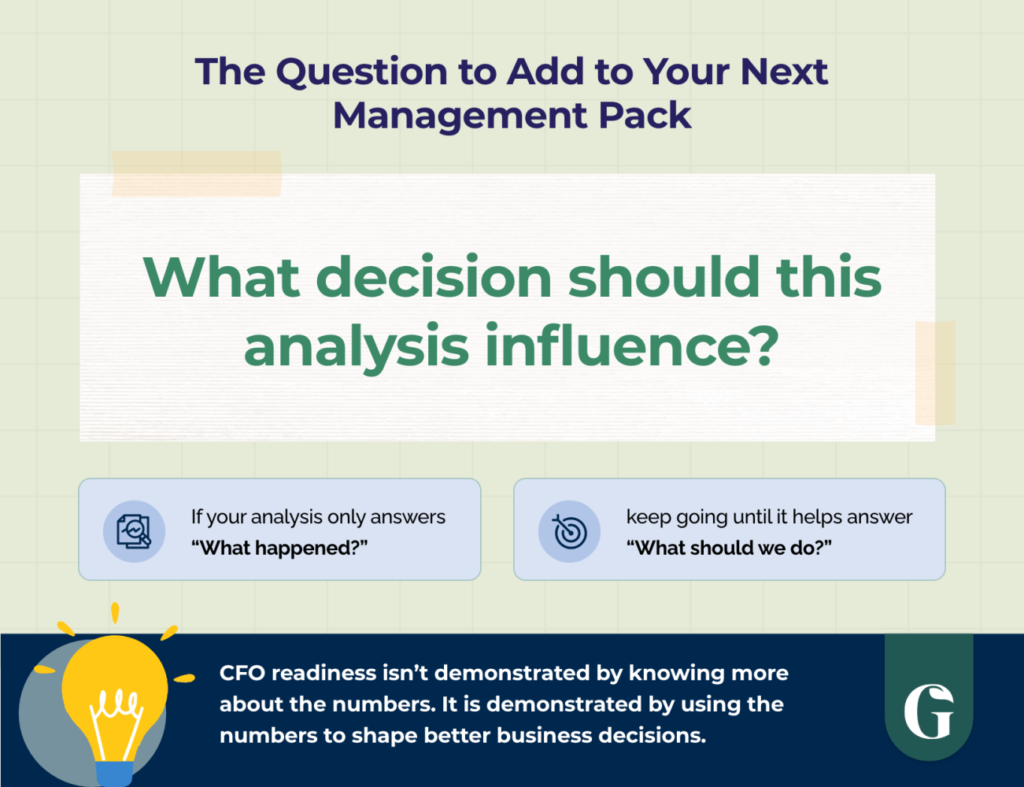
SHAPE: What decision should this analysis influence?
The third question is the important one.
If you cannot identify the decision, ask yourself why the information is being presented in the first place.
How to turn a management pack into a decision tool
One practical change you can make this month is to review every major page of your management pack and ask:
“What conversation should this page create?”
Suppose you currently have a page showing:
Gross margin: 42% Budget: 46% Variance: -4 percentage points
Don’t simply add more variance commentary.
Move through the framework.
REPORT: Gross margin is four percentage points below budget.
INTERPRET: The decline is concentrated in two lower-margin customer segments where discounting has increased.
SHAPE: Management needs to decide whether current discounting is generating enough incremental volume to justify the margin sacrifice.
The numbers haven’t changed.
The value of finance’s contribution has.
What to do this week
Pick one piece of analysis you are due to present and write three headings before doing any additional work:
1. What happened? Write the financial fact in one sentence.
2. Why does it matter? Identify the commercial driver and its consequence.
3. What decision could this shape? Write down the decision, trade-off or action management needs to consider.
Then make sure your analysis gets you all the way to question three.
This exercise also gives you a useful way to examine your own development.
Look back at the last five important meetings you attended. Were you mainly reporting, interpreting, or shaping?
You don’t need every contribution to be at Level 3. Accurate reporting remains fundamental. But if your ambition is CFO and almost all your value sits at Level 1, you have identified a development gap worth addressing.
The goal isn’t to become less rigorous as a finance professional. It is to build on that rigour by becoming commercially useful in a different way.
Is your finance process keeping you stuck in reporting?
Our latest survey of 273 finance leaders found that 68.9% say manual spreadsheet work is a weakness in their planning process, while 45.1% say too much time is spent producing numbers.
If finance is going to spend more time interpreting performance and shaping decisions, reducing that manual workload matters.
See how finance leaders are approaching this in our AI in Planning, Budgeting and Forecasting Survey 2026.
Read the full survey findings →
If you want to learn more about making the transition from reporting performance to shaping decisions, we develop these capabilities further in GrowCFO’s Future CFO Programme.
To learn more about the programme, join one of our free Future CFO Programme preview events.
Where are you spending most of your time today: reporting, interpreting or shaping?