CFOs Want AI in Planning, But Not a Black Box
Table of Contents
AI is rapidly changing expectations around planning, budgeting and forecasting. CFOs are being asked whether forecasts can be updated faster, whether scenarios can be modelled instantly, whether commentary can be generated automatically, and whether AI can help explain what is changing in the business.
But the latest GrowCFO survey of 273 finance leaders suggests a more grounded reality. Before finance teams can unlock the full potential of AI-enabled planning, many still need to fix the foundations of planning itself.
This article draws on the AI in Planning, Budgeting and Forecasting Survey 2026, an independent GrowCFO study of 273 finance leaders, sponsored by Acterys.
The message from finance leaders is clear: they want faster, more dynamic and more accurate planning. They want to spend less time collecting numbers and more time interpreting them. They want better scenario modelling, stronger business engagement and more reliable forecasting. But they do not want black-box automation. They want transparency, control, auditability and human judgement firmly built into the process.
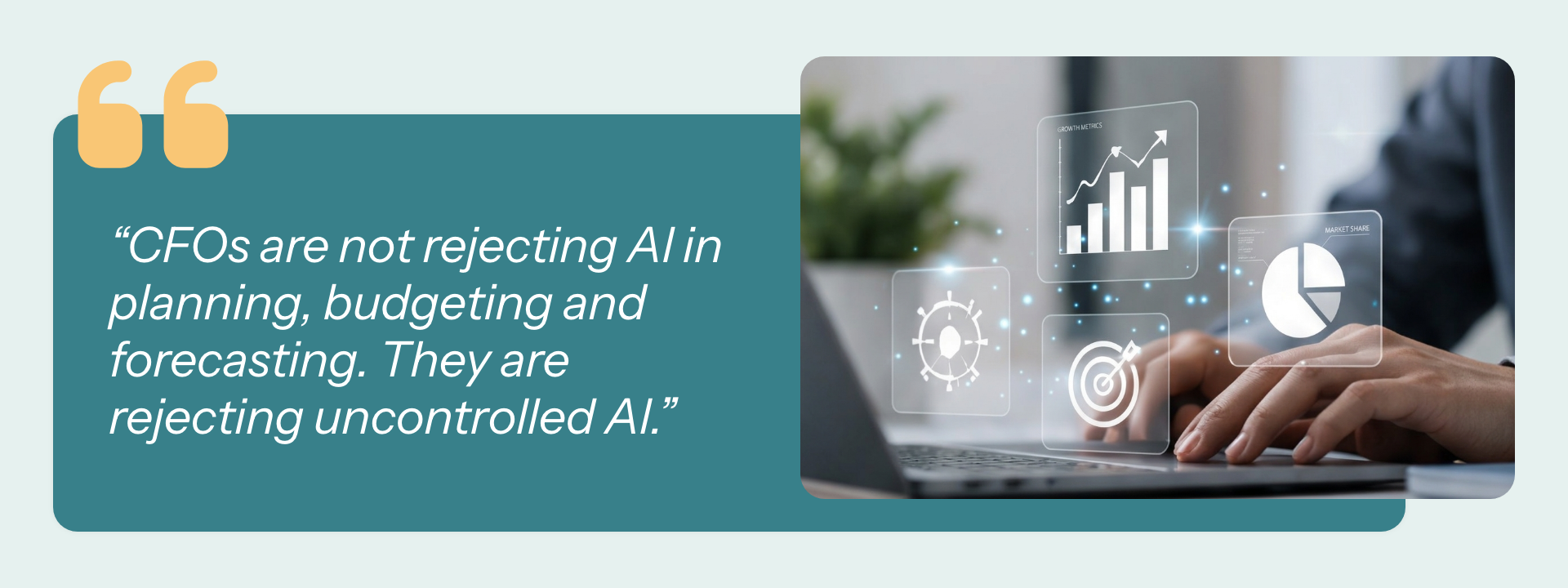
In other words, CFOs are not rejecting AI in planning, budgeting and forecasting. They are rejecting uncontrolled AI.
Spreadsheet-led planning is still the default operating model
Despite years of investment in ERP, BI, EPM and FP&A platforms, spreadsheet-led planning remains deeply embedded in finance teams. In the GrowCFO survey, 86% of respondents described their planning, budgeting and forecasting process as either mostly spreadsheet-based or spreadsheet-led with some ERP or BI input.
That finding matters. It shows that, for most finance teams, the planning process is still heavily dependent on manual models, offline data manipulation and spreadsheet-based consolidation.
This does not mean finance teams have failed to modernise. In many organisations, Excel continues to provide flexibility, familiarity and speed. It allows finance teams to build models quickly, adapt assumptions and work around gaps in source systems. The problem is not Excel itself. The problem is that spreadsheets are often being asked to do too much.
In many businesses, spreadsheets are not just modelling tools. They are being used to collect budget inputs, consolidate departmental plans, manage assumptions, reconcile actuals, produce scenarios, control versions and prepare reporting outputs. That creates fragility. It also makes the process harder to audit, harder to scale and harder to connect to live business data.
Several finance leaders told us they wanted to “move away from Excel,” “get it out of spreadsheets,” or create “one source of truth.” Others were more nuanced. They did not necessarily want to abandon Excel, but they wanted the flexibility of Excel combined with the integrity of a governed planning platform.
That distinction matters. The future of planning is unlikely to be a simple story of replacing spreadsheets. For many finance teams, the more realistic opportunity is to connect familiar finance workflows with governed data, controlled write-back, workflow, scenario modelling and BI integration.
AI is exposing weak planning foundations
One of the strongest findings from the survey is that the barriers to AI-enabled planning are not primarily AI barriers. They are planning barriers.
The most commonly cited weakness was manual spreadsheet work, selected by 69% of respondents. More than half, 52%, said it takes too long to produce or update forecasts. A further 45% said too much time is spent producing numbers and not enough time interpreting them. Poor integration with ERP, CRM or operational data and limited scenario modelling were each selected by roughly a third of respondents.
One thread runs through nearly all of these frustrations. Finance leaders are spending their days producing numbers rather than interpreting them, doing the assembly work instead of the advisory work they are there to do. That is the gap finance is asking AI to close, which is why reducing manual effort, not smarter algorithms, is what they say they want from it first.
There is also a people problem the technology conversation tends to skip. Nearly a third of respondents (31%) say budget owners do not engage properly with the plan, a quarter (25%) struggle to consolidate inputs from different teams, and 23% want AI to help non-finance colleagues engage with planning at all. A plan is only as good as the participation behind it, and for many teams that participation is the hardest part to secure.
These are not new problems. Finance leaders have been wrestling with them for years. What has changed is that AI raises the stakes. If an organisation has fragmented data, unclear assumptions and weak process ownership, AI will not magically create a trusted forecast. It may simply produce faster outputs from weak inputs.
That is why the AI conversation in planning, budgeting and forecasting needs to move beyond features. The question is not only whether AI can generate a forecast, explain a variance or draft commentary. The more important question is whether the organisation has a planning model that is connected, trusted and governed enough for AI to add value.
AI does not remove the need for planning discipline. It increases the importance of it.
The organisations best placed to benefit from AI will not necessarily be the ones with the most advanced AI tools. They will be the ones with clean data flows, clear ownership of assumptions, integrated actuals, disciplined model structures and a finance team that understands where human review is required.
Finance leaders want speed, but not uncontrolled automation
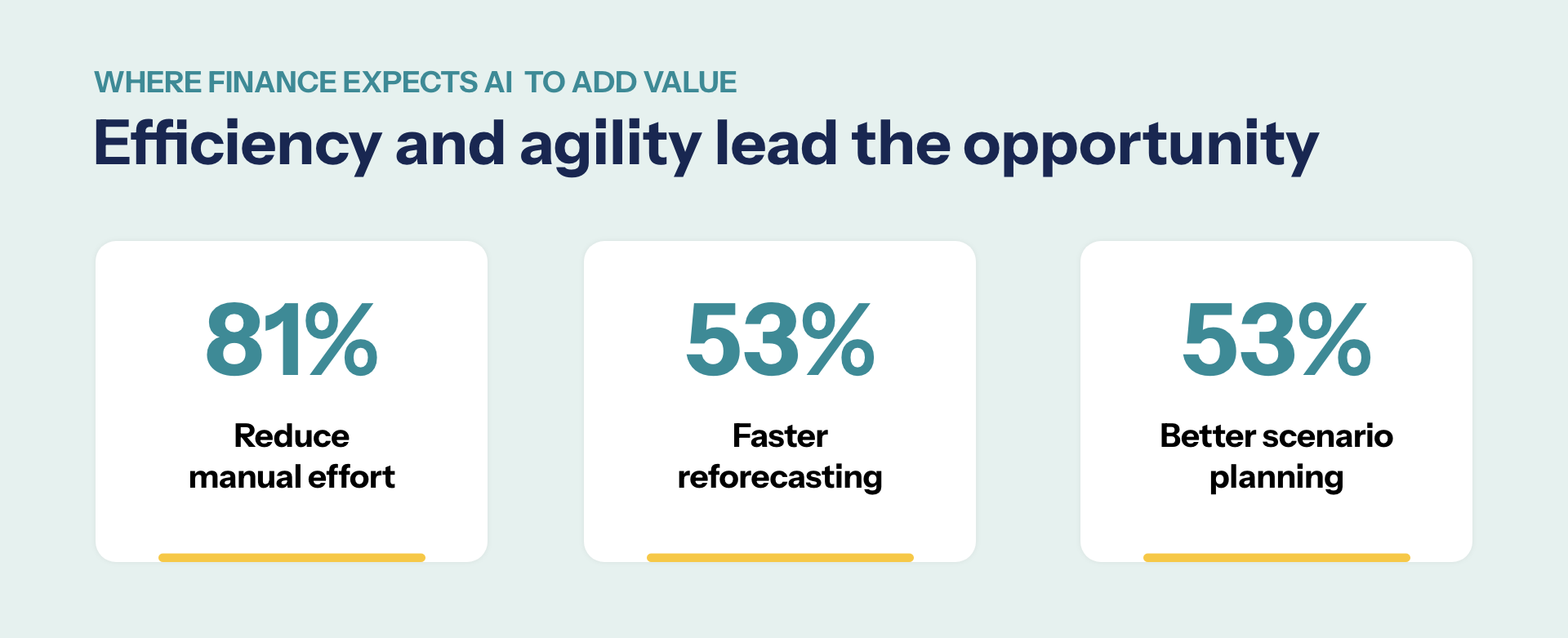
Speed was one of the strongest themes in the survey. When asked where AI could add the most value, 81% of respondents selected reducing manual effort. More than half selected faster reforecasting and improved scenario planning, at 53% each. Improving forecast accuracy was also a major theme, selected by 41% of respondents.
The cadence data shows why that pressure is building. Most teams still reforecast on fixed, infrequent cycles: 40% update their forecast only quarterly and a further 14% only annually, while just 11% reforecast continuously as assumptions change and only 2% do so weekly. When the business moves faster than the planning cycle, a forecast can be out of date before it is finished.
That is exactly where AI can help. It can support data cleansing, anomaly detection, variance explanation, forecasting, scenario generation, commentary and board reporting. It can help finance teams identify what has changed, challenge assumptions and focus attention on the areas that matter.
But the survey also shows a clear boundary. Finance leaders do not want AI to take control of the planning process without explanation or review.
When asked what would make them more comfortable using AI-generated forecasts or recommendations, respondents pointed to clear visibility of source data, transparent assumptions, human approval and audit trails. 55% selected clear visibility of source data, 50% selected transparent assumptions, 46% selected human approval before changes are adopted, and 44% selected a full audit trail of changes.
These responses are highly consistent with the role of finance. CFOs and FP&A leaders are accountable for the numbers. They need to understand the assumptions, explain the movements and defend the conclusions.
The message is not “let AI take over the forecast.” It is “help us produce better forecasts faster, while keeping finance in control.”
That is likely to define serious AI adoption in finance. The winning use cases will not be the ones that remove human judgement. They will be the ones that make human judgement better informed, faster and more focused.
AI maturity is still early
The survey also shows that AI adoption in planning, budgeting and forecasting remains at an early stage.
84% of respondents said their organisation is either not using AI, exploring possible use cases, or experimenting informally. Only 16% said they have AI embedded in parts of the process, use AI regularly with human review, or have AI central to their planning and forecasting process.
The pattern of use tells the same story. Where AI features today, it clusters at the edges of the process: ad hoc analysis in tools like ChatGPT (32%), drafting commentary (22%) and cleaning data (19%). The work finance most wants it for, forecasting and scenario modelling, is also where finance most intends to invest. AI is being used at the margins while finance wants it at the core.
This is an important finding for CFOs. The conversation around AI in finance has moved very quickly, but operating models have not yet caught up. Many finance teams can see the potential, but few have fully industrialised AI inside their planning cycle.
This should give CFOs confidence that they are not behind if they are still experimenting. But it should also create urgency. AI-enabled planning is no longer a distant future concept. It is moving from experimentation into practical adoption, and finance teams now need to decide where AI can genuinely improve the planning process.
The barriers are practical, not philosophical. Asked for the single biggest barrier to AI adoption, respondents pointed first to a lack of internal skills (22%), then security or confidentiality concerns (17%) and a lack of integration between systems (14%). Those three operational issues account for 53% of responses.
Scenario planning is where AI becomes strategically interesting
Much of the early discussion around AI in finance has focused on automation. That is understandable. Finance teams are under constant pressure to do more with limited resources, and the survey clearly shows frustration with manual work.
But the more strategic opportunity is scenario planning.
Finance leaders do not just want one faster forecast. They want to understand what could happen under different conditions. They want to model changes in revenue, pricing, margin, headcount, demand, cash, capacity and cost. They want to test assumptions with management teams and boards. They want to compare scenarios side by side and understand which drivers matter most.
This is where AI can move planning from static reporting to decision intelligence.
A traditional forecast often answers the question: “What do we currently think will happen?” AI-assisted scenario planning can help answer a more valuable set of questions: “What has changed? What assumptions are most sensitive? What risks are emerging? What happens if demand softens, pricing changes, hiring slows, costs rise or cash collection deteriorates? Which decisions should we consider now?”
That does not make the planning process less human. It makes it more strategic. AI can help finance teams explore more possibilities, but the CFO still needs to decide which scenarios matter, which assumptions are credible and which actions should follow.
The real promise of AI in planning is not that it creates a perfect forecast. It is that it helps finance teams explore multiple futures faster, with clearer assumptions and better business context.
Integration is the missing foundation
If there is one practical message from the survey for technology leaders, it is this: AI-enabled planning depends on integration.
Respondents repeatedly referred to the need to connect planning models with accounting systems, ERP, CRM, BI tools, operational systems and actuals. This also came through in investment priorities. When asked what type of improvement they were most likely to consider, the largest group, 36%, selected AI-enabled forecasting or scenario modelling. But many others selected ERP, CRM or finance-system integration, dedicated FP&A platforms, BI-linked planning, better use of Excel, or data warehouse and data-model improvements.
Power BI was the 2nd most common primary reporting tool after Excel, cited by 32% of respondents, and 1 in 10 named the ability to use their BI tool for planning as the improvement they most want. Finance is signalling that the place it already reports is a place it would like to plan.
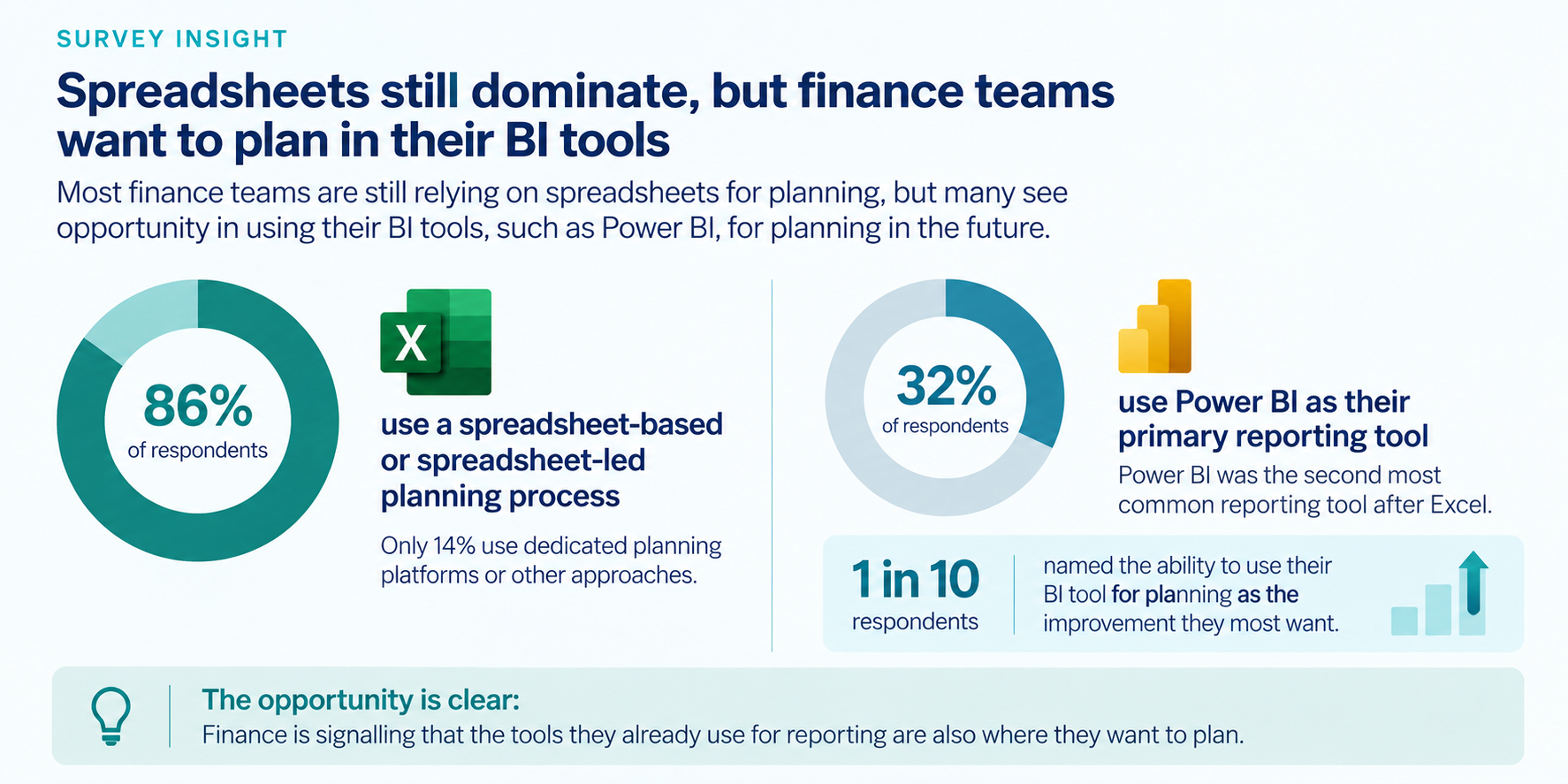
This is also why so much still happens in spreadsheets. Most reporting tools are read-only, so when a number needs to change, finance leaves the tool it was analysing in and rebuilds the change in a spreadsheet. That round trip is a large part of the manual effort the survey identifies as its top weakness.
That pattern is important. It shows that finance leaders do not see AI in isolation. They know that AI-enabled planning needs better data infrastructure around it.
Planning does not happen in isolation. Revenue forecasts depend on sales pipeline, customer behaviour, pricing and churn. Workforce plans depend on hiring, capacity, productivity and attrition. Cash forecasts depend on billing, collections, payables and working capital. Cost forecasts depend on procurement, commitments, usage and operational activity.
If these data flows remain fragmented, finance teams will continue spending too much time extracting, cleansing, reconciling and rekeying data. AI can assist with some of that work, but the bigger opportunity is to reduce the fragmentation in the first place.
This is also why finance keeps returning to the systems it already runs. Asked what would build their confidence in AI, respondents pointed to integration with existing finance systems and strong data security as much as to accuracy. Finance is unlikely to trust AI that sits apart from the tools, data and controls it already depends on, however capable that AI is on its own.
Human-in-the-loop is not a compromise. It is the control model
One of the most revealing questions in the survey asked whether finance leaders would trust an AI-generated forecast enough to present it to the board.
Only 5% said no outright. But that does not mean finance leaders are ready to present AI-generated forecasts without scrutiny. The dominant response, selected by 58%, was “yes, if reviewed and adjusted by finance.” A further 20% said yes if the assumptions and source data are transparent. Another 15% would only use it as a supporting input.
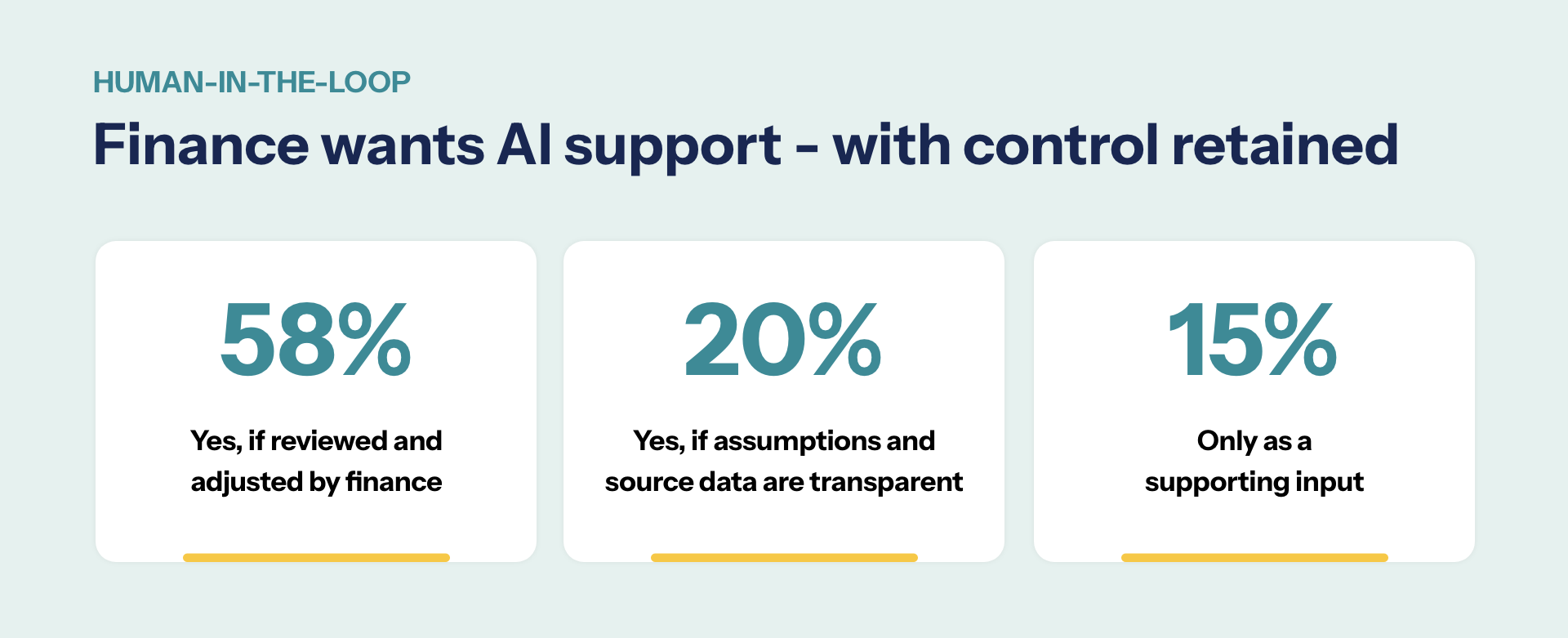
That is not resistance. It is responsible governance.
Planning, budgeting and forecasting influence decisions about investment, hiring, pricing, cost control, cash, capital allocation and performance management. These are not low-risk administrative activities. A poor forecast can lead to poor decisions. A forecast that cannot be explained can damage confidence. A forecast that changes without a clear audit trail can create governance problems.
For this reason, human-in-the-loop will be central to AI adoption in finance. AI may generate a recommendation, but finance must be able to review it. AI may identify an anomaly, but finance must interpret it. AI may suggest a forecast movement, but the CFO must understand whether it is commercially sensible.
The future CFO role is not to accept the AI forecast. It is to interrogate it.
What CFOs should do next
The survey suggests that finance leaders should approach AI in planning, budgeting and forecasting as a planning transformation issue, not simply a technology selection issue.
The first step is to identify where the current process loses time and trust. Is the biggest problem manual data collection, spreadsheet version control, poor budget-owner engagement, weak scenario modelling, slow consolidation, limited integration, unreliable data or lack of transparency around assumptions?
The second step is to select practical AI use cases. These may include variance explanation, scenario generation, anomaly detection, automated commentary, revenue forecasting, cash forecasting or assumption checking. The best starting point is usually a use case where AI can reduce friction without creating unacceptable risk.
The third step is to strengthen the foundations: connected data, clear model ownership, documented assumptions, audit trails, access controls and workflow. Without these, AI can become another layer of complexity on top of an already fragile planning process.
The fourth step is to define the control model. CFOs should be explicit about where AI can recommend, where finance must review, where business owners must validate and where formal approval is required.
The real opportunity: faster, trusted decision-making
The GrowCFO survey shows a clear gap between ambition and readiness. Finance leaders want AI to make planning faster, more accurate and more dynamic, but their biggest barriers are still the fundamentals: data quality, system integration, spreadsheet dependency, budget-owner engagement and trust.
That should not be seen as a negative finding. It is a call to action.
AI has the potential to transform planning, budgeting and forecasting, but only if it is connected to the way the business actually works. The next wave of innovation in FP&A will not be defined by AI features alone. It will be defined by how effectively finance teams connect data, govern assumptions, engage the business and turn forecasts into better decisions.
CFOs are ready for AI-assisted planning. But they are not asking for a black box. They are asking for planning that is faster, more connected, more explainable and more trusted.
That is where AI can make the greatest difference.
Read the full findings in the AI in Planning, Budgeting and Forecasting Survey 2026 report.
This research was based on an independent survey conducted by GrowCFO within its community, with Acterys serving as the research sponsor.