How to Know If You’re 12 Months Away from a CFO Role
How do you know whether becoming a CFO is realistically one year away or still several career moves away?
Job titles do not tell you much.
Two Finance Directors can have the same title while one is already operating close to CFO level and the other still needs significant exposure before taking the seat.
The better question is not:
How many years of experience do I have?
It is:
How much of the CFO role am I already practicing
You do not need to have done everything a CFO will ever encounter.
But if the role is genuinely within reach over the next 12 months, there are several things that should already be starting to happen.
Here are five signs to look for.
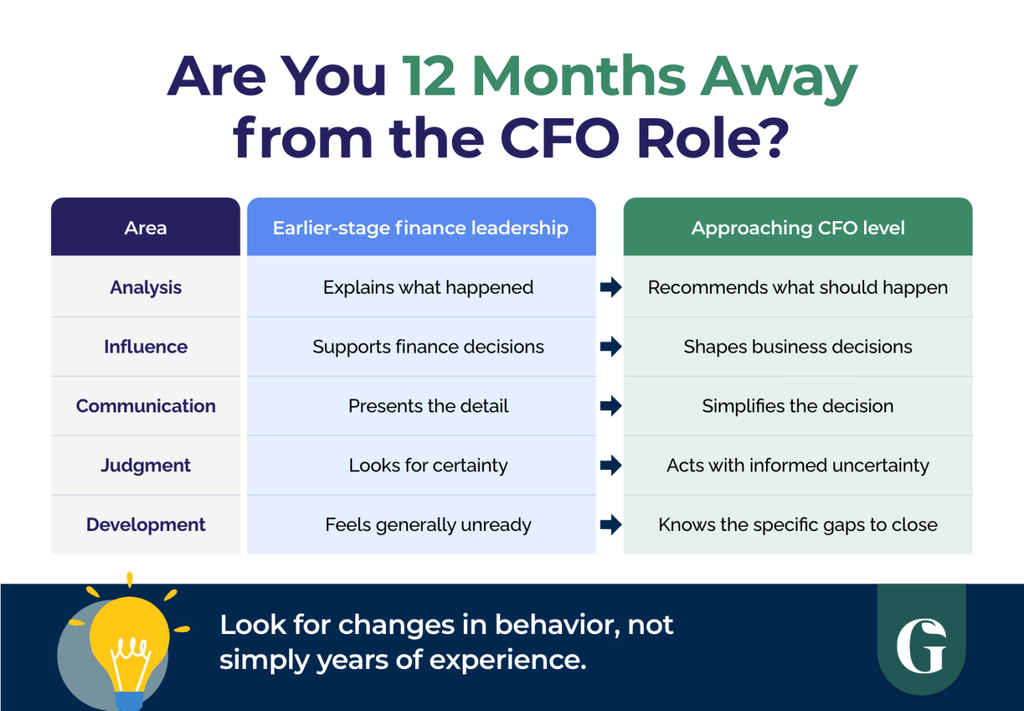
1. You are being asked for a recommendation, not just an explanation
Earlier in your finance career, your value often comes from answering questions accurately.
Why did margin fall?
What happened to cash?
Where are costs above budget?
As you move toward CFO level, the questions begin to change.
People start asking:
What do you think we should do?
That shift matters.
The CFO is expected to move beyond diagnosing the problem and help determine the response.
For example:
Finance update:
Gross margin is 180 basis points below plan because of discounting and product mix.
CFO-level contribution:
If current discounting levels continue, the business is unlikely to recover margin this year. The recommendation is to restrict discounts above 10% unless a deal meets an agreed strategic threshold.
One explains the result.
The other helps change it.
Test yourself
Think about your last three executive discussions.
How often were you asked for your judgment rather than your analysis?
If the answer is rarely, that is a capability you need to deliberately start building.
2. You are influencing decisions outside finance
A CFO cannot operate only inside the finance function.
They need to contribute to decisions about:
- pricing
- hiring
- commercial investment
- product decisions
- operations
- transformation
- risk
- capital allocation
- growth
That does not mean pretending to be the expert in every function.
It means understanding enough about the business to evaluate the financial and strategic consequences of different choices.
For example, the conversation should start moving from:
Marketing is £150,000 above budget.
To:
Marketing is £150,000 above budget, but the additional spend is producing pipeline ahead of target. I would protect this investment and find the cost reduction elsewhere.
The second statement requires you to understand the business outcome, not simply the budget variance.
Test yourself
Ask:
Which important business decisions would the leadership team currently involve me in even if there were no obvious finance question?
If the answer is very few, your next 12 months should include more deliberate exposure outside finance.
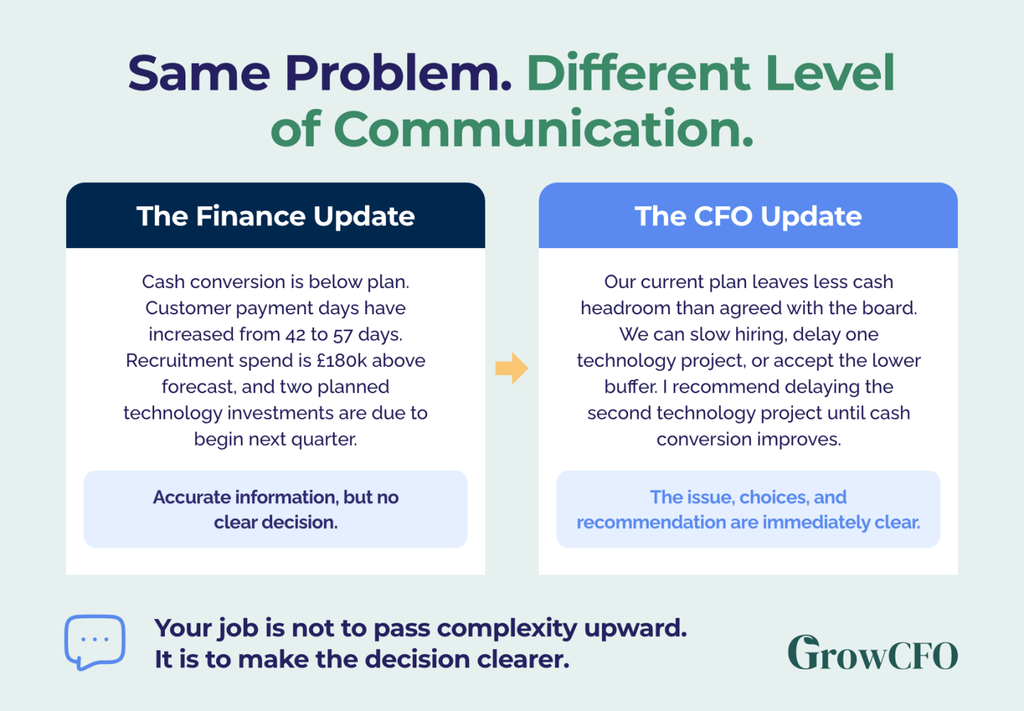
3. You can turn complexity into a clear decision
Senior finance roles expose you to increasingly complicated information.
CFOs cannot simply pass that complexity upward.
Imagine the business is facing:
- weaker cash conversion
- delayed customer payments
- an ambitious hiring plan
- two major technology investments
- slower-than-expected revenue growth
A technically strong finance leader may explain every element.
A CFO needs to identify what matters most.
For example:
We have enough cash to fund the current plan, but not with the level of headroom we agreed with the board. We have three realistic choices: slow recruitment, delay one of the technology projects, or accept the lower cash buffer. The recommendation is to delay the second technology project.
That is a much harder skill than producing the analysis behind it.
It requires prioritization.
Test yourself
Take your latest management report or board pack.
Can you reduce the main issue to:
- the decision required
- no more than three options
- your recommendation
- the biggest risk
If not, practice simplifying before you add more information.
4. You are comfortable owning a view when there is no perfect answer
One of the biggest transitions into the CFO role is moving away from certainty.
There are many decisions where the spreadsheet cannot give you the answer.
Should the business hire ahead of demand?
Should you accept lower margin to enter a new market?
Should you invest in a system now or protect cash?
Should you raise capital earlier than planned?
You can model the scenarios.
You can identify the risks.
But someone still needs to exercise judgment.
If you are approaching CFO readiness, you should increasingly be able to say:
Based on the information we have, this is the recommendation.
And then explain:
- why
- what could go wrong
- what assumption matters most
- what would make you change your position
You are not claiming certainty.
You are taking responsibility for a considered view.
Test yourself
Think about a recent decision with no obvious answer.
Did you:
A. provide the analysis and allow others to decide
or
B. provide the analysis and state what you believed the business should do?
If A is still your default, this is an important area to practice.
5. You can see your own readiness gaps clearly
Being close to CFO level does not mean believing you have mastered everything.
In many cases, the opposite is true.
You should have enough understanding of the role to identify where you still need exposure.
For example:
I am comfortable with board reporting and commercial decision support, but I have limited experience with fundraising and investor relations.
That is much more useful than:
I do not think I am ready yet.
One gives you a development plan.
The other gives you a feeling.
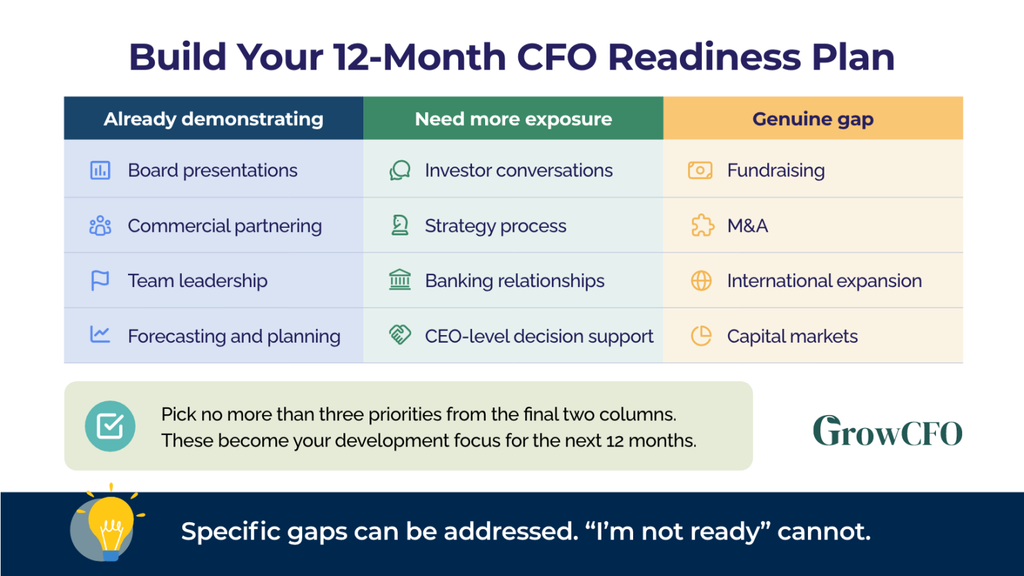
Here’s how to start
Create three columns
Your own list will be different.
The important part is separating things you have never done from things you simply do not feel completely confident doing yet.
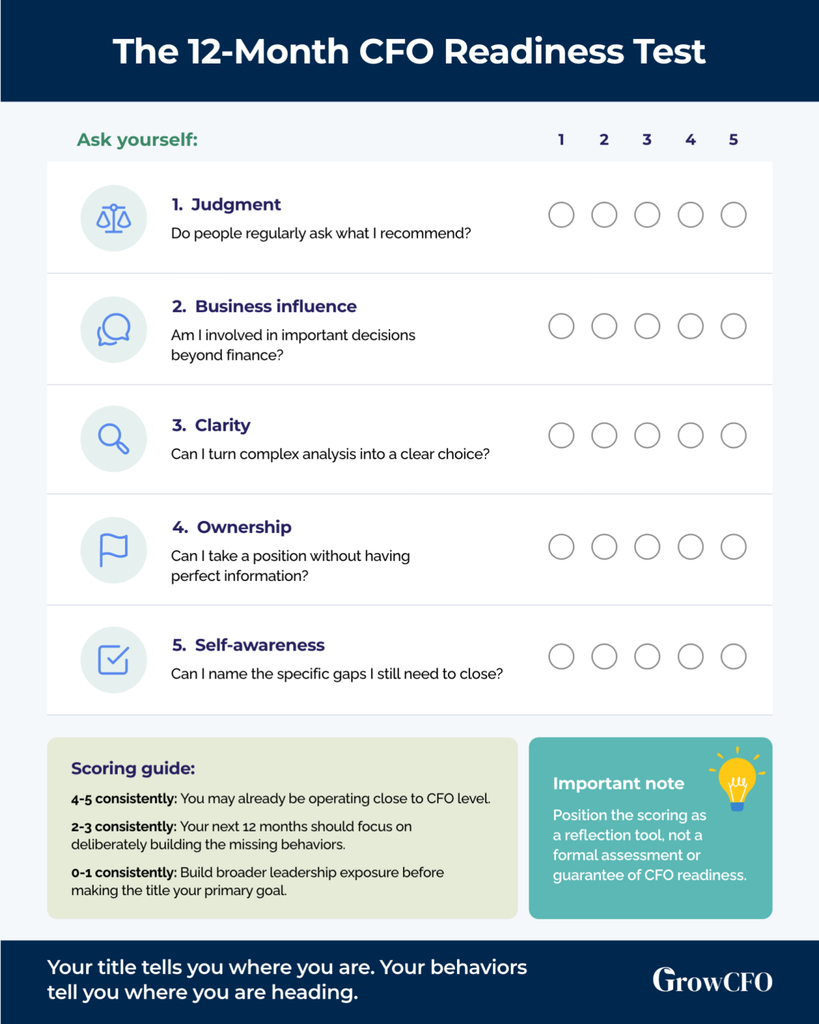
The 12-Month CFO Readiness Test
If you are seriously considering a CFO move within the next year, ask yourself:
- Judgment: Am I regularly giving recommendations, not just analysis?
- Business influence: Am I involved in major decisions outside finance?
- Clarity: Can I simplify complex issues into decisions and trade-offs?
- Ownership: Can I take a position when there is no perfect answer?
- Self-awareness: Can I clearly identify the few experience gaps I still need to close?
You do not need five perfect answers.
But if most of these behaviors are still absent from your current role, the next 12 months probably need to be about building them rather than simply waiting for a CFO vacancy.
The One Thing to Remember
Your distance from the CFO role is not best measured in years.
Measure it in behaviors.
If you are already shaping business decisions, making recommendations, simplifying complexity, exercising judgment, and deliberately closing your remaining gaps, the CFO role may be much closer than your current title suggests.
If becoming a CFO is one of your priorities over the next 12 months, the Future CFO Program is designed to help you identify and close those readiness gaps through practical development, peer learning, mentoring, and CFO-level application.
Learn more about the Future CFO Program at GrowCFO’s next preview event.