What Finance AI Tools Should Finance Teams Learn First?
What AI tools should finance teams learn?
Finance AI tools are rapidly becoming a core capability for modern finance teams. Whether the goal is faster reporting, better forecasting, stronger controls, or improved decision support, finance AI tools can help finance professionals automate routine work and focus more time on analysis and business partnering.The most valuable finance AI tools typically fall into five categories: Microsoft Copilot and Excel AI features, FP&A platforms with AI forecasting, AP automation solutions, close and consolidation software, and AI-powered business intelligence tools. The right finance AI tools depend on where your team is losing time, where risk is highest, and which processes create the greatest bottlenecks.
What Are the Best Finance AI Tools?
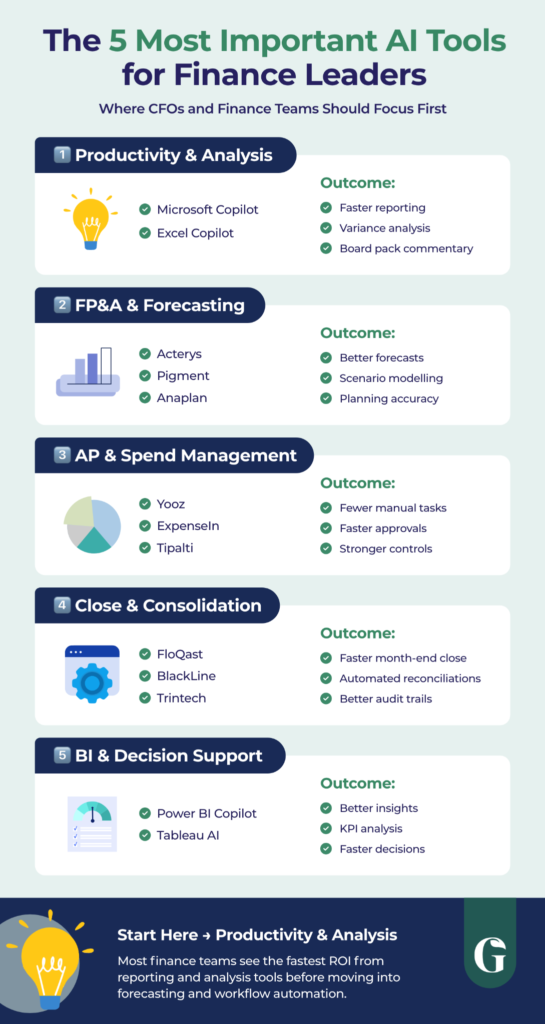
The best finance AI tools for most organizations are Microsoft Copilot, Power BI AI features, Acterys, Pigment, Anaplan, Yooz, ExpenseIn, FloQast, and BlackLine.
These finance AI tools help finance teams:
- Automate reporting
- Improve forecasting accuracy
- Reduce manual reconciliations
- Accelerate month-end close
- Strengthen controls
- Support faster decision-making
Key takeaway: Most finance teams should start with finance AI tools that improve reporting and analysis before expanding into workflow automation and advanced forecasting.
Why Should Finance Teams Learn Finance AI Tools Now?
Finance AI tools are moving from optional technology to an expected part of the finance toolkit.
Finance leaders are under pressure to deliver faster insights while managing increasingly complex datasets across ERP, CRM, payroll, and spend-management systems. Finance AI tools help teams meet these expectations without continually increasing headcount.
Finance AI tools also change stakeholder expectations. CEOs and boards increasingly expect finance to provide recommendations and forward-looking insights rather than simply reporting historical performance.
For CFOs and Finance Directors, finance AI tools offer three major benefits:
- Greater productivity
- Better decision support
- More time for strategic business partnering
At the same time, finance AI tools introduce governance challenges that require clear policies, controls, and accountability.
Which Categories of Finance AI Tools Deliver the Biggest Productivity Gains?
Most finance AI tools that generate measurable value fall into a small number of categories.
The finance AI tools delivering the largest productivity gains today are typically focused on reporting, forecasting, accounts payable, reconciliations, and decision support.
| Category | Example Finance AI Tools | Primary Benefit |
| Productivity & Analysis | Microsoft Copilot, Excel Copilot | Faster reporting and analysis |
| FP&A & Forecasting | Acterys, Pigment, Anaplan | Better planning and forecasting |
| AP & Spend Management | Yooz, ExpenseIn, Tipalti | Reduced manual processing |
| Close & Consolidation | FloQast, BlackLine, Trintech | Faster close cycles |
| BI & Decision Support | Power BI Copilot, Tableau AI | Improved business insights |
When evaluating finance AI tools, CFOs should focus on business outcomes rather than features.
What Finance AI Tools Should Finance Teams Learn First?
Finance AI tools should be learned in a sequence that matches the maturity of your finance processes and data.
Microsoft Copilot, Excel and Power BI
For most organizations, these finance AI tools provide the fastest route to productivity gains because they integrate into existing workflows.
FP&A Platforms with AI Capabilities
These finance AI tools support forecasting, scenario modelling, and planning decisions.
AP Automation and Spend Management Solutions
These finance AI tools reduce manual invoice processing and improve policy compliance.
Close and Reconciliation Platforms
These finance AI tools help shorten close cycles through automated matching and exception management.
Secure Enterprise AI Workbenches
These finance AI tools allow finance teams to use generative AI safely within approved environments.
How Do Finance AI Tools Compare Across Common Finance Use Cases?
Different finance AI tools are designed for different workflows.
| Use Case | Best-Fit Finance AI Tools | What Good Looks Like |
| Management reporting | Microsoft Copilot + BI tools | Faster commentary linked to KPIs |
| Forecasting | FP&A finance AI tools | Driver-based planning and scenarios |
| AP processing | Spend management finance AI tools | High automation with strong controls |
| Reconciliations | Close management finance AI tools | Automated matching and audit trails |
| Risk monitoring | Analytics finance AI tools | Actionable alerts and anomaly detection |
The best finance AI tools combine security, auditability, usability, and measurable business impact.
What Skills Do Finance Teams Need to Use Finance AI Tools Successfully?
Finance AI tools create the most value when teams develop the skills needed to use them effectively.
Three capabilities matter most:
- Prompt design
- Data literacy
- Control and governance design
Finance professionals should treat finance AI tools like junior analysts: capable of producing useful work quickly, but still requiring review and professional judgement.
What Governance Should CFOs Put in Place Around Finance AI Tools?
Finance AI tools require governance frameworks that balance innovation with risk management.
Every finance AI tools policy should address:
- Approved tools
- Data classification
- Acceptable use
- Review requirements
- Audit logging
- Security controls
Finance AI tools should never be used with sensitive data unless the environment has been approved and governed appropriately.
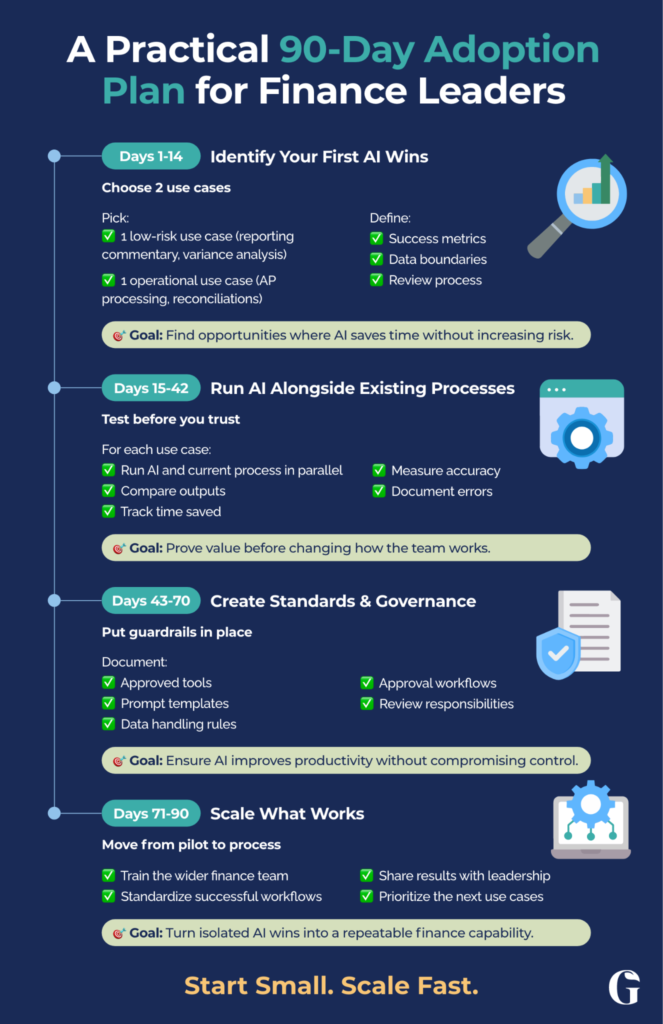
What Is a Realistic 90-Day Adoption Plan for Finance AI Tools?
The best finance AI tools implementations start with focused pilots.
Weeks 1-2
Select two finance AI tools use cases, define success metrics, and establish governance boundaries.
Weeks 3-6
Run finance AI tools alongside existing processes and measure time savings, quality, and risk.
Weeks 7-12
Standardize successful finance AI tools workflows, train the wider team, and identify the next opportunities for automation.
What Evidence Supports the Value of Finance AI Tools?
The value of finance AI tools is increasingly supported by research and real-world adoption.
Research from McKinsey suggests generative AI could contribute between $2.6 trillion and $4.4 trillion annually in productivity gains across industries.
For finance leaders, the opportunity is clear. Finance AI tools can reduce time spent on reporting, reconciliations, forecasting support, and information gathering while improving the speed and quality of decision-making.
The most successful finance AI tools initiatives focus on measurable outcomes rather than technology adoption alone.
Next Steps
Finance AI tools are quickly becoming a core capability for finance teams. Organizations that invest in finance AI tools skills today will be better positioned to improve efficiency, strengthen decision-making, and create more strategic finance functions.
Explore GrowCFO’s AI training and development pathways to build practical skills in finance AI tools, reporting automation, forecasting, prompting, governance, and finance transformation.