The AI-Ready CFO: How Finance Leaders Can Prepare for What’s Next
Table of Contents
AI is rapidly moving from boardroom conversation to everyday business reality. Across the organization, teams are experimenting with new tools, automating repetitive tasks and exploring how generative AI can improve productivity, insight and decision-making.
For CFOs, this creates both opportunity and pressure.
The opportunity is clear. AI has the potential to transform how finance teams operate. It can accelerate reporting, support faster forecasting, improve scenario modeling, automate routine tasks, and surface insights that would previously have taken days or weeks to identify.
But there is also a risk. Many organizations are racing towards AI adoption without a clear framework for maintaining trust, transparency and control, or a clear picture where AI can deliver the greatest value across the finance function.
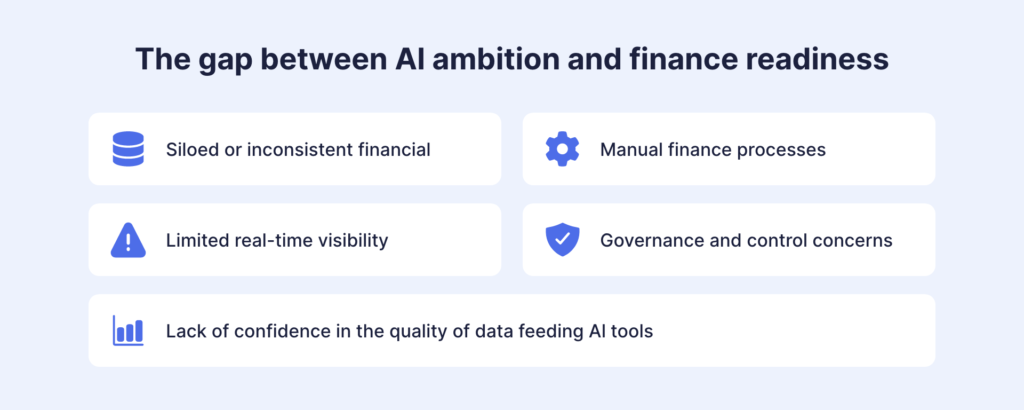
The danger lies in fragmented, inconsistent or poorly governed financial data combined with a continued reliance on manual processes. When underlying data is unreliable and continued reliance on manual processes. AI tools will struggle to generate accurate, reliable insights. Likewise, if reporting still depends on manual spreadsheet workarounds, AI may speed up isolated tasks without changing the underlying operating model. And when finance leaders lack confidence in the quality of the data feeding AI tools, they will struggle to trust the outputs those tools produce.
The question for CFOs is therefore not simply: “How do we adopt AI?”
The question that will truly make an impact is: “How do we build a finance function that is ready to unlock long-term value supported by AI and automation?”
Explore how a modern finance platform combines trusted financial data with AI-powered capabilities to help finance teams work more efficiently and strategically. Book a demo with AccountsIQ.
AI readiness starts with finance readiness
Finance leaders have always been custodians of financial data, control and performance insight. In an AI-enabled organization, that responsibility becomes even more important.
AI depends on data. Not just any data, but accessible, consistent, well-structured and trusted data. It also depends on clear processes, strong controls and a system architecture that enables information to flow across the business.
This is where many finance functions face a readiness gap.
They may have started experimenting with AI tools, but still rely on disconnected systems, manual reconciliations and periodic reporting cycles. They may have ambitions for continuous forecasting and real-time insight, but still spend too much of each month producing the basic numbers. They may want AI-supported decision-making, but lack a single reliable source of financial truth.
That creates a fundamental problem. AI can only be as effective as the environment in which it operates.
For CFOs, the immediate priority is not to chase every new AI tool. It is to assess whether the finance function has the data, systems, processes, and governance required for AI to deliver meaningful value.
The system of record still matters
Despite a growing reliance on AI for key operations, finance still needs robust systems of record that are human-controlled. Ledgers, controls, audit trails, reconciliations, approvals and statutory reporting do not disappear because AI has arrived. In fact, as AI becomes more embedded in workflows, the need for reliable, explainable and governed financial data becomes even greater.
The future finance architecture is likely to be more connected and more intelligent, but not less controlled. AI will increasingly sit around and above core finance systems, helping to automate work, interrogate data, identify anomalies, generate forecasts and support decision-making. But those tools need to be anchored in trusted financial data.
This is why the choice of finance platform matters significantly. A finance system that creates clean data with a clear audit trail, supports multi-entity reporting, integrates with other business systems and provides real-time visibility becomes a foundation for AI readiness.
Without that foundation, AI risks becoming another layer of complexity.
To explore how the right finance system can strengthen data quality, automation, and control, book a demo with AccountsIQ.
Automate the manual before chasing the magical
There is a temptation to view AI capabilities as a shortcut to financial transformation. But for many finance teams, the biggest gains still come from removing manual effort from core processes.
Reporting, consolidations, reconciliations, intercompany accounting, approvals and month-end close activities are often still too dependent on spreadsheets, email trails and individual knowledge. These processes absorb capacity and create risk. They also prevent finance teams from spending enough time on analysis, forecasting and strategic business partnering.
Before CFOs ask what AI can do, they should ask a more practical question: where and why are manual processes still being used by finance teams?
This matters because automation creates the capacity for AI to add value. If the finance team is constantly firefighting, it has limited bandwidth to redesign processes, interpret AI outputs or engage the business in better decision-making.
AI readiness is therefore not just a technology issue. It is an operating model issue.
Finance leaders should prioritize automation in areas where the benefits are clear: faster reporting, smoother close processes, better consolidations, improved accuracy and less reliance on manual workarounds. These improvements strengthen control, reduce pressure on teams and create the conditions for higher-value finance work.
Build a single source of financial truth
One of the biggest barriers to effective AI adoption is inconsistent data.
Many finance teams operate across multiple systems, entities, geographies and reporting structures. Data exists in ledgers, spreadsheets, CRM systems, billing platforms, payroll systems and operational tools. Different teams may define metrics differently, extract information at different points in time or maintain their own versions of the truth.
AI does not remove that problem. It magnifies it.
If the organization cannot agree on the underlying numbers, AI will not magically create alignment. It may simply generate faster answers from flawed inputs.
The CFO has a critical role to play here – leading the creation of a trusted financial data layer across the business. That means consistent definitions, strong governance, clear ownership, robust integration, and confidence that people are making decisions from the same information.
This is particularly important as finance moves beyond historic reporting. Forecasting, scenario planning, and predictive insight all depend on reliable data. The more forward-looking finance becomes, the more important it is that the underlying data is complete, connected, and trusted.
From reporting the past to shaping the future
AI has the potential to accelerate a shift that has been underway for years: the move from finance as a reporting function to finance as a forward-looking decision partner.
Traditional finance cycles are often too slow for today’s business environment. Monthly reporting, quarterly reforecasts and annual budgeting can feel increasingly out of step with the speed of operational decision-making.
The next stage is more continuous. Finance teams need to support rolling forecasts, rapid scenario modelling and earlier identification of risks and opportunities. AI can help by processing more data, identifying patterns, producing draft analysis and enabling faster modelling of alternative outcomes.
But human judgement and analysis remains essential.
CFOs cannot outsource accountability to an algorithm. Finance leaders will still need to challenge assumptions, validate outputs, understand model limitations and explain the implications to the board and executive team. The value of AI is not that it removes human judgement. It is that it gives finance leaders more timely information with which to apply that judgement.
This is where the role of the CFO becomes more strategic. The AI-ready CFO is not simply adopting tools. They are redesigning the finance function so that people, process, data and technology work together to improve decision-making.
Governance, control, and trust cannot be afterthoughts
Finance leaders are right to be excited about AI. They are also right to be cautious.
AI raises new questions about data security, explainability, auditability, model governance, and regulatory compliance. These questions are especially important in finance, where decisions affect reporting, cash, risk, funding, performance management, and stakeholder confidence.
CFOs need to ensure that AI is adopted responsibly. That means understanding where AI is being used, what data it can access, how outputs are validated, what controls exist, and who remains accountable for decisions.
The aim should not be to slow innovation. It should be to create the conditions in which innovation can scale safely.
Trust will become a major differentiator. Finance teams will need confidence that AI-enabled workflows are accurate, controlled and explainable. Boards will need confidence that AI is not creating hidden risks. Auditors and regulators will expect transparency over how financial information is produced and governed.
For CFOs, this makes AI governance a leadership issue, not a technical detail.
Four practical steps for CFOs
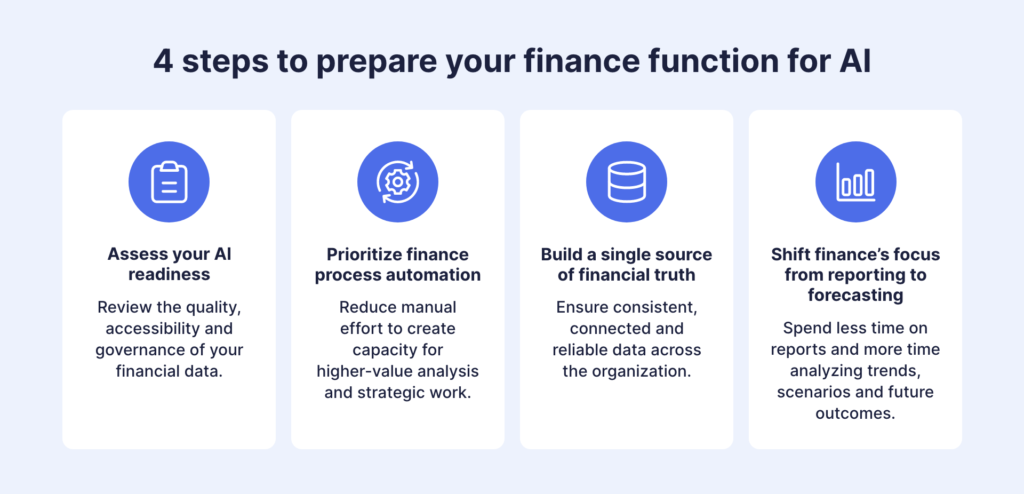
The path to AI readiness does not require finance leaders to have all the answers today. But it does require deliberate action.
- Assess the quality and accessibility of your financial data. Identify where data is duplicated, inconsistent, incomplete, or trapped in disconnected systems. Be honest about whether your current reporting environment could support reliable AI-enabled insight.
- Prioritize automation of core finance processes. Focus on the areas where manual work is creating delay, risk, or pressure on the team. Reporting, consolidations, reconciliations, and close processes are obvious starting points.
- Strengthen your single source of financial truth. Ensure that finance and the wider business are working from consistent, connected, and reliable data. This is essential for better reporting today and AI-enabled forecasting tomorrow.
- Shift the finance agenda from backward-looking reporting to forward-looking insight. Use technology to reduce time spent producing numbers and increase time spent analyzing trends, testing scenarios, and supporting decisions.
These steps are not glamorous. But they are the work that makes AI valuable.
The CFO’s role in what comes next
AI is shifting how finance operates, but the winners will not necessarily be the organizations that experiment first. They will be the organizations that build the strongest foundations and apply AI to the right problems.
For CFOs, this is a moment to lead and create systems that work together, improving daily operations for finance teams and the wider business
Finance has a unique view across the organization. It understands performance, risk, investment, controls and decision-making. That puts CFOs in a powerful position to shape the responsible and effective adoption of AI.
The AI-ready CFO understands that AI value depends on trusted data, automated processes, connected systems, strong governance and a finance team with the capacity to focus on higher-value work.
The future of finance will not be defined by AI alone. It will be defined by finance leaders who know how to combine technology, judgment and trust to help their organizations make better decisions.
Interested in what this could look like for your team? Book a demo with AccountsIQ.
For more insight on how finance leaders are preparing for the next stage of finance transformation, you can also:
- Listen to the GrowCFO Show episode with Darren Cran, CEO of AccountsIQ
- Explore AccountsIQ’s CFO Mindset Report 2.0 for further insight into how finance leaders are preparing for the next stage of finance transformation.