AP Automation Is Still the Best Place to Start — But Not the Place to Stop
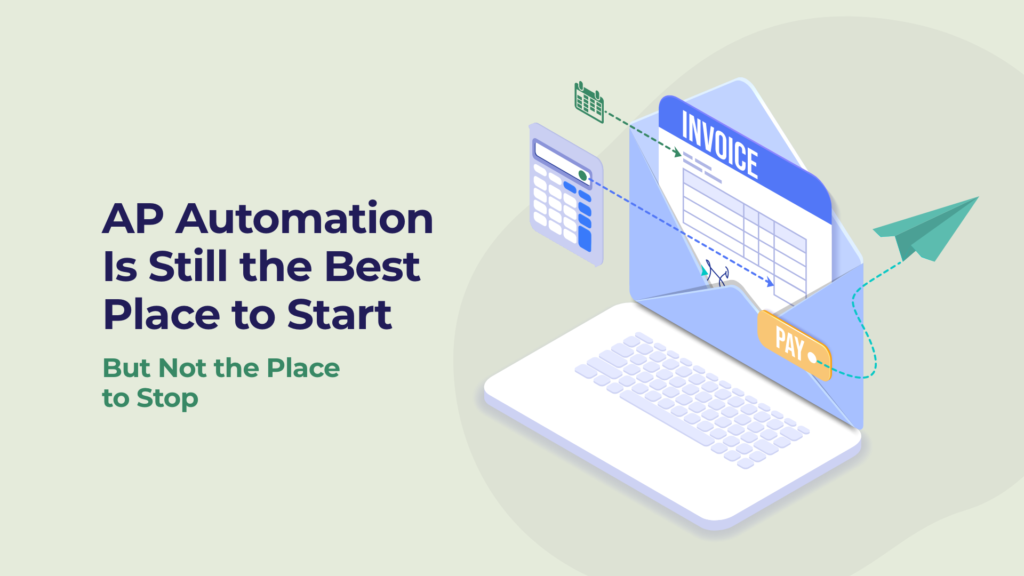
In the new GrowCFO Q2 Tech Innovation Report on Spend Management and Accounts Payable, one message comes through very clearly: the original case for AP automation has not gone away. If anything, it has become stronger. Manual invoice processing still creates delays, errors, fraud exposure, weak audit trails and poor visibility over committed spend. Finance teams are still spending too much time chasing approvals, resolving exceptions and trying to create reliable spend insight from fragmented data.
But the report also makes a second, more important point. AP automation is no longer the whole conversation. It remains a very good place to start, but the spend management agenda has broadened significantly. Finance leaders now need to think about AP, procurement, supplier management, SaaS renewals, AI usage, cloud consumption and technology-enabled spend as part of a connected control environment.
That shift matters because the CFO’s question has changed. The old question was, “What did we spend?” The new question is, “What have we committed to, who approved it, who is consuming it, what value are we getting and where is cost leaking?” AP automation can help answer part of that question, but it cannot answer all of it unless it sits inside a broader spend management model.
Manual AP is still more damaging than many leaders realise
The Q2 Tech Innovation Report highlights five persistent issues in AP and spend management: fraud exposure, inefficient processes, limited visibility, compliance and audit risk, and supplier or stakeholder friction. None of these are new, but they remain stubbornly common in many finance functions. Invoices still arrive outside agreed channels, purchase orders are missing or incomplete, approvals depend on email chains, supplier-bank changes are not always independently verified, and duplicate payment checks often happen too late.
These are not just administrative problems. They affect cash forecasting, supplier relationships, employee productivity, working capital, audit evidence and management confidence in the numbers. A delayed invoice can mean a missed discount, a late payment penalty, a disputed supplier relationship, an understated liability or a last-minute month-end surprise. A duplicated invoice may be small in isolation, but material when repeated across thousands of transactions.
The deeper issue is that manual AP weakens the organisation’s ability to see, challenge and control spend before cash leaves the business. By the time finance sees the invoice, the business may already have selected the supplier, agreed the work, received the service and created the liability. At that point, finance is processing a consequence rather than controlling a decision.
That is why AP automation still deserves attention. It addresses a very real operational problem, but it also creates the structured data, workflow discipline and exception visibility needed for stronger financial management.
Faster processing is not the full business case
The obvious argument for AP automation is efficiency. Finance teams should not be manually keying invoice data, chasing routine approvals, repeatedly checking supplier information or spending hours reconciling avoidable differences. Reducing that manual effort matters, particularly when finance teams are under pressure to do more without adding headcount.
However, the Q2 report is clear that the stronger business case is not simply speed. The real purpose of automation is to create a controlled digital pathway from purchase request to approval, receipt, invoice, payment and reporting. That pathway provides the audit trail, structured data and exception visibility that finance needs if it is to manage spend more effectively.
This distinction is important because it is entirely possible to automate a poor process and still be left with a poor process. If supplier records are unreliable, approval hierarchies are unclear, coding rules are weak or policy exceptions are routinely ignored, technology will not solve the underlying operating model problem on its own. It may simply make the weaknesses move faster.
The better question is not, “How do we process invoices faster?” It is, “How do we create a controlled digital pathway for spend?” That question immediately widens the conversation beyond AP processing and towards purchase-to-pay, supplier governance, budget ownership and spend visibility.
Automation should expose exceptions, not hide them
One of the most useful themes in the report is that automation delivers most value when it improves exception management. A good AP system should handle the easy work efficiently, but CFOs should be even more interested in how it handles the messy work. The real test is not what happens when an invoice arrives with a valid purchase order, clean supplier data, a clear approver and no matching issues. The real test is what happens when something does not fit.
That might be an invoice without a purchase order, a supplier-bank change, a duplicate invoice submitted with slightly different wording, an urgent payment request outside the normal process, a price or quantity mismatch, unusual coding, an absent approver or a policy exception that needs to be approved and evidenced. These are the points where finance processes usually break, and they are also the points where risk tends to sit.
The best AP automation does not simply push everything through faster. It makes exceptions visible, routes them to the right people, applies the right controls and creates a clear audit trail. That is where automation becomes a control mechanism rather than just a productivity tool. The CFO does not only need AP to be efficient. The CFO needs AP to be trustworthy.
This is an important point for anyone attending the GrowCFO Cost Management Tech Showcase on 24 June. When watching a vendor demo, the most useful question is rarely, “Can the system process an invoice?” Most modern AP tools can do that. The more useful question is, “Can the system handle our exceptions, with our approval thresholds, our controls and our reporting needs?”
Fraud prevention now needs a stronger 2026 lens
The Q2 report also updates the fraud conversation for 2026. Accounts payable teams have always been attractive targets because they control supplier records, payment runs and high-volume transactions. Traditional controls such as three-way matching, duplicate payment checks, segregation of duties and bank detail verification remain essential. The difference now is that fraud attempts can be more convincing and easier to scale.
AI-generated correspondence can imitate a supplier’s tone, generate plausible explanations, create supporting documents and personalise social engineering attempts. Voice and video manipulation also make informal approval shortcuts more dangerous. This raises the importance of robust supplier validation, independent call-back procedures for bank detail changes, approval thresholds for unusual payments, duplicate payment analytics, anomaly detection, role-based access and full audit logs.
The response is not to abandon automation. It is to build stronger control points into digital workflows. AI and automation can help identify duplicate invoices, unusual payment patterns, anomalous supplier behaviour and high-risk supplier-data changes, but alerts are not certainty. Finance teams still need to review context, contact known supplier representatives, challenge business users and intervene where urgency, authority pressure or unusual payment routes suggest heightened risk.
The principle is simple. Any change that affects who gets paid, how much is paid or when payment is made deserves proportionate control. AI can help finance detect the risk earlier, but judgement and accountability cannot be removed from the process.
AP data is the foundation for wider spend control
Another important point from the report is that AP data becomes much more valuable when it is structured, timely and connected. Once invoice data is reliable, finance can start to understand supplier concentration, category spend, recurring costs, payment behaviour, approval bottlenecks, policy exceptions and working capital opportunities.
That matters because many organisations still have a weak view of spend until after the event. They know what has been paid, but not always what has been committed. They know which supplier sent the invoice, but not always whether the spend was properly approved. They know what appears in the general ledger, but not always whether the business is duplicating suppliers, renewing unnecessary services or drifting outside policy.
The Q2 report argues that finance leaders need visibility over invoices, open purchase orders, committed spend, contracted spend, renewal dates, licence utilisation and AI usage. That is a much broader view than traditional AP reporting. It also reflects the reality that controllable cost is no longer limited to supplier invoices and purchase orders.
This is where AP automation becomes the foundation, not the destination. It creates part of the data layer required for wider spend control, but the next step is to connect AP with procurement, supplier management, budget ownership, SaaS spend, renewals, expenses, payments and reporting.
The agenda has broadened beyond AP
The Q2 Tech Innovation Report deliberately extends the spend management lens beyond supplier invoices. It highlights two newer issues that finance leaders now need to address: SaaS sprawl and AI cost leakage. These may not always sit naturally inside a traditional AP automation conversation, but they are rapidly becoming part of the CFO’s cost management agenda.
SaaS sprawl creates duplicated tools, unused licences, departmental buying, auto-renewals and weak offboarding. AI cost leakage creates a different set of problems: pilots that become permanent, embedded AI charges, unpredictable usage, unclear ownership and insufficient measurement of realised value. In both cases, the issue is not simply the invoice. The issue is the commitment, the consumption and the value being created.
That is why the report’s final message is so important: visibility first, control second, optimisation third. Without visibility, finance is guessing. Without control, the organisation may simply automate weak processes or allow spend to grow unchecked. Without optimisation, the business may fail to convert spend into measurable value.
AP automation fits into that sequence. It improves visibility over invoices and liabilities. It strengthens control over approvals, supplier records and payments. It creates data that can support optimisation. But it needs to be connected to the broader operating model if finance is to manage modern spend properly.
What CFOs should look for
When reviewing AP automation and spend management tools, finance leaders should look beyond the polished workflow. The right questions are practical and control-focused. Does the system handle real-world exceptions? Does it strengthen approvals, segregation of duties, audit logs and bank-change controls? Does it provide useful spend, supplier, SaaS, AI and renewal analytics? Does it connect cleanly with ERP, accounting, HR, procurement and identity systems? Can AI recommendations be explained, restricted, audited and costed? Are implementation, support, API, AI usage and renewal costs transparent?
Those questions come directly from the buying challenge highlighted in the report. No single solution fits every requirement. Finance leaders need to be clear about their needs, examine the alternatives and ask vendors to tailor demonstrations to the scenarios that matter most in their organisation.
That is particularly important because the procure-to-pay market is mature, but not every vendor will be equally strong across every capability. Some tools may be excellent at invoice capture and approval workflows. Others may offer stronger expense control, supplier management, procurement integration, SaaS visibility or AI-enabled analytics. The key is to understand what problem the organisation is really trying to solve.
Final thought
The case for AP automation and spend management has strengthened, not weakened. Manual processes still create cost, delay, risk and poor visibility. Procurement and AP still need to be connected. Finance still benefits from better controls, faster approvals, improved supplier relationships and more reliable data.
What has changed is the breadth of the opportunity and the risk. AI-enabled workflows can accelerate finance operations, but they also introduce new governance, cost and control questions. SaaS platforms can improve productivity, but they can also create sprawl, waste and hidden commitments. Technology spend is therefore becoming a mainstream finance issue.
AP automation remains one of the most practical places to begin. The business case is clear, the process pain is familiar and the benefits can be significant. But CFOs should avoid seeing it as a narrow efficiency project. The bigger opportunity is to use it as a foundation for stronger spend control across the organisation.
At the GrowCFO Cost Management Tech Showcase on 24 June, GrowCFO will be exploring exactly these themes from the Q2 Tech Innovation Report: AP automation, intelligent procurement, SaaS spend control, AI cost leakage and the finance leader’s role in creating better visibility, stronger control and clearer value from business spend.
If an AP process still depends on inboxes, spreadsheets and manual chasing, the showcase should provide a practical view of what modern tools can now do. More importantly, it should help finance leaders think about the bigger question: how can finance move from processing spend after the event to controlling it earlier, with better visibility, stronger controls and clearer insight into value?