What CFOs Do Differently in Their First 90 Days

The fastest way to fail your first 90 days is by trying to impress everyone instead of fixing friction.
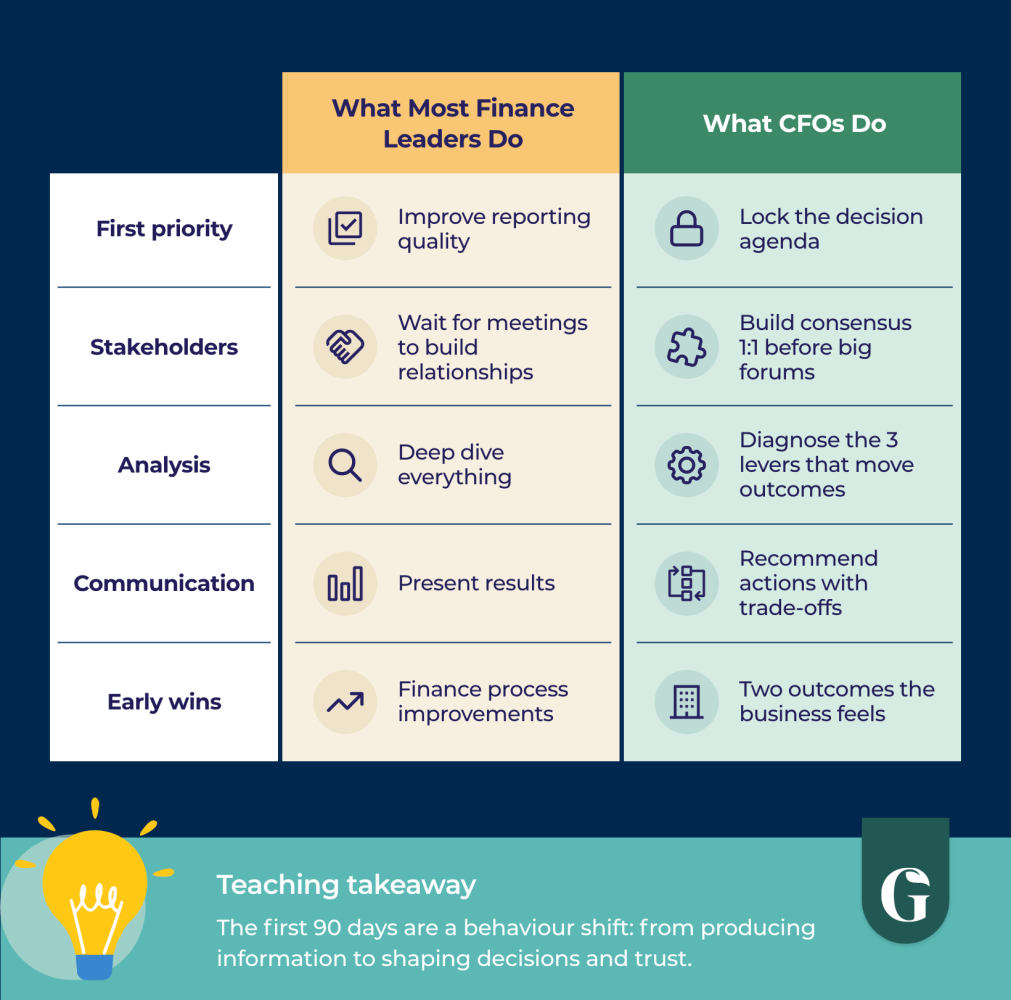
GrowCFO sees a consistent pattern when finance leaders step into bigger roles: the instinct is to fix finance first. The CFOs who establish themselves successfully take a different approach.
The problem is:
- You’re busy learning, but leaders still feel unclear.
- You’re producing more, but trust is not increasing.
- You’re improving reports, but decisions are not changing.
- You’re reacting to issues rather than shaping priorities.
- You’re hoping impact will appear over time.
For finance leaders looking to accelerate this transition, GrowCFO offers a free Preview Event featuring a live walk-through of the platform, simulators, and CFO Competency Framework.
The CFO’s First 90 Days Reality Check
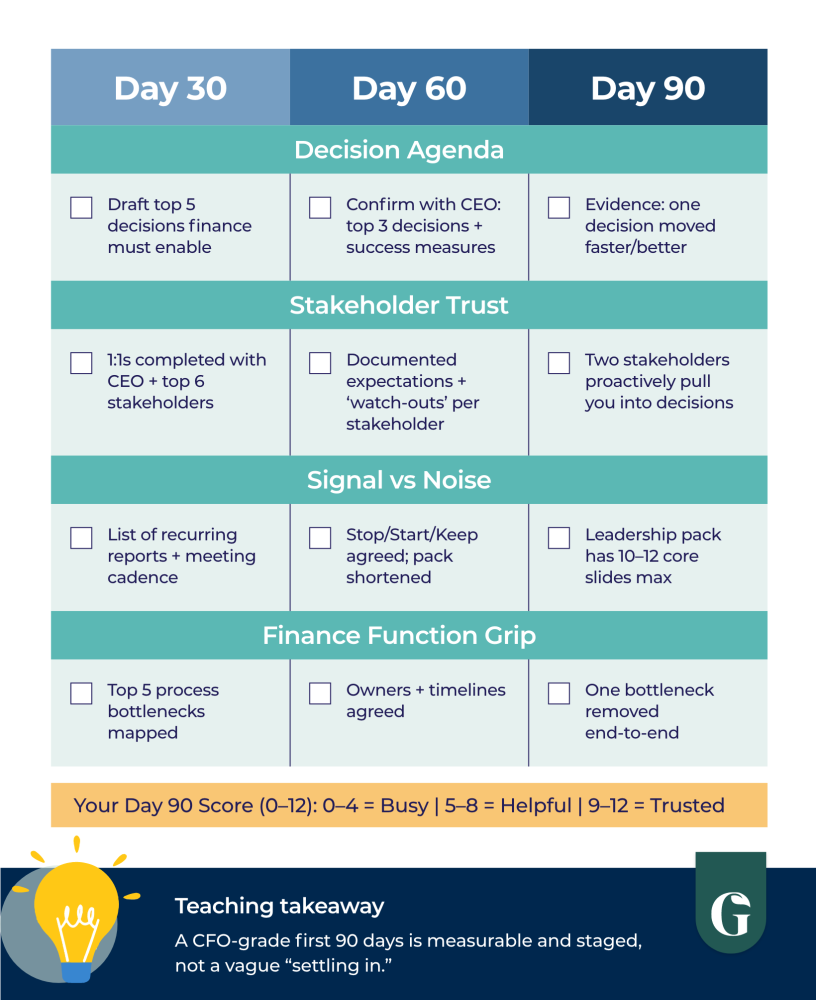
Agenda: Agree on the 3–5 decisions that matter most.
Stakeholders: Build trust one-to-one before relying on large meetings.
Diagnosis: Focus on value drivers and risks, not administrative tidying.
Simplification: Remove noise so leaders can make decisions faster.
Wins: Deliver two visible outcomes rather than a list of work in progress.
Cadence: Establish a weekly rhythm that makes progress inevitable.
The CFO First 90 Days Playbook (What To Do This Week)
1) Start with the decision agenda, not the finance agenda
Write down the five biggest decisions the business could make over the next 90 days—pricing, hiring, investment, cost reduction, product mix, or similar priorities.
Then reduce the list to three.
Micro-prompt:
“If we make these three decisions well, what changes for the business by quarter-end?”
2) Align expectations with the CEO in 30 minutes
Schedule a short conversation with one goal: defining what a successful first 90 days looks like.
Ask three questions:
What would make you confident recommending me to the board?
Which decisions do you want finance to improve?
What would you like to stop happening?
3) Map stakeholders before trying to influence them
Create a simple stakeholder map:
- CEO
- COO
- Sales Leader
- Product or Operations Leader
- HR Leader
- Chair or Board Contact (where relevant)
For each person, identify:
- How they prefer information (detail versus summary, written versus verbal)
- What they care about this quarter
- What they currently distrust or struggle with regarding finance
4) Diagnose value levers and risks in parallel
CFOs build credibility by understanding the commercial picture early.
This week, identify:
- Three value levers where profit or cash flow can move significantly
- Five key risks that could derail outcomes
Technique:
Create a one-page “Levers and Risks” summary that can be discussed confidently without relying on slides.
5) Reduce noise: Stop / Start / Keep reporting immediately
Review every recurring report and meeting produced by the finance team.
Highlight anything that does not lead directly to a decision, action, or accountability.
A practical experiment:
- Stop two reports for two weeks
- Shorten the board or executive pack
- Replace detailed content with supporting links where appropriate
The objective is not less information. It is more focus.
6) Deliver two visible wins that matter to non-finance leaders
Choose wins that other leaders experience directly, not just finance improvements.
Examples include:
- A clearer weekly cash view that changes spending behaviour
- A pricing or discount guardrail that protects margin
- A faster investment approval process that accelerates execution
Rule: Each win should have an owner outside finance who benefits from the outcome.
The Future CFO Program is structured around nine development modules and supported by practical tools such as the CFO Competency Framework and business simulators. These resources help finance leaders identify capability gaps and build the habits required for CFO-level performance. The “First 100 Days” component focuses on applying those capabilities under real-world leadership pressure.
For finance leaders who want help diagnosing gaps and building a practical CFO-ready development plan, the Future CFO Preview Event provides a detailed look at how the programme works.
P.S. This week: (1) Write your Day 90 definition of success in five bullet points. (2) Eliminate one recurring report that creates noise rather than action. (3) In your next executive meeting, add one simple sentence: “My recommendation is X, because Y.”