What will AI in finance look like in 2026?
What will AI and finance look like in 2026?
AI and finance in 2026 will be deeply integrated, shifting finance teams from reporting to real-time decision-making, automation, and strategic influence. AI will handle forecasting, anomaly detection, and reporting at scale, while finance leaders focus on judgment, risk, and business partnering. The biggest chang
How will AI and finance change the role of finance teams in 2026?
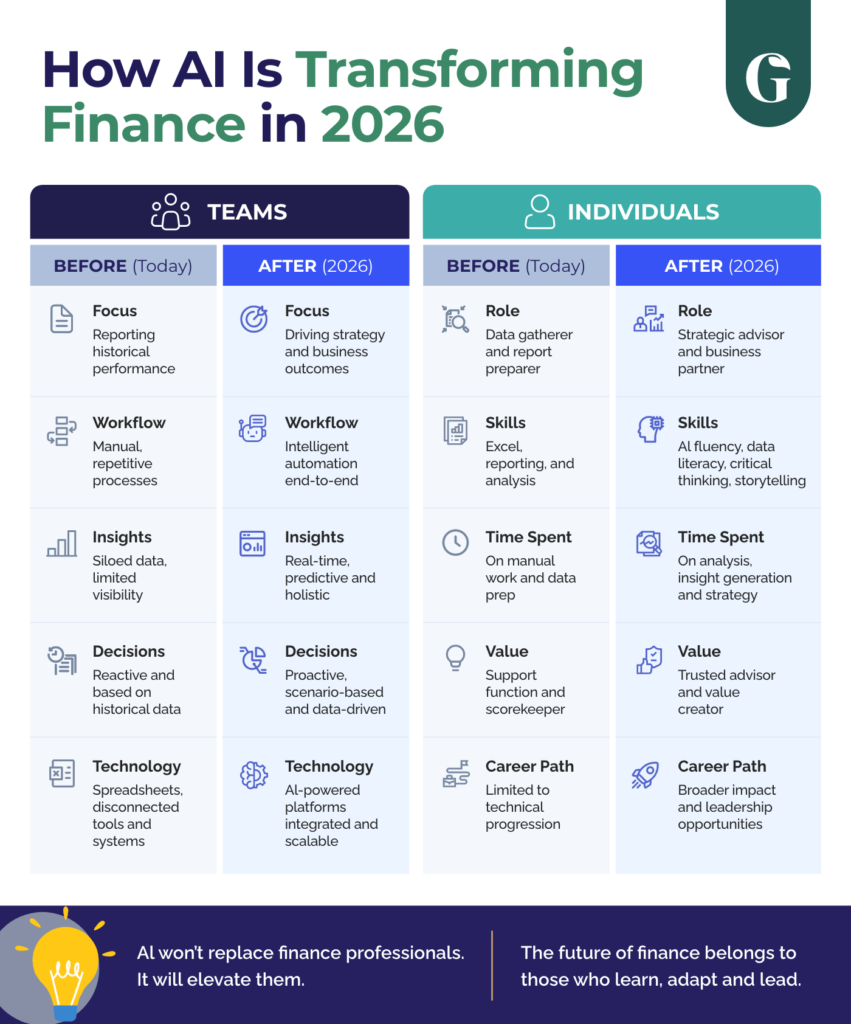
AI and finance in 2026 will fundamentally reshape what finance teams spend time on. Routine work such as reconciliations, reporting, and variance analysis will be largely automated, allowing finance professionals to operate as strategic advisors rather than data processors.
Research shows that AI adoption in finance is accelerating rapidly, with over 70% of financial services firms already using AI in some capacity, particularly in forecasting and risk management OECD overview on AI in finance. This shift means finance teams will be expected to interpret outputs, challenge assumptions, and guide decisions, not just produce numbers.
In practice, this means fewer manual tasks and more involvement in areas like capital allocation, pricing strategy, and growth planning. Finance becomes a decision function, not a reporting function.
What key AI capabilities will define finance in 2026?
AI and finance in 2026 will be defined by a few core capabilities that move beyond basic automation into intelligent decision support.
Key capabilities include:
- Predictive forecasting: AI models continuously update forecasts using real-time data instead of static monthly cycles
- Anomaly detection: Automated identification of unusual transactions, risks, or performance deviations
- Natural language reporting: AI-generated board reports and insights written in plain language
- Scenario modeling: Instant simulation of multiple business scenarios to support faster decisions
- Autonomous workflows: End-to-end processes such as accounts payable and close cycles running with minimal human input
A recent McKinsey report found that high-performing AI organizations are more likely to redesign workflows and embed AI into decision-making processes, helping teams improve speed, productivity, and business impact.
How will AI and finance impact CFO decision-making?
AI and finance in 2026 will not replace CFOs, but it will change how decisions are made. Instead of relying on historical reports, CFOs will operate with forward-looking, real-time insights.
This creates a shift from:
- Retrospective analysis to predictive insight
- Periodic reporting to continuous monitoring
- Data gathering to decision-making
Companies using AI in decision processes outperform peers in speed and quality of decisions, particularly in finance and operations.
The implication is clear. The value of a CFO will increasingly depend on their ability to interpret AI outputs, apply judgment, and communicate decisions clearly to stakeholders.
What will AI and finance workflows look like day-to-day?
AI and finance in 2026 will transform daily workflows into something far more streamlined and intelligent.
| Traditional Finance Workflow | AI-Enabled Finance Workflow (2026) |
| Monthly reporting cycles | Real-time dashboards and alerts |
| Manual variance analysis | AI-generated explanations and insights |
| Static budgets | Rolling forecasts updated continuously |
| Spreadsheet-heavy processes | Integrated AI platforms and automation |
| Reactive decision-making | Proactive, predictive planning |
This evolution reduces time spent on low-value tasks and increases time spent on interpretation and strategic input. Finance professionals will spend more time asking “what should we do?” rather than “what happened?”
What risks and challenges will AI and finance face in 2026?
AI and finance in 2026 will bring significant benefits, but also new risks that finance leaders must manage carefully.
The main challenges include:
- Model risk: Over-reliance on AI outputs without understanding underlying assumptions
- Data quality issues: Poor data leads to inaccurate insights, amplified at scale
- Governance and compliance: Increased scrutiny around AI decision-making and transparency
- Skill gaps: Many finance teams are not yet trained to work effectively with AI tools
Regulatory bodies are already emphasizing the need for explainability and accountability in AI systems, particularly in financial decision-making OECD AI governance principles.
This means finance leaders must balance innovation with control, ensuring AI enhances decisions rather than introducing new risks.
What skills will finance professionals need in an AI-driven future?
AI and finance in 2026 will demand a new skill set that combines technical awareness with strategic thinking.
The most important skills will be:
- Data literacy: Understanding how data flows, is structured, and impacts outputs
- AI fluency: Knowing how to use AI tools, prompt effectively, and interpret results
- Business judgment: Applying context and experience to AI-generated insights
- Communication: Translating complex outputs into clear recommendations
- Critical thinking: Challenging AI outputs rather than accepting them blindly
The shift is not about becoming a data scientist, but about becoming a more effective decision-maker in an AI-enabled environment.
How should finance teams prepare for AI and finance in 2026?
AI and finance in 2026 will reward teams that start early and build capability progressively rather than waiting for full transformation.
The most effective approach includes:
- Identifying high-impact use cases such as forecasting and reporting
- Training teams on AI tools and practical applications
- Embedding AI into existing workflows instead of replacing everything at once
- Building governance frameworks alongside adoption
Organizations that take a structured approach to AI adoption are more likely to see measurable ROI and avoid common pitfalls.
What does this mean for the future of finance leadership?
AI and finance in 2026 will elevate the role of finance leaders rather than diminish it. The CFO becomes a strategic operator who uses AI to enhance decision-making, not replace it.
The differentiator will not be access to AI tools, but how effectively finance leaders use them to influence outcomes, guide strategy, and create value.
If you want to stay competitive, the focus should be on building practical AI capability now, not later.If you are looking to understand your current skill gaps and start applying AI in real finance scenarios, explore the GrowCFO Academy where you can take your first course for free. If you are ready to transform your team’s capabilities at scale, the AI Finance Program is designed to help finance teams lead with AI in 2026.