How can AI support financial planning and analysis?
How can finance teams use AI in FP&A to improve forecasting, budgeting, reporting, and decision-making?
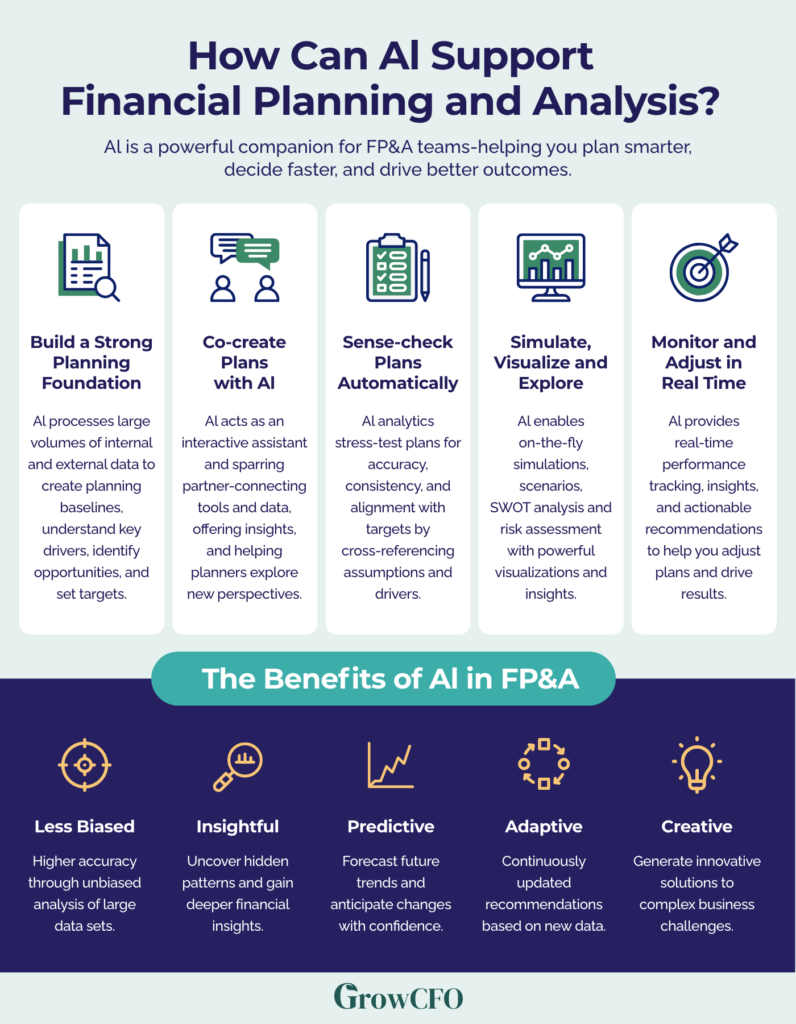
AI in FP&A is helping finance teams work faster, forecast more accurately, and make better decisions. By using AI for FP&A, businesses can automate repetitive tasks, improve scenario planning, and give finance professionals more time for strategic work.
Why Is AI in FP&A Becoming Essential for Finance Teams?
The expectations placed on FP&A teams have changed. Leaders now expect faster insights, stronger forecasts, and clearer recommendations. This is why AI in FP&A is becoming increasingly important.
Traditional planning cycles are often slowed by manual data gathering, spreadsheet complexity, and delayed reporting. AI for FP&A helps reduce these bottlenecks by processing large volumes of data quickly and highlighting trends humans may miss.
For modern finance teams, AI in FP&A supports a shift from backward-looking reporting to forward-looking strategic planning.
How Can AI in FP&A Improve Forecasting Accuracy?
One of the strongest use cases for AI in FP&A is forecasting. Many teams still rely heavily on static models and manual assumptions. AI can strengthen this process by identifying patterns across internal and external data sources.
With AI for FP&A, teams can:
- Detect seasonality and trends
- Continuously refresh forecasts
- Spot anomalies early
- Compare actuals against expectations
- Improve rolling forecast accuracy
This allows finance leaders to react faster when market conditions change.
According to global research from the Financial Planning Standards Board, 78% of professionals believe AI will help improve client service, while 60% believe it will enhance advice quality. The wider takeaway is that AI can strengthen professional decision-making when used effectively.
How Does AI for FP&A Strengthen Scenario Planning?
Scenario planning is now a core responsibility for FP&A teams. Leaders want to know how revenue changes, inflation, hiring shifts, or new investments may affect performance. AI in FP&A helps model these possibilities quickly.
Instead of rebuilding models manually, AI for FP&A can run multiple scenarios and compare outcomes in minutes.
| Scenario | How AI in FP&A Helps |
| Revenue decline | Models impact on cash flow and margin |
| Cost inflation | Tests pricing and cost responses |
| Hiring growth | Forecasts payroll and overhead impact |
| Expansion plans | Simulates investment returns |
| Currency movement | Assesses FX exposure |
This helps finance teams become more agile and commercially valuable.
Can AI in FP&A Reduce Manual Reporting Work?
Yes. Many teams spend too much time creating reports and too little time interpreting them. AI in FP&A can automate repetitive reporting tasks and free up capacity for higher-value work.
Examples of AI for FP&A include:
- Drafting monthly commentary
- Summarizing KPI changes
- Producing variance explanations
- Building dashboards faster
- Pulling insights across systems
- Highlighting unusual performance trends
This allows finance professionals to spend more time influencing decisions.
How Does AI for FP&A Improve Data Quality?
Better planning depends on better data. If data is incomplete or inconsistent, outputs become unreliable. A major benefit of AI in FP&A is the ability to identify anomalies and improve data integrity.
Examples include:
- Duplicate transactions flagged
- Missing data identified
- Outlier expenses highlighted
- Inconsistent coding detected
- Forecast assumptions checked against history
Cleaner data creates stronger planning foundations and more confidence in decisions.
Will AI in FP&A Replace Finance Professionals?
No. The most effective model is finance professionals working alongside AI.
While AI for FP&A can automate analysis and generate insights, people remain essential for:
- Strategic judgment
- Stakeholder management
- Communication with leadership
- Commercial trade-off decisions
- Governance and accountability
AI supports finance teams. It does not replace experienced finance leaders.
What Should Finance Leaders Prioritize First With AI in FP&A?
The best way to adopt AI in FP&A is to start with practical use cases that create visible wins.
A smart roadmap includes:
- Automate reporting commentary
- Improve forecast speed
- Introduce scenario planning tools
- Clean planning data sources
- Upskill teams on responsible AI use
This builds confidence and momentum across the finance function.
How GrowCFO Helps Finance Teams Build FP&A and AI Capability
GrowCFO helps finance teams strengthen FP&A capability while building practical AI skills that can be applied immediately across reporting, forecasting, planning, and decision-making.
Through the GrowCFO Academy, finance professionals can now access their first course completely free, including the opportunity to trial any of our 18 AI courses designed specifically for finance teams.
Explore the GrowCFO Academy and start learning practical AI for finance today.