How should finance teams be trained on AI?
How should finance teams be trained on AI to drive real business value?
Finance and AI training should be practical, role-specific, andembedded into day-to-day workflows rather than treated as theoretical learning. The most effective approach combines foundational AI literacy with hands-on use cases, enabling finance teams to automate processes, improve decision-making, and shift toward more strategic work.
Why Is Training Critical for Finance and AI Adoption?
Finance and AI initiatives often fail not because of technology, but because teams lack the skills and confidence to use it effectively. Research shows that up to 70% of digital transformation efforts fail due to people and process challenges, not tools
For finance teams, this is even more pronounced. Without structured training, AI becomes underutilized, misapplied, or avoided entirely. Training ensures teams can trust outputs, challenge insights, and apply AI within real business contexts.
What Skills Do Finance Teams Need for Finance and AI Success?
To make finance and AI work, teams need a combination of technical and strategic capabilities. The most effective training programs focus on three core areas:
1. Prompt Engineering and AI Communication
Finance professionals must learn how to interact with AI tools effectively. This includes writing clear prompts, refining outputs, and understanding limitations. Strong prompting enables faster analysis, better forecasts, and clearer data storytelling.
2. Data Interpretation and Judgment
AI can generate insights, but finance teams must validate them. This requires moving beyond traditional reporting into predictive and prescriptive thinking. Teams need to interpret AI outputs within real business conditions and challenge anomalies.
3. Automation Opportunity Identification
High-performing finance teams are trained to spot where AI can replace manual work. This includes processes like reconciliations, variance analysis, and invoice matching. Identifying the right use cases ensures AI delivers efficiency without compromising control.
According to industry research, organizations that focus on AI-specific skill development see significantly higher productivity gains and faster adoption rates
How Should Finance and AI Training Be Structured?
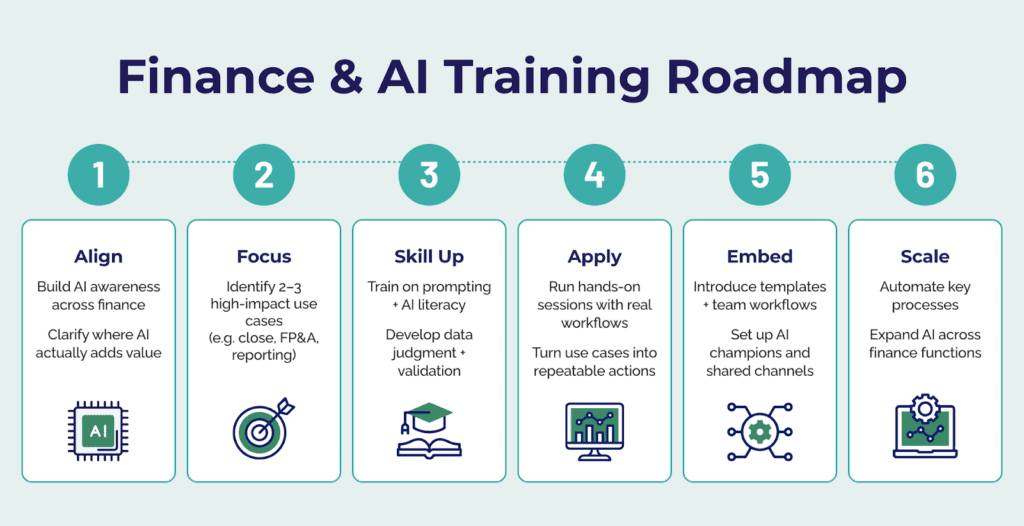
The most effective finance and AI training follows a layered, practical approach rather than a one-time course.
A Proven Training Framework
| Stage | Focus | Outcome |
| AI Awareness | Understanding AI capabilities and limitations | Reduces fear and resistance |
| Use Case Training | Applying AI to finance workflows | Immediate productivity gains |
| Hands-on Practice | Real tasks and exercises | Builds confidence and retention |
| Embedding & Scaling | Integrating into daily work | Long-term adoption |
This structured approach ensures training translates into behavior change, not just knowledge.
What Does a High-Impact Finance and AI Training Program Look Like?
The most effective programs are not generic. They are tailored to finance teams and focused on real workflows.
A practical rollout typically includes:
- 1-hour executive or company-wide session to align teams on what AI means for finance and where it creates value
- 2-hour hands-on workshop focused on finance-specific use cases like FP&A, reporting, and close processes
- Collaboration setup (Slack or Teams) with templates, champions, and ongoing learning frameworks
- AI hackathons or build sessions where teams create their own tools, such as custom GPTs or automation workflows
This approach ensures that finance and AI training is not passive. It becomes something teams actively use and build into their workflows.
How Can Finance Teams Apply AI in Real Workflows?
Training becomes effective when it is directly tied to real finance processes. Some of the highest-impact applications include:
- Month-end close: Automating reconciliations and variance analysis to reduce manual work
- Accounts payable: Matching invoices to payments and flagging discrepancies
- FP&A: Generating forecasts, scenarios, and narrative insights faster
- Reporting: Automating data preparation and commentary
These use cases allow teams to shift from manual processing to interpretation and decision-making, which is where finance adds the most value.
Research shows that automation in finance processes can significantly reduce errors and accelerate timelines, particularly in close and reporting cycles
What Are the Common Mistakes in Finance and AI Training?
Many organizations approach finance and AI training incorrectly, which limits impact.
Common pitfalls include:
- Treating AI as a one-time training session instead of an ongoing capability
- Focusing on tools rather than workflows and outcomes
- Not tailoring training to finance-specific use cases
- Failing to build internal champions or ownership
- Ignoring change management and team adoption
The result is predictable: low usage, skepticism, and minimal ROI.
How Can You Build Long-Term Finance and AI Capability?
Sustainable finance and AI adoption requires more than training. It requires embedding AI into how teams operate.
Key steps include:
- Creating internal AI champions within finance teams
- Building repeatable templates and workflows
- Encouraging experimentation and safe testing environments
- Continuously updating skills as tools evolve
This shifts AI from a project to a core capability within finance.
How Should You Start Training Your Finance Team on AI?
The most effective starting point is not complexity. It is clarity and action.
Start by identifying a small number of high-impact use cases, then train your team to apply AI directly to those workflows. Focus on speed, simplicity, and real outcomes.
You can run this playbook yourself, or if you need support, you can work with a structured program designed specifically for finance teams.
At GrowCFO, we help finance leaders build real finance and AI capability through practical, hands-on training. This includes tailored workshops, real use case implementation, and tools your team can apply immediately.If you want to move beyond theory and start seeing real results, explore how to implement AI in finance processes here.