The One Thing CFOs Misjudge as Companies Grow

Why smart CFOs still get caught out
Most finance mistakes aren’t technical, they’re made at the wrong stage of the business.
Early in my career, I treated every finance decision the same.
Later, I learned the hard way that timing matters just as much as technical correctness.
Most finance decisions don’t fail because the numbers are wrong. They fail because the numbers are right for the wrong stage of the business.
A control that protects cash early can suffocate growth later. A flexible process that enables speed in a scale-up quietly compounds risk once complexity sets in.
This is where CFOs get caught:applying yesterday’s logic to today’s reality and only realising it once the damage is already compounding.
The business lifecycle mistake CFOs make most often
Revenue size gets too much attention.
What matters more is:
- Complexity
- Repeatability
- Risk exposure
Two companies with the same ARR can require completely different finance decisions.
Lifecycle awareness is about matching capital, controls, talent, and decision criteria to where the business actually is, not where it used to be, or where leadership hopes it is.
The 5 business lifecycle decisions every CFO must recalibrate
1. Identify the real lifecycle stage
Ignore revenue alone. Ask:
- Is growth still fragile or genuinely repeatable?
- Are decisions reversible or structural?
- Is cash the constraint — or execution?
Misdiagnosis here breaks everything downstream.
2. Define the primary finance job
Each stage demands a different focus:
- Early: preserve runway and learning speed
- Scaling: protect unit economics and execution quality
- Optimising: extract efficiency and predictability
- Transforming: fund change without breaking the core
Trying to optimise for all four at once is where CFOs stall.
3. Change decision criteria, not just tools
The same metric means different things at different stages.
A 5% variance early might be noise. The same variance later may signal structural failure.
Judgment improves when decision thresholds evolve with the business.
4. Match controls to risk not comfort
Over-controlling early slows learning. Under-controlling later invites surprises.
Controls should scale with exposure, not anxiety.
5. Design the finance team for the next phase
Ask what the business will need 12–18 months from now, not what feels safe today.
- Generalists create momentum early
- Specialists protect scale later
Hiring too early or too late both carry hidden costs.
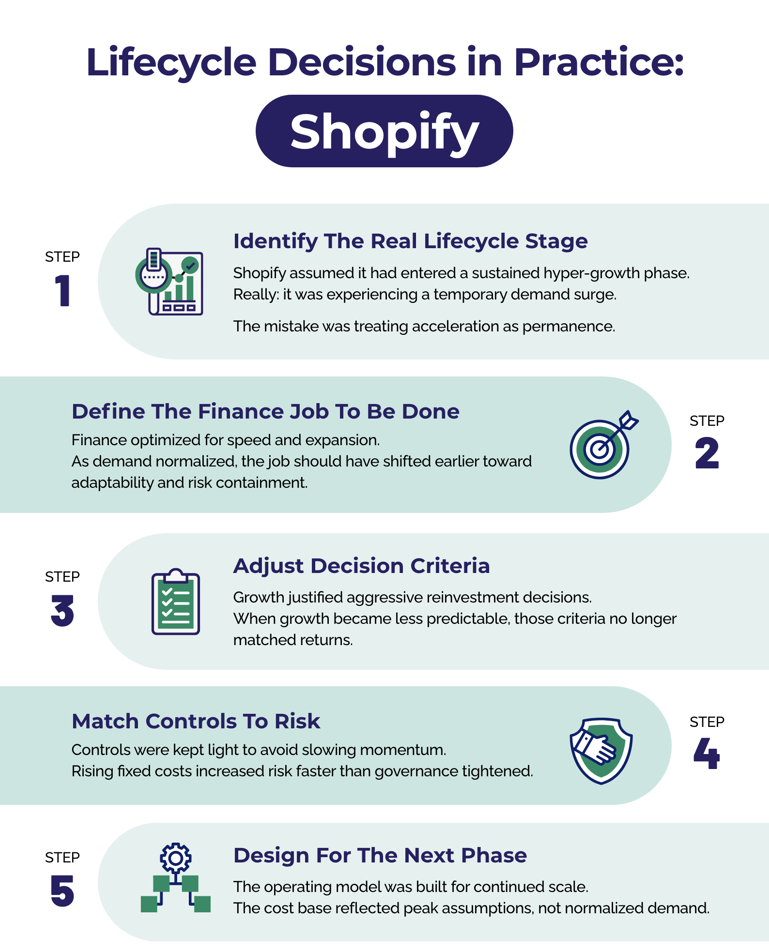
Lifecycle decisions in practice: Shopify
During the pandemic, Shopify experienced exceptional demand growth.
Finance decisions — cost base, investment pace, organisational scale — were set assuming that demand level was durable.
When growth normalised, those same decisions became misaligned.
This wasn’t a failure of modelling. It was a misread of lifecycle durability.
The lesson for CFOs isn’t “be conservative.” It’s stress-testing which assumptions are temporary and which are structural — before locking in cost, controls, and complexity.
The operating discipline most CFOs miss
Before finalising any major decision, pressure-test it with one question:
What does this optimise for now and what does it constrain later?
Good CFOs model outcomes. Great CFOs model consequences.
And because businesses move faster than org charts, lifecycle assumptions need revisiting quarterly, not annually.
Lifecycle awareness isn’t a one-off diagnosis. It’s an operating discipline.
Why this framework exists
One pattern we see repeatedly inside GrowCFO is this:
Finance leaders rarely struggle with technical capability. They struggle with knowing which judgment to apply, when.
As finance leaders progress through the Future CFO Program; from strategic leadership and executive presence to board-level decision-making. They are repeatedly exposed to situations where conditions shift, pressure rises, and ambiguity increases.
Lifecycle awareness is not taught as a standalone module. It shows up as a lens, helping leaders adjust their thinking as the business evolves, expectations change, and risk profiles shift.
Many participants describe this as the missing link between:
- Strong finance skills
- And consistent executive-level impact
If you want to understand how the Future CFO Program develops this kind of judgment over time, the Future CFO Preview Event is the right starting point.
You’ll walk through the program structure and modules, meet peers at a similar stage, and get clarity on how the journey prepares finance leaders for broader ownership and CFO-level impact.
Mini FAQ
Do I need a large team for this to work?
No. Most methods work for solo finance leaders and lean teams.
Does this replace financial expertise?
Never. It enhances influence so your expertise lands with more impact.
What if I already collaborate well?
Then these tools help you scale that influence across more teams, especially at senior levels.