What will the CFO role demand by 2027?

What the Future CFO Role Will Demand by 2027: 48% of Finance Leaders Say Faster Insight Is Already a Priority
You’re sitting in an executive meeting and the CEO asks whether the business should accelerate an investment, hold cash, change pricing or redirect resources.
You have the numbers. You can explain last month’s performance. You know where the variances are.
But that isn’t really what the CEO is asking.
They’re asking: What should we do next?
That distinction is becoming increasingly important for finance leaders.
Deloitte’s 2027 Finance Trends research, based on 1,434 finance leaders across 26 countries, found that 43% prioritise embedding AI and advanced technology to automate operations through FY2027. Meanwhile, 32% prioritise strengthening finance’s strategic influence across the enterprise, and 48% say finance needs to improve its responsiveness by providing real-time financial data and insights to the business.
The future CFO will still need strong financial control, technical credibility and reliable reporting.
But those capabilities increasingly become the foundation rather than the differentiator.
The differentiator is what happens after you know the numbers.
Why the future CFO will be judged by decisions, not reports
AI and automation are steadily reducing the value of finance work that consists primarily of collecting, processing and presenting information.
Deloitte reported in January 2026 that 87% of surveyed North American CFOs expected AI to be extremely or very important to finance operations during 2026, while 49% named automating processes to free employees for higher-value work as their leading finance talent priority.
That does not make finance less important.
It changes where finance creates value.
If producing information becomes faster, the scarce capability becomes interpreting that information commercially and helping other leaders decide what to do with it.
This is why aspiring CFOs should start developing what I call the D.E.C.I.D.E. framework:
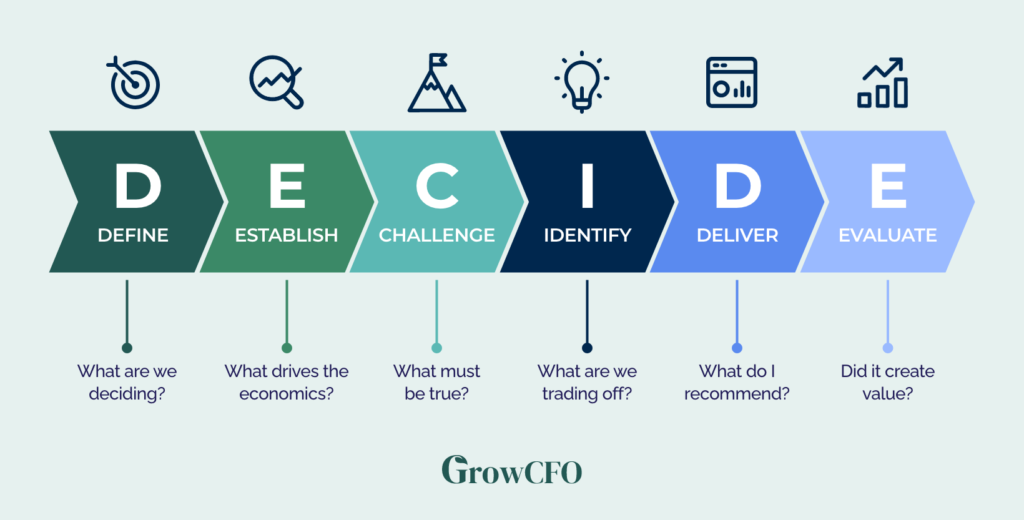
D — Define the decision E — Establish the economics C — Challenge the assumptions I — Identify the trade-offs D — Deliver a recommendation E — Evaluate the outcome
It is a simple way to move finance conversations from reporting performance to shaping decisions.
What: Define the decision before doing the analysis
Finance teams are often asked questions that sound analytical but are actually decision problems.
“Can you analyse customer profitability?”
“Can you model the new product?”
“Can you update the forecast?”
The danger is doing excellent analysis without establishing which decision it needs to support.
Before starting, ask:
What decision will this analysis change?
A profitability analysis might actually be needed to decide whether to increase prices, exit customers or redesign service levels.
A forecast might be needed to decide whether recruitment can continue.
An investment model might be needed to decide whether £2m goes into Project A, Project B or neither.
Once the decision is clear, the analysis becomes much more focused.
Here’s how to start: Before accepting your next major analysis request, rewrite it as a decision.
Instead of:
“Analyse the performance of Product X.”
Try:
“Should we continue investing in Product X at the current level, increase investment or redirect capital elsewhere?”
That is a much more useful question for finance to answer.
Why: Establish the economics behind the decision
Once you know the decision, identify the handful of economic drivers that actually determine the answer.
When evaluating new market entry, building complex models is less effective than identifying key economic drivers like customer acquisition cost, gross margin, scale timing, working capital, and volume probability. The goal is to make the core economics visible rather than creating exhaustive detail.
This is particularly important as CFO responsibilities expand. Deloitte found that 54% of surveyed finance leaders who lead responsibilities outside traditional finance are involved in cross-enterprise AI and technology capital allocation.
Finance increasingly needs to answer not only “Can we afford this?” but also “Is this the best use of our resources?”
How: Challenge assumptions before presenting conclusions
One of finance’s most valuable strategic contributions is challenging the assumptions sitting underneath an attractive business case.
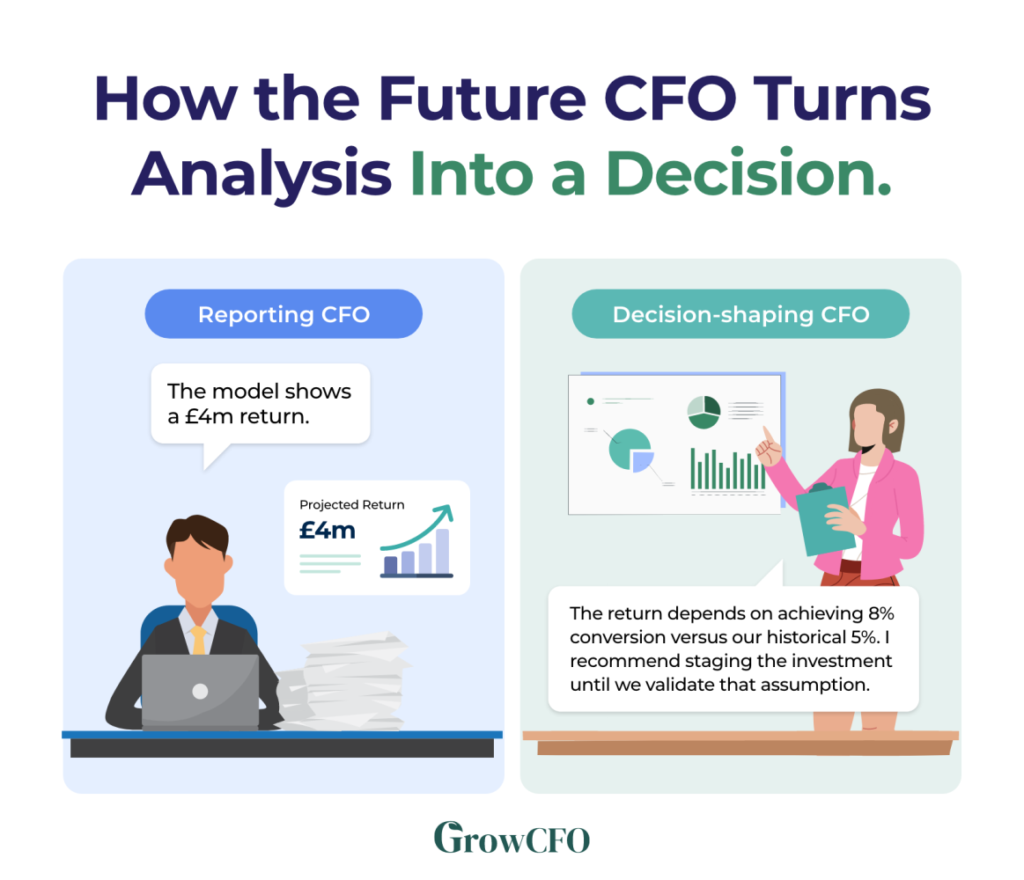
Imagine a proposal that promises a £4m return.
The headline number sounds compelling.
But perhaps £3m of that return depends on achieving a customer conversion rate the business has never achieved before.
The conversation should therefore move away from:
“The model shows a £4m return.”
Towards:
“The investment generates an attractive return if conversion reaches 8%. At our historical 5% conversion rate, the return falls substantially. The decision therefore depends on whether we have credible evidence that the new channel can close that gap.”
Instead of simply reporting your model’s answer, show management what needs to be true for the decision to work. Make the trade-offs clear, such as growth versus cash or speed versus control, so they understand what they are choosing between.
For example:
Option A: Accelerate now Higher near-term cash requirement, faster market entry, greater execution risk.
Option B: Stage the investment Lower initial exposure, slower growth, ability to validate assumptions before committing further capital.
Option C: Do not invest Preserves cash and management capacity, but potentially sacrifices the opportunity.
Reframing the discussion around these options shifts the focus from presenting financial analysis to supporting strategic decisions, which requires finance leaders to move beyond simply laying out the data and leaving the choice to others by offering a clear recommendation, even when some uncertainty remains.
It should explain what you recommend given the evidence available.
A useful structure is:
I recommend…
because…
the biggest assumption is…
the downside is…
we should reconsider the decision if…
For example:
“I recommend staging the investment because the economics are attractive but customer acquisition assumptions remain unproven. Commit the first £500k, test acquisition economics for 90 days and release the remaining capital if CAC stays below £X.”
Leaving leadership with a definitive direction is far more impactful than ending with:
“Here are three potential scenarios.”
E — Evaluate the outcome: Determine if the choice delivered real value
Organizations frequently skip the closing phase of the process.
Finance builds the financial model, leadership signs off, and everyone shifts focus to the next project.
Half a year down the line, rarely does anyone measure actual performance against the initial forecasts.
This omission deprives the business of a critical feedback loop for growth.
For every significant decision, record three things at approval:
What did we expect to happen? Which assumptions mattered most? When will we review them?
Then revisit the decision.
Did the expected value materialise?
Which assumptions were wrong?
What should change in the next investment decision?
This turns finance from a function that evaluates decisions once into a function that continuously improves the organisation’s decision-making.
How to practise this capability this week
Choose one item already coming through finance: an investment request, pricing proposal, forecast change, recruitment decision or cost-saving initiative.
Then put it through D.E.C.I.D.E.:
Define the actual decision management needs to make.
Establish the 3–5 economic drivers that determine whether it creates value.
Challenge the assumptions carrying the most risk.
Identify the genuine trade-offs between the available choices.
Deliver a clear finance recommendation.
Evaluate the decision later against the assumptions used to approve it.
You do not need to wait until you become CFO to start operating this way.
In fact, developing the capability before you have the title is the point.
The One Thing to Remember
The future CFO will not create the most value by knowing more numbers. They will create it by turning those numbers into better decisions.
AI can accelerate analysis.
Automation can accelerate reporting.
Dashboards can accelerate access to information.
But somebody still has to connect strategy, economics, risk and judgement and help the organisation decide where to act.
That is where the opportunity for the next generation of CFOs lies.
If you want to develop the skills required to move from finance expert to decision-shaping finance leader, we cover this kind of strategic capability in GrowCFO’s Future CFO Programme.
You can learn more about the programme by joining a free Future CFO Programme preview event: Book a free Future CFO Programme preview event
Which part of D.E.C.I.D.E. do you think finance leaders find hardest: challenging assumptions, exposing trade-offs or making the recommendation?