How do you build CFO-level credibility before you have the CFO title?

In a Deloitte survey of 200 CFOs, 39% say communication is the quality they value most in the next CFO.
Your CEO asks why margin is falling. You explain the numbers, and then they ask someone else what the business should do next.
That moment tells you a lot about your CFO readiness.
Because being trusted with the numbers is not the same as being trusted with the decision.
And if you’re waiting until you become CFO to start building that second kind of credibility, you’re waiting too long.
Why credibility comes before the title
There’s a useful signal in recent research.
Deloitte’s research also highlights three levers behind CFO-level influence: trust, having a clear point of view connected to business outcomes, and being present in the forums where decisions are shaped.
That matters because credibility at this level isn’t simply:
“Does this person know their finance?”
It’s:
“Would I involve this person before I make an important decision?”
That is a very different test.
And you can start passing it long before somebody changes your job title.
What is the CRED framework?
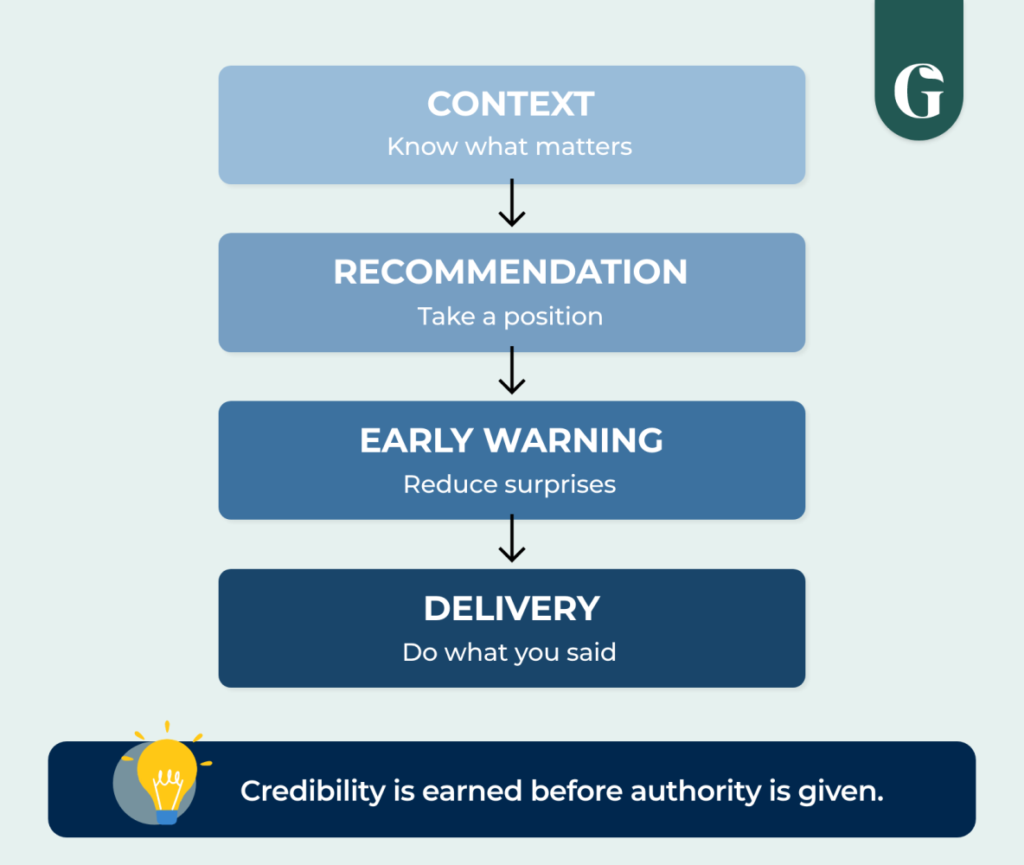
Think about CEO credibility as four behaviours:
C — Context: Understand what matters beyond the finance function. R — Recommendation: Bring a point of view, not just information. E — Early warning: Tell the CEO what they need to know before they need to ask. D — Delivery: Become predictably reliable on the commitments that matter.
You don’t need CFO authority to demonstrate any of them.
How do you demonstrate Context?
One of the fastest ways to remain positioned as “the finance person” is to answer every question through a finance lens.
Suppose the CEO asks:
“Can we afford to accelerate this product launch?”
A finance-only answer might be:
“We have sufficient budget, although it will increase operating costs by £400k.”
Technically useful.
But a future-CFO answer goes further:
“We can fund the £400k. The bigger question is whether accelerating by three months creates enough commercial advantage to justify using capacity we had earmarked for the second-half expansion.”
Same numbers.
Very different contribution.
The first tells the CEO whether there is money.
The second helps the CEO think about the trade-off.
Here’s how to start:
Before your next CEO conversation, write down three things:
What decision are they actually trying to make? What commercial outcome matters most? What trade-off does the financial analysis reveal?
Then build your contribution around those questions rather than around the spreadsheet.
Why should you bring a Recommendation?
Many aspiring CFOs believe credibility means being careful.
So they provide all the analysis and allow the CEO to decide.
But senior executives already have plenty of information.
What they increasingly need from finance is judgement.
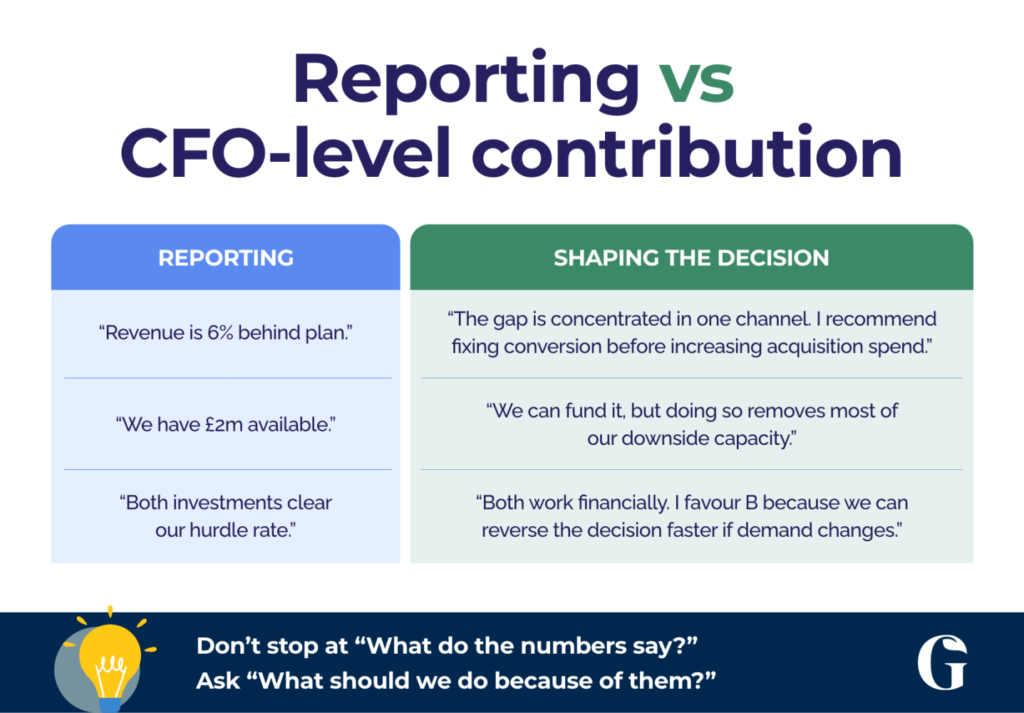
Instead of:
“Option A has a 19% return and Option B has a 16% return.”
Try:
“I recommend Option A. The expected return is stronger, but more importantly, it preserves our ability to delay the second phase if demand is weaker than forecast.”
Now you’re doing something different.
You’re combining finance, risk and commercial judgement into a point of view.
Your recommendation might be challenged.
That’s fine.
The objective isn’t to always be right.
It’s to demonstrate that you can turn evidence into a defensible position.
When should you give an Early Warning?
CEOs remember surprises.
Particularly the ones finance knew about first.
Imagine that your forecast suggests cash will become tight in four months.
You could wait until the forecast is fully validated.
Or you could say:
“This isn’t yet my base case, but I want it on your radar. If collections continue at the current rate, we could have a liquidity constraint in Q1. I’m validating the assumptions now and I’ll bring you options on Friday.”
Notice what that does.
You haven’t presented uncertainty as fact.
You’ve separated the signal from the conclusion.
And you’ve given the CEO time to think.
Credibility grows when the CEO starts believing:
“If something important changes, finance will tell me early.”
Create a simple threshold for yourself:
If this becomes true, would the CEO wish they had known about it two weeks earlier?
If the answer is yes, consider raising the signal.
How does Delivery turn trust into credibility?
There’s a less glamorous part of becoming CFO-ready.
Do what you said you would do.
If you tell the CEO:
“I’ll come back tomorrow with three scenarios.”
Come back tomorrow with three scenarios.
If you promise:
“I’ll find out what is driving the margin decline.”
Don’t return with another dashboard.
Return with the answer.
Small commitments compound.
And this is where some aspiring CFOs make a mistake: they focus heavily on increasing their visibility with the CEO.
But visibility without reliability can damage credibility.
You want the CEO to experience a consistent pattern:
You understand the issue. You form a view. You flag problems early. You follow through.
That pattern is CRED.
Where can you practise this in the next 7 days?
Don’t ask for more executive exposure just for the sake of exposure.
Use the exposure you already have differently.
Choose one live business decision this week.
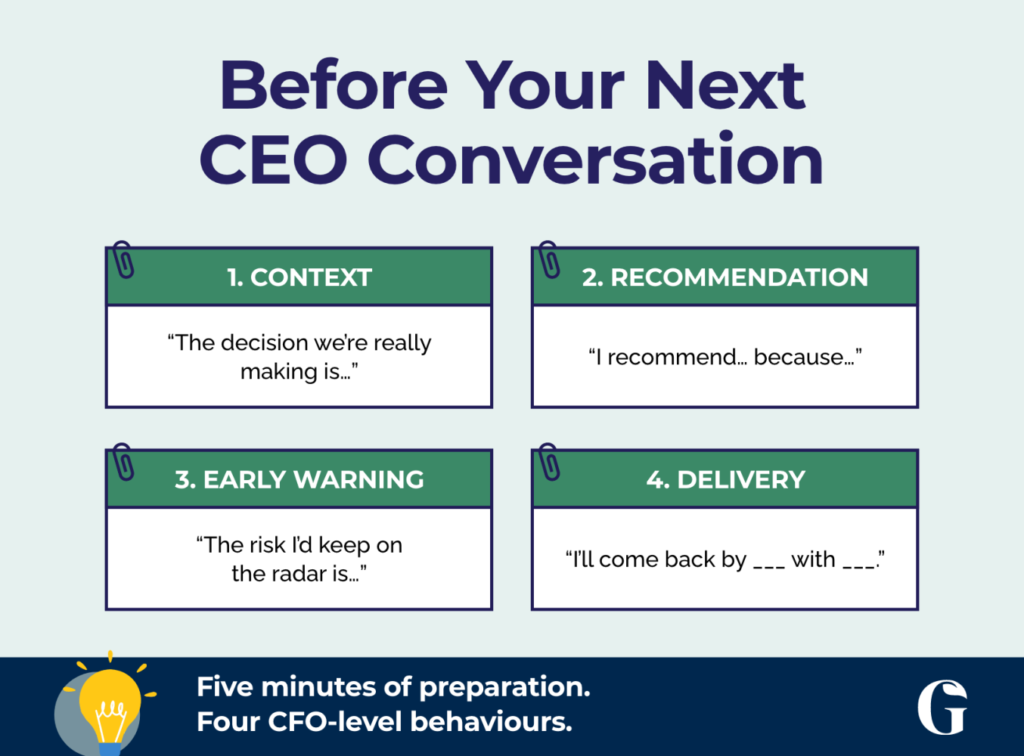
Before your next conversation with the CEO or another executive, prepare four sentences:
Context: “The decision we’re really making is…” Recommendation: “Based on what we know, I recommend…” Early warning: “The risk I’d keep on the radar is…” Delivery: “I’ll come back by [time/date] with…”
That is a five-minute preparation exercise.
But repeat it consistently and you start changing how people experience you.
Not as the person who supplies finance information.
As the person who helps them make better decisions.
What’s the One Thing to Remember?
Don’t wait for CFO authority to demonstrate CFO judgement.
The title gives you formal authority.
But credibility is accumulated in hundreds of smaller moments before that: how you frame a decision, whether you have a point of view, whether you surface uncomfortable information early and whether people can rely on your word.
Do those consistently enough and something important starts to happen.
The CEO starts asking:
“What do you think?”
That’s one of the strongest signals that you’re already operating beyond your current title.
Building executive credibility and learning how to shape decisions are capabilities we develop further in GrowCFO’s Future CFO Program.
If you want to learn more about the program and how it helps finance leaders prepare for the CFO role, join one of GrowCFO’s free Preview Events.
What changed the way your CEO saw you: better analysis, better communication, or better judgement?