Will AI Replace Finance Professionals?
Will artificial intelligence eventually replace finance professionals, or will it change the skills and roles needed across the AI finance industry?
AI is unlikely to replace finance professionals entirely. Instead, the AI finance industry is automating repetitive work such as transaction reconciliation, data preparation and routine reporting while increasing the value of human judgment, strategic thinking, communication and leadership. The professionals most likely to thrive will be those who learn to combine strong finance expertise with AI-enabled ways of working.
How is the AI finance industry changing finance roles?
The AI finance industry is changing what finance professionals spend their time doing rather than eliminating the finance function itself. AI can process large amounts of information, identify patterns, produce first drafts of reports and accelerate analysis far faster than traditional manual workflows. Forbes, for example, highlights how generative AI is already automating routine reporting, financial modelling and data processing while creating new hybrid roles that combine finance expertise with AI oversight.
This shift matters because finance teams have historically devoted significant capacity to collecting, cleaning and reconciling information before they can interpret it. As the AI finance industry absorbs more of this preparation work, finance professionals have an opportunity to spend more time challenging assumptions, advising stakeholders and supporting decisions.
GrowCFO’s research into the [future of the finance function]future of the finance function reaches a similar conclusion: AI is changing the nature of finance work rather than simply replacing it. The strategic opportunity is to convert time released through automation into higher-value finance activity.
What finance tasks is AI most likely to replace?
Within the AI finance industry, the greatest disruption is likely to occur at task level. Jobs rarely consist of a single activity, which means it is more useful to ask which parts of a finance role AI can perform rather than whether an entire profession will disappear.
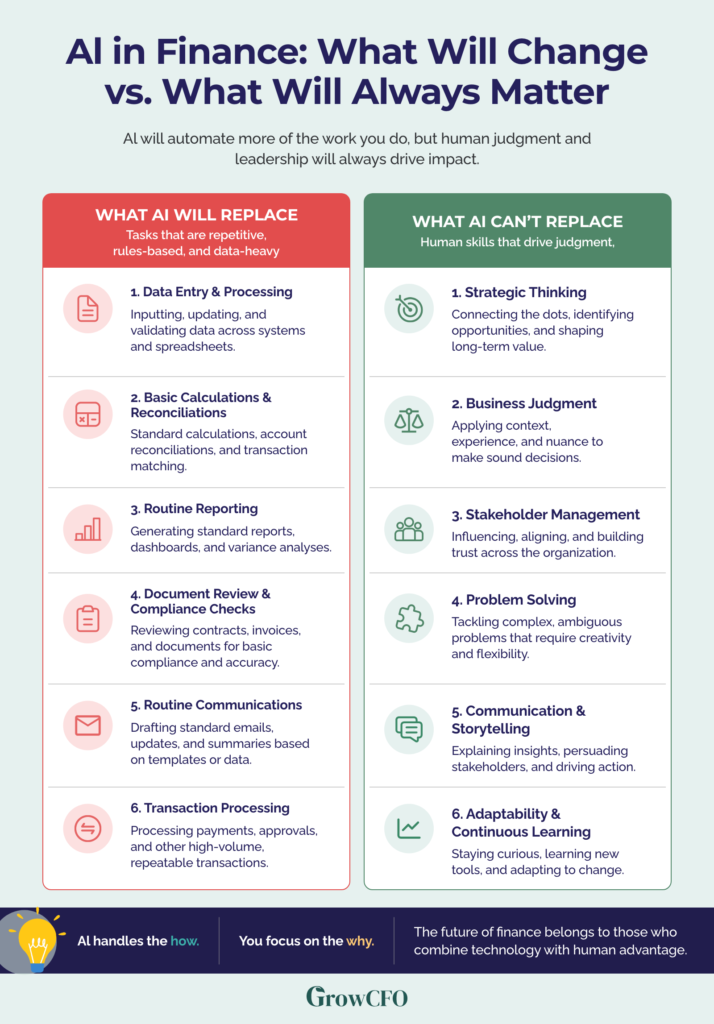
AI is increasingly capable of handling:
- Transaction matching and reconciliations
- Data entry, cleansing and classification
- First drafts of variance commentary and management reports
- Routine compliance and control checks
- Initial financial model development
- Extracting and organising information from large datasets
- Drafting board-report commentary and presentation content
These activities are typically repetitive, rules-based or heavily dependent on processing information. Oversight describes a similar model in audit and financial control, where technology can perform tedious data analysis while human auditors focus on exceptions requiring judgment.
Key takeaway: AI is more likely to replace individual finance tasks than entire finance careers.
Why can’t the AI finance industry replace human judgment?
The AI finance industry can produce an answer, but finance leaders remain accountable for deciding whether that answer makes commercial sense. Strategic decisions often depend on incomplete information, competing priorities, organisational politics, risk appetite and assumptions that cannot simply be extracted from a dataset.
A forecasting model might predict a cash shortfall, for example, but a CFO still needs to determine how management should respond. That requires understanding the business model, assessing risk, challenging operational leaders and balancing short-term liquidity with long-term strategy.
Research from Harvard Business School illustrates why human oversight remains so important. In an experiment involving 758 consultants, people using generative AI completed certain tasks more than 25% faster and achieved more than 40% higher human-rated performance. However, performance declined when AI was applied to tasks outside its capabilities, illustrating what researchers describe as a “jagged technological frontier.”
For finance leaders, the lesson is significant: AI capability does not remove the need for expertise; it increases the importance of knowing when AI output can and cannot be trusted.
Will AI reduce entry-level finance jobs?
The AI finance industry may have its greatest near-term impact on junior roles because many traditional entry-level responsibilities involve manual preparation, basic modelling and repetitive reporting. Forbes notes that bookkeeping, transactional accounting, data entry and some junior analytical work are among the areas most exposed to automation.
Finance professionals discussing the issue on Reddit express a similar view: AI is frequently described as a productivity tool that may reduce some lower-level work rather than remove the need for skilled finance professionals altogether.
That creates an important development challenge. Junior professionals have traditionally learned by building models, preparing reports and investigating variances. If AI performs more of those activities, finance leaders will need to redesign development pathways so younger team members build commercial judgment, communication skills and business understanding earlier.
Which human skills will become more valuable in the AI finance industry?
As technical production becomes faster, the AI finance industry should increase the relative value of capabilities that technology struggles to replicate.
These include commercial judgment, because somebody must evaluate whether an AI-generated conclusion makes sense; communication, because finance still needs to explain complexity clearly; influence, because recommendations create value only when stakeholders act on them; relationship management, because trust remains central to business partnering; and leadership, because transformation requires people to make decisions and take accountability.
This is why finance business partnering is likely to become more important rather than less important. GrowCFO’s [Finance Business Partner Course]Finance Business Partner Course focuses on moving professionals beyond technical expertise towards influencing decisions, collaborating effectively and becoming trusted strategic advisors.
Will finance professionals who use AI replace those who do not?
A more useful question about the AI finance industry may be whether AI-enabled finance professionals will outperform colleagues who continue working entirely manually.
History suggests that technology usually changes the baseline expectation of a role. Spreadsheet software did not eliminate finance professionals, but spreadsheet fluency eventually became fundamental. AI is likely to follow a similar path.
The distinction will increasingly be between professionals who simply accept AI outputs and those who know how to use AI intelligently. Strong performers will understand how to structure prompts, validate results, protect sensitive information, challenge assumptions and embed AI within controlled finance workflows.
The competitive advantage will not come from using AI alone. It will come from combining AI speed with finance expertise and human judgment.
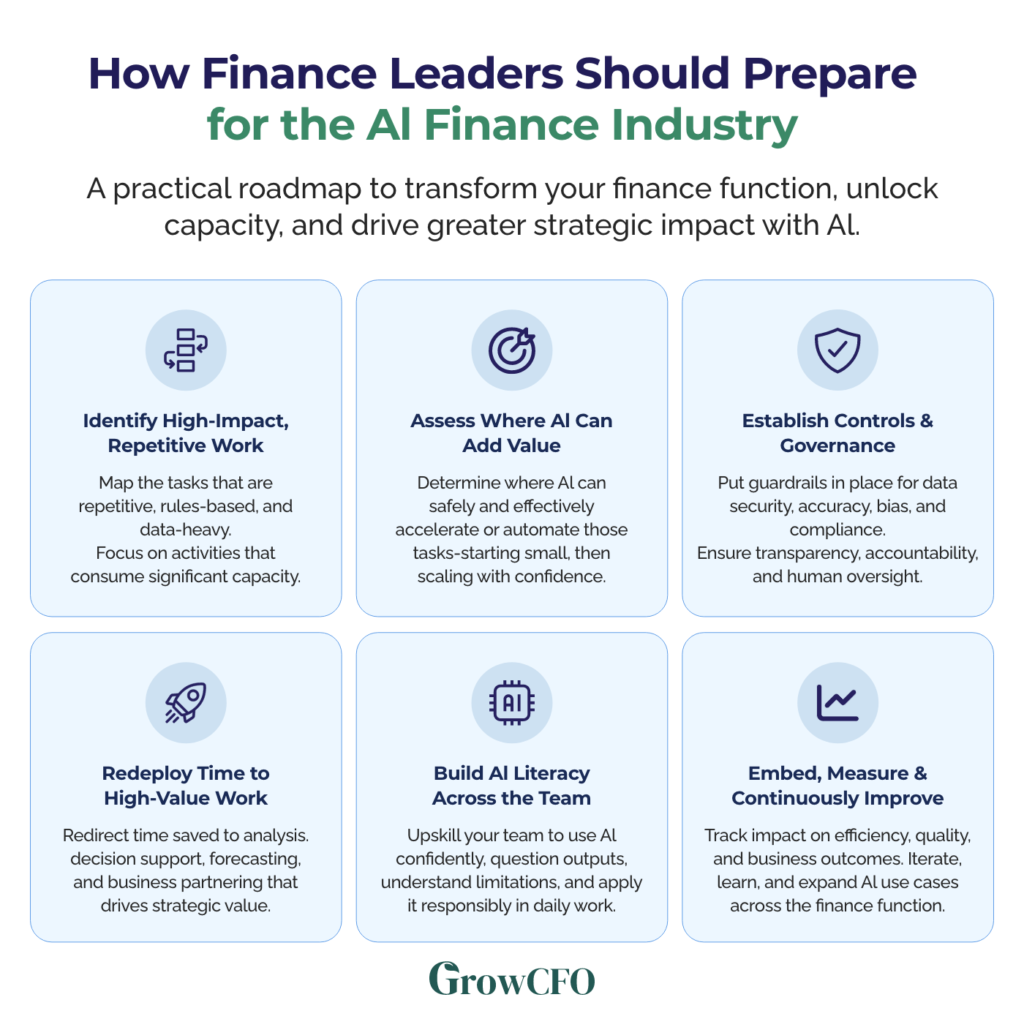
How should finance leaders prepare for the AI finance industry?
Finance leaders should avoid treating AI adoption as either an IT project or a threat-management exercise. The AI finance industry requires a broader transformation of roles, processes and skills.
Start by identifying repetitive activities that consume significant finance capacity. Determine where AI can safely accelerate those tasks, establish controls around accuracy and governance, and then deliberately redirect the time saved towards analysis, decision support and business partnering.
At the same time, develop AI literacy throughout the team. Finance professionals do not all need to become data scientists, but they do need enough understanding to use AI confidently, question outputs and recognise its limitations.
GrowCFO’s [AI for Finance learning pathway]AI for Finance learning pathway is designed specifically around these practical requirements, including AI for cash flow forecasting, financial modelling, FP&A, board reporting, productivity, writing, risk and governance.
So, will AI replace finance professionals?
No. The AI finance industry will replace some tasks, reshape some positions and potentially reduce demand for roles dominated by repetitive processing. But finance still requires judgment, accountability, strategic interpretation, influence and trusted relationships.
The bigger risk for finance professionals is therefore not simply being replaced by AI. It is failing to adapt while other finance professionals learn to use AI to produce faster analysis, stronger insights and greater strategic value.
The future of finance is unlikely to be human versus AI. It will be finance professionals who know how to combine human expertise with AI capability.
For finance leaders who want to build those capabilities practically, explore GrowCFO Academy for the 18 AI learning pathways. It provides finance-specific training designed to help professionals embed AI into real workflows while developing the judgment and strategic capabilities needed to lead the finance function of the future.