
The CFO Leadership Shift Nobody Teaches You

You can know the numbers inside out and still find it difficult when the conversation moves from “what does the analysis show?” to “what should we do?”
Learning to give a clear recommendation and trust your judgment, even when there isn’t an obvious answer, is an important part of preparing for your first CFO role.
Many future CFOs prepare for the role by becoming better at finance.
The bigger development challenge is learning how to create clarity, confidence and action when the answer isn’t obvious.
The leadership trap for future CFOs
Strong finance leaders are often rewarded for three things:
- being accurate
- spotting problems
- having the detail
Those capabilities matter.
But as your responsibility grows, they stop being enough.
At CFO level, you increasingly operate in situations where:
- the data is incomplete
- several answers are defensible
- different executives want different things
- the decision cannot wait for another round of analysis
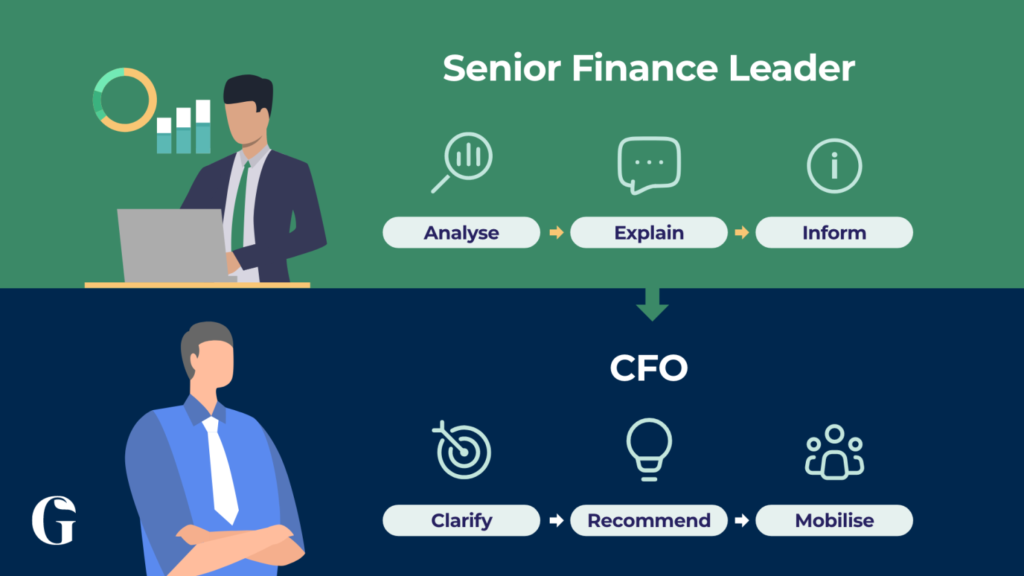
You are then no longer simply helping the organisation understand the numbers.
You are helping it decide what to do next.
That requires a different leadership capability.
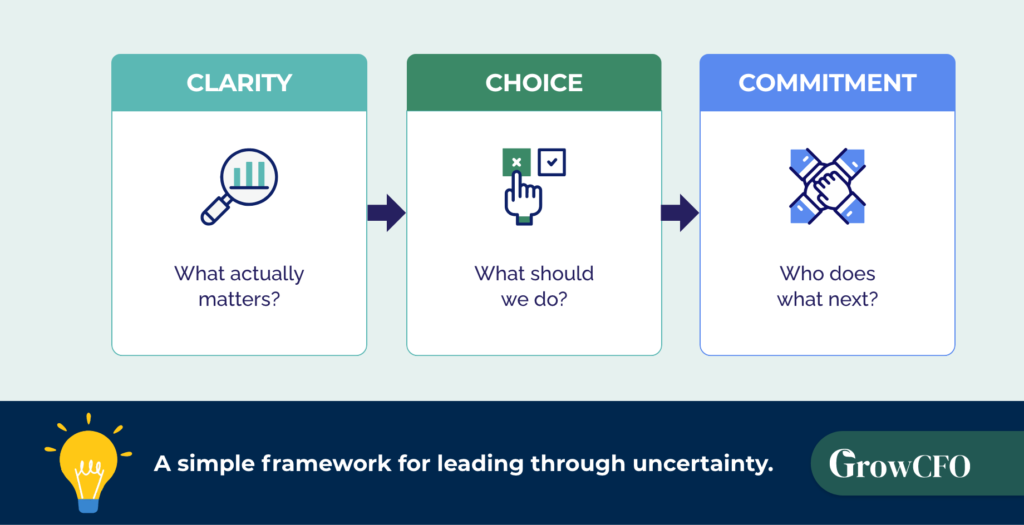
A simple framework: Clarity → Choice → Commitment
When you need to lead a difficult business conversation, think in three stages:
1. Clarity: What actually matters? 2. Choice: What decision needs to be made? 3. Commitment: What happens next?
In complex situations, leadership often means reducing complexity for everyone else.
1. CLARITY: Separate the signal from the noise
Finance leaders can see complexity that others miss.
The danger is transferring all of that complexity into the meeting.
Imagine revenue is 7% behind plan.
A technically strong finance leader might explain:
“Revenue is behind budget due to lower volumes in Segment A, some timing differences in enterprise contracts and an adverse product mix, although margins are partially offsetting the impact.”
This may be accurate, but what should everyone do with it?
A CFO-level intervention sounds more like:
“The headline isn’t the 7% revenue gap. It’s that our enterprise conversion rate has fallen for three consecutive months. If that continues, we will miss the second-half plan even if the delayed contracts close.”
Now the room knows where to focus.
Here’s how to start
Before your next executive meeting, force yourself to complete this sentence:
“The one thing this team needs to understand is…”
If you need three paragraphs to finish the sentence, you haven’t found the signal yet.
Your job isn’t to remove complexity from the analysis.
It’s to remove unnecessary complexity from the decision.
2. CHOICE: Turn analysis into a decision
One of the easiest ways for finance to accidentally avoid leadership is to present options without taking a position.
Consider this:
“We could continue with the investment, reduce the scope or pause the project. Each option has different financial implications.”
Compare it with:
“We have three options. I recommend reducing the scope. It protects the strategic objective while limiting another £1.2m of exposure. The trade-off is a three-month delay.”
The analysis hasn’t disappeared, it just now serves a decision.
A useful CFO decision statement has four components:
Decision: What needs deciding? Recommendation: What do you think we should do? Evidence: What are the 2–3 facts that matter most? Trade-off: What are we accepting by choosing it?
For example:
Finance update
CFO leadership
Decision
“Marketing spend is 12% over budget.”
“We need to decide whether to protect growth or recover the overspend.”
Recommendation
None
“Protect acquisition spend but freeze the lowest-return campaigns.”
Evidence
Detailed variance analysis
“CAC remains within target, but three campaigns are below our hurdle rate.”
Trade-off
Not explicit
“We accept a smaller short-term saving to protect the growth target.”
The second version makes it easier for the business to act.
3. COMMITMENT: Don’t let a good conversation become no decision
You’ve probably been in meetings where everyone agreed with the discussion…
…and nothing changed afterwards.
Leadership isn’t finished when the recommendation is accepted.
It is finished when there is clarity about action.
Before a decision closes, establish:
Who owns it? What happens next? By when? What would cause us to revisit the decision?
That final question is particularly useful for CFOs.
Instead of endlessly debating uncertainty, define the trigger that would change your decision.
For example:
“We proceed with the hiring plan. If monthly recurring revenue falls below £4.5m for two consecutive months, we reopen the decision.”
You have turned uncertainty into a management mechanism.
That creates confidence without pretending you can predict the future.
Try this in your next leadership meeting
Pick one decision where finance has an important voice.
Before the meeting, write a one-page leadership brief:
CLARITY
The one thing the team needs to understand: [One sentence]
CHOICE
Decision required: [One sentence]
My recommendation: [One sentence]
The three facts that matter:
- [Fact]
- [Fact]
- [Fact]
The trade-off we are accepting: [One sentence]
COMMITMENT
Owner: [Name/role]
Next action: [Action]
Deadline: [Date]
We revisit this decision if: [Trigger]
Don’t make it a new reporting exercise.
Use it to prepare how you will lead the conversation.
What changes as you move towards CFO?
While technical analysis is essential for gaining entry into important conversations, a future CFO’s true influence is defined by their leadership rather than their expertise alone.
That means being willing to say:
“This is what matters.”
“This is what I recommend.”
“This is the trade-off.”
“This is what we need to do next.”
Those sentences can feel uncomfortable when you’ve built a career around precision.
But senior leadership rarely gives you the luxury of certainty.
The CFO has to help the organisation move forward anyway.
The One Thing to Remember
CFO leadership isn’t having all the answers. It’s creating enough clarity for the organisation to make a choice and commit to action.
That is a capability future CFOs can start practising long before they get the title.
GrowCFO develops these leadership capabilities to help finance leaders prepare for broader CFO responsibilities.
Finance leaders looking to develop these capabilities further can join an upcoming Future CFO Program briefing
Which part of the transition to CFO do you think is hardest: creating clarity, making the recommendation, or driving commitment?