The CFO’s Next Cost Problem: SaaS Sprawl and AI Spend Leakage
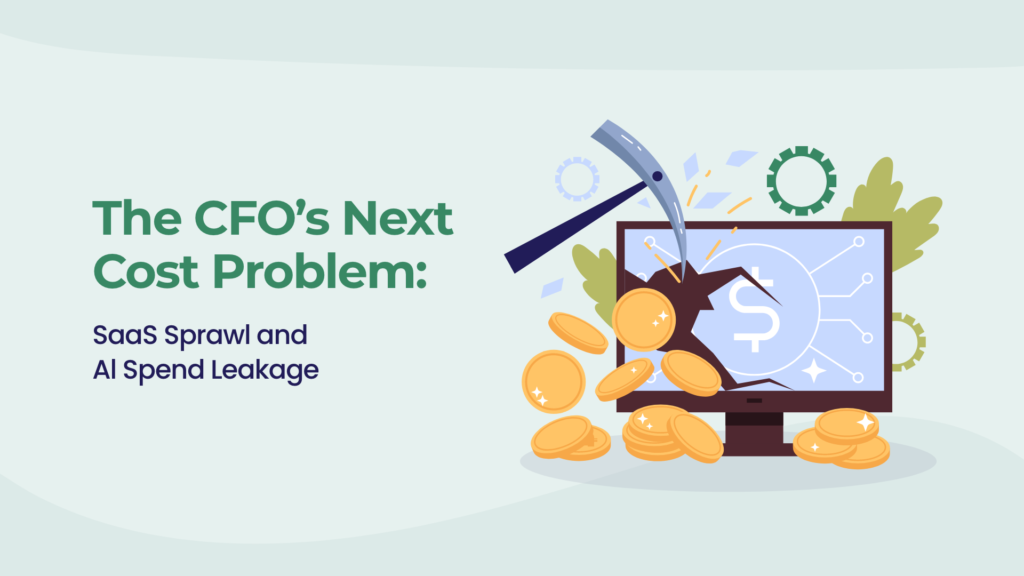
AI may be the first major technology wave where the CFO discovers the cost problem after the business has already started consuming it. That is not an argument against AI. The opportunity is real: AI is already helping finance teams work faster, analyse better, automate routine tasks, improve forecasting, accelerate reporting and support better decision-making. But the cost challenge is also real, and it is arriving at exactly the point when many finance teams are already dealing with another related issue: SaaS sprawl.
This is one of the themes explored in the latest GrowCFO Tech Innovation Report on cost management. As finance teams look for better ways to control spend, the challenge is no longer limited to accounts payable, purchase orders or supplier invoices. Increasingly, CFOs need visibility over commitments, renewals, subscriptions, AI usage, software consumption and the value being created by technology-enabled spend.
Over the last decade, it has become easier than ever for teams to buy software. A department needs a tool, a budget holder approves it, a subscription is created, and the business moves on. In isolation, each decision may make sense. But over time, the organisation accumulates a growing estate of software platforms, overlapping tools, unused licences, unclear owners and automatic renewals.
Now AI is adding another layer. Some AI tools are bought directly. Some are embedded inside existing software platforms. Some are charged by user. Some are charged by usage. Some appear initially as pilots or trials. Some are introduced as premium add-ons at renewal.
The result is a new kind of finance problem. It is no longer enough to ask, “How much are we spending?” The better question is: what have we committed to, who is consuming it, what value are we getting, and where is cost leaking? That is why SaaS and AI spend should now be firmly on the CFO agenda.
SaaS sprawl is no longer just an IT issue
In many organisations, SaaS spend has grown quietly. The individual tools may not look material: one platform here, a few licences there, a specialist departmental tool, a marketing subscription, a sales enablement platform, a reporting tool, a project management application, a data connector, a customer success platform, or a finance add-on. Individually, each one may be easy to justify. Collectively, they can become a significant and poorly controlled cost base.
The problem is not just the total spend. It is the lack of visibility and ownership. Common issues include:
- duplicated systems and overlapping functionality;
- unused licences and poor offboarding when employees leave;
- unclear product owners and weak accountability;
- departmental buying outside a central process;
- automatic renewals and hidden price increases;
- multiple vendors solving similar problems;
- poor linkage between usage, cost and business value.
This matters because SaaS is not just a technology category. It is a recurring financial commitment. If finance cannot see what tools the business has, who owns them, how they are used and when they renew, then the organisation is managing spend reactively. By the time the renewal notice appears, the negotiating leverage may already have gone.
The latest GrowCFO Tech Innovation Report looks at this wider cost management challenge and considers how finance leaders can move beyond reactive reporting towards earlier visibility and better control. It is a useful starting point for CFOs who want to assess whether their current spend management processes are keeping pace with the way the business now buys and consumes technology.
AI spend behaves differently
AI makes the challenge more complicated because AI costs do not always behave like traditional software costs. Traditional software was often priced by user, module or annual licence. AI costs may be driven by:
- number of users;
- volume of prompts;
- data processed;
- model choice;
- API calls;
- automation frequency;
- workflow volume;
- infrastructure consumption;
- embedded AI features inside existing platforms.
That makes the cost profile harder to forecast. A tool that looks inexpensive during a pilot can behave very differently when rolled out across a team, a function or a customer-facing process. The CFO therefore needs to understand not only the subscription cost, but the consumption model.
That means asking practical commercial questions before usage scales. What drives the cost? Can usage be capped? Can usage be reported by team, user, process or customer? What happens if adoption increases significantly? Are there different cost implications for different AI models? Are AI features included in the current licence or separately charged? What costs could emerge at renewal?
This is not about blocking AI adoption. It is about making sure adoption is commercially understood.
These are exactly the kinds of questions that will be explored at the GrowCFO Cost Management Tech Showcase on 24 June. The aim is not simply to see product demonstrations, but to understand how modern technology can help finance teams improve visibility over spend before it becomes another uncontrolled cost line.
AI pilots can quietly become permanent costs
Most organisations are rightly experimenting with AI. Finance teams should be testing use cases, building capability and learning where AI can create genuine value. But experimentation still needs a financial control framework, because the danger is not that companies experiment with AI. The danger is that experimentation becomes a permanent cost base without becoming a measured source of value.
A pilot can start informally. A few users test a tool, the results are promising, more people are added, and the tool becomes part of the team’s workflow. Then the renewal arrives, or the usage bill increases, or the vendor introduces a premium AI tier. At that point, finance may find itself trying to impose control after the cost has already become embedded.
That is the wrong sequence. Before AI tools become operationally dependent, organisations should be clear on:
- who owns the tool;
- who owns the budget;
- who approved the ongoing cost;
- what business value is expected;
- how that value will be measured;
- what data is being used;
- what controls apply;
- what happens if usage scales;
- what happens at renewal;
- what the exit route looks like.
This is where the CFO has a critical role to play, not as the person saying “no”, but as the person making sure the business can say “yes” responsibly.
Embedded AI features create hidden cost inflation
One of the biggest challenges for finance leaders is that AI will not always appear as a new supplier or a new tool. Increasingly, AI features are being embedded into platforms the business already uses. That creates a more subtle cost issue.
The vendor may introduce AI functionality as part of a product roadmap. It may be positioned as a productivity enhancement. It may be offered as a premium feature, a higher-tier plan, a usage-based add-on or a renewal uplift. In many cases, the functionality may be genuinely useful. But the CFO still needs to ask:
- Is the feature included or separately charged?
- Is pricing fixed, per user or usage-based?
- Can we switch it off?
- Can we control which users access it?
- Can we monitor usage?
- Can we link the feature to measurable business value?
- Does this change the total cost of ownership?
- Are we paying for similar AI capabilities in multiple platforms?
This is where AI spend can start leaking into the cost base: not through one large visible decision, but through a series of incremental upgrades, add-ons and renewals across the software estate. The CFO’s job is to make that visible.
The Tech Innovation Report makes this wider point clearly: finance leaders need to think about spend management earlier in the lifecycle. The invoice is no longer the first point of control. By then, the business may already have committed to the spend, embedded the tool into its workflow and reduced its ability to challenge the commercial terms.
Visibility comes before optimisation
When cost pressure increases, the instinct is often to cut. But with SaaS and AI spend, blunt cost-cutting can be dangerous. The business may be using certain tools to drive productivity, customer experience, automation or insight. Cutting without understanding usage and value can damage performance.
The better sequence is:
- visibility;
- control;
- optimisation.
Visibility means understanding what tools the organisation has, who owns them, who uses them, what they cost, how pricing works, what renewals are coming, what usage looks like, where duplication exists and where value is unclear.
Control means putting governance around approval of new tools, renewal decisions, licence allocation, user access, AI add-ons, usage-based charges, supplier ownership and budget accountability.
Only then can optimisation begin. That might mean consolidating vendors, reducing unused licences, renegotiating renewals, removing duplicated functionality, scaling high-value tools, stopping low-value tools, or linking technology spend more clearly to measurable business outcomes. This is a much better CFO conversation than simply asking teams to cut software spend by a fixed percentage.
This is also why the 24 June Tech Showcase is timely. Finance leaders do not just need another dashboard. They need practical ways to see where spend is being committed, where usage is growing, where renewals are approaching, where duplication exists and where technology spend is not translating into value.
Finance and IT need a shared control model
SaaS and AI cost management cannot sit with finance alone. Finance may own the budget discipline, but IT, procurement, security, data governance and business leaders all have important roles to play. IT understands architecture, access, security and integration. Procurement understands supplier management, commercial terms and renewal leverage. Finance understands cost, forecasting, ownership, controls and value measurement. Business teams understand whether tools are genuinely improving performance.
The best approach is a shared operating model that answers some basic questions:
- Who can approve new SaaS or AI tools?
- When does finance need to be involved?
- When does IT or security need to review the tool?
- Who owns the supplier relationship?
- Who monitors usage?
- Who challenges renewals?
- Who measures value?
- Who decides whether the tool continues?
Without that shared model, the business either loses control or creates bureaucracy. Neither is good enough. The aim should be disciplined enablement: helping the business adopt useful technology while maintaining financial visibility and control.
One practical way to start is to use the Tech Innovation Report as a discussion document across finance, IT, procurement and business teams. The report can help frame the conversation around what modern cost management now needs to cover, where the current control gaps may sit, and what capabilities finance leaders should be looking for in the next generation of tools.
The CFO’s role is changing
The CFO does not need to become the Chief Information Officer. But the CFO does need to understand how technology-enabled spend behaves, including SaaS, AI, cloud, automation platforms, data tools, finance systems and embedded AI functionality inside existing vendor relationships.
The finance function needs to be able to distinguish between:
- cost and investment;
- experimentation and operational dependency;
- usage and value;
- innovation and duplication;
- automation and uncontrolled consumption;
- productivity improvement and hidden cost inflation.
That requires better data, better governance and better conversations across the business. It also requires finance to get involved earlier. If finance only sees the spend when the invoice arrives, it is too late.
The new CFO question
The old question was: what did we spend? The better question is: what have we committed to, who is consuming it, what value are we getting, and where is cost leaking?
That question is becoming more important as more spend moves into subscriptions, renewals, usage-based models and embedded AI features. The organisations that answer it well will not necessarily be the ones that spend the least. They will be the ones that understand where technology creates value, where it creates risk, and where it quietly drains margin.
That is the real opportunity: not to stop SaaS, not to slow AI, but to bring financial discipline to the way the organisation adopts, scales and governs modern technology.
Closing thought
SaaS and AI spend are now part of the CFO’s cost management agenda. They are too material, too variable and too strategically important to be treated as invisible technology costs. The goal is not to stop innovation. The goal is to make innovation financially visible, commercially disciplined and linked to measurable value.
This is one of the key themes in the latest GrowCFO Tech Innovation Report, which explores how finance leaders can improve visibility, control and value across AP, procurement, SaaS, AI and wider business spend.
It is also why GrowCFO is bringing this topic to life at the GrowCFO Cost Management Tech Showcase on 24 June. The event will explore the technologies that can help finance teams move from reactive spend reporting to earlier visibility, stronger control and better decision-making.
One of the questions GrowCFO will be asking vendors is simple:
Can this solution help finance see technology-enabled spend before it becomes another surprise renewal or uncontrolled usage bill?
If SaaS sprawl, AI costs or technology renewals are becoming harder to control in your organisation, download the latest GrowCFO Tech Innovation Report and join the Cost Management Tech Showcase on 24 June.