AI Promises Speed. FP&A Is Still Stuck. Why?
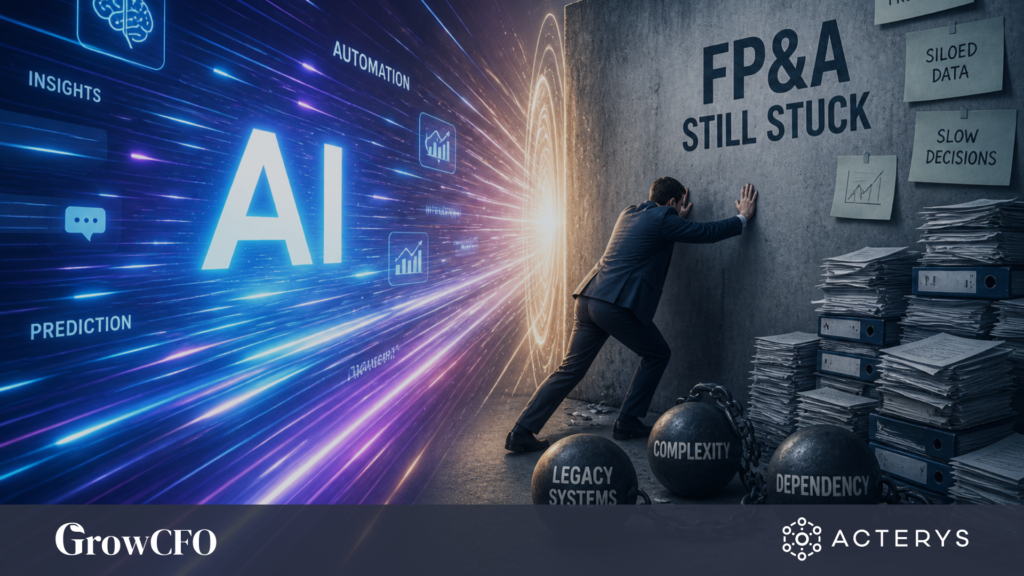
Table of Contents
There’s an uncomfortable truth many finance leaders are starting to recognize:
AI may not be the main reason FP&A is struggling to move faster. In many organizations, the bigger constraint is legacy architecture.
Across boardrooms, AI dominates the agenda. The expectations are clear—faster forecasts, continuous planning, real-time scenarios, predictive insight.
And yet, inside many finance functions, the reality feels very different. Planning cycles still take weeks. Forecasts are still manually stitched together. And when the business asks, “What happens if…?”—the answer is often, “Give us a few days.”
In a world that increasingly operates in real time, that’s more than inefficient. It can become a real business risk.
GrowCFO perspective: Across the GrowCFO community, this tension comes up repeatedly. Finance leaders are aligned on the need for speed and insight—but many recognize that their current FP&A environments weren’t designed for this level of agility. The conversation is shifting from “how do we go faster?” to “what is actually slowing us down?”
Acterys insight: This is where modern platforms built for today’s data landscape stand apart. Solutions like Acterys, designed to sit natively within environments like Microsoft Fabric enable finance teams to operate in real time—removing the structural delays that legacy architectures introduce.
To find out more click here.
The hidden cost of “keeping things running”
Most legacy FP&A systems were implemented years ago—often successfully, for the needs they were designed to serve at the time.
They were designed for structured, periodic planning. Annual budgets. Quarterly forecasts. Controlled environments. But fast forward to today, and those same systems are being asked to support:
- Continuous reforecasting
- Real-time decision-making
- Increasing data volumes
- AI-driven insight
That’s where the strain often starts to show. What’s often overlooked isn’t just the functional limitation—it’s the operational cost of maintaining them.
Behind the scenes, many organizations are dealing with:
- Significant support and maintenance overhead
- Reliance on a handful of individuals who understand the system
- Loss of original implementation knowledge
- Increasing dependency on IT, for even minor changes
What was once a business-led planning environment quietly becomes IT-dependent infrastructure. And that has consequences.
GrowCFO perspective: We frequently hear from finance leaders who describe legacy FP&A platforms as “stable—but heavy.” They work, but at a cost—both financially and operationally. Increasingly, that cost isn’t just licence or infrastructure—it’s the hidden drag on finance teams’ ability to adapt and respond.
Recruiting good FP&A people is becoming harder, and there’s more pressure than ever to enable the people you already have to add more business value. Outdated infrastructure is a major obstacle to achieving this.
Acterys insight: Modern planning platforms such as Acterys are designed to shift this balance back—reducing dependency on technical resources and enabling finance teams to operate in a more agile, self-sufficient way within familiar environments like Excel and Power BI. Built to leverage cloud-native architectures, they also significantly reduce the long-term cost burden associated with maintaining legacy systems. To find out more click here.
When FP&A stops being self-service
One of the biggest shifts in modern finance has been the move toward self-service.
Finance teams want control. Flexibility. The ability to model, iterate, and respond quickly—without waiting in a queue for technical support. Legacy FP&A systems do not always make that easy.
Need to update a model? Call IT.
Want to add a new dimension? Raise a ticket.
Trying to adapt to a new business scenario? Hope someone still understands how the logic was built.
That may not be true in every organization, but it is a familiar pattern in many. Over time, it creates friction. And that friction slows everything down. Not just systems—but decisions.
GrowCFO perspective: Self-service FP&A is no longer a “nice to have”—it’s becoming essential. Finance teams that can’t move independently often find themselves outpaced by the business, particularly in fast-changing environments.
Acterys insight: This is where modern, integrated planning solutions stand apart—enabling finance teams to take back control of modelling and forecasting, without sacrificing governance or requiring constant IT intervention. When combined with platforms like Microsoft Fabric, this enables true self-service on top of trusted, enterprise-grade data. To find out more click here.
Then comes AI… and everything gets exposed
Into this environment comes AI. On paper, it sounds like the perfect solution:
- Automate forecasting
- Accelerate scenario modelling
- Surface predictive insights
But in practice, many organizations hit a wall. Because AI doesn’t operate in isolation—it depends on the underlying FP&A environment. And that’s where the cracks start to show.
GrowCFO perspective: AI is one of the most discussed topics across the finance community—but there’s also a growing realism. Leaders are recognizing that AI success depends heavily on the strength of existing data and planning foundations.
We see AI in spreadsheets where the agent can almost build the model for you, and we’re teaching finance teams how to do this in the classroom. Modern FP&A systems are heading in the same direction, and soon you’ll be able to ask the tool in plain English to go build the model. Most legacy tools simply can’t adapt to these new ways of working.
Acterys insight: Platforms like Acterys, that are AI-ready by design—rather than retrofitted—are fundamentally better positioned to support this shift. By embedding planning directly into modern data platforms, AI becomes a natural extension of the process rather than an overlay. To find out more click here.
What breaks first?
When organizations attempt to layer AI onto legacy FP&A systems, a few things tend to happen:
1. Data limitations become critical
AI needs clean, connected, accessible data. Legacy systems often still rely on fragmented, batch-driven, or manually prepared inputs.
2. Models become a constraint
Rigid, complex planning models don’t adapt easily to AI-driven iteration.
3. Trust starts to erode
If outputs can’t be easily explained, validated, or reconciled, finance teams lose confidence quickly.
4. Complexity increases—not decreases
Instead of simplifying planning, AI can become another layer on top of an already stretched structure.
The result? AI doesn’t always unlock value straight away. Sometimes it simply exposes the limitations that were already there.
GrowCFO perspective: This is a critical inflection point. Many finance teams are realising that layering new capabilities onto old structures rarely delivers the expected outcomes—and can sometimes make things harder.
Meanwhile, the rest of the data landscape has moved on
Across the enterprise, there’s been a significant shift toward modern data platforms like Microsoft Fabric and Power BI.
Analytics has evolved rapidly:
- Real-time dashboards
- Scalable data models
- Self-service reporting
But planning and forecasting often remain disconnected—locked in legacy systems with limited real-time integration and no governed enterprise write-back. This creates a fundamental disconnect. The business can often see what’s happening faster than finance can respond to it. And that gap is becoming harder to ignore.
GrowCFO perspective: We’re seeing a clear divide emerge: organizations with connected data and planning environments versus those still operating in silos. The difference in responsiveness—and strategic impact—is significant.
Acterys insight: Acterys is purpose-built to operate within Microsoft Fabric and Power BI, enabling planning directly on top of the data platform. This includes enterprise-grade, governed write-back, allowing finance teams not only to analyze data—but to act on it immediately within the same environment. To find out more click here.
The write-back problem no one talks about
One of the most overlooked challenges in FP&A today is deceptively simple: Turning insight into action.
Modern analytics platforms are excellent at surfacing insight. But planning systems need to operationalize it—securely, accurately, and at scale. Without governed, bi-directional integration, insight stays in dashboards. It informs conversations, but it doesn’t drive outcomes. And that’s where a lot of the value can be lost.
GrowCFO perspective: This is a topic gaining increasing attention—because insight alone isn’t enough. Finance teams need to close the loop between analysis and execution.
Acterys insight: Enterprise write-back is a critical part of modern FP&A. Acterys enables organizations to connect planning directly with Microsoft Fabric, leverage enterprise-grade write-back, and build a truly AI-ready FP&A environment from the start. To find out more click here.
So what does “AI-ready FP&A” actually mean?
It’s not about adding more technology. And it’s definitely not about forcing AI into an environment that isn’t designed for it.
AI-ready FP&A starts with something more fundamental:
A planning architecture that is modern enough to support the way finance now needs to operate. One that is:
- Connected to trusted data platforms
- Scalable and flexible by design
- Capable of supporting iterative, continuous planning
- Built with governance and control at its core
- Able to integrate planning and analytics into a more unified ecosystem
In that environment, AI becomes powerful—not because it’s new, but because it’s because it has the right foundations beneath it.
GrowCFO perspective: The concept of “AI-ready” is evolving. Increasingly, it’s less about tools and more about readiness—data, architecture, and operating models.
Acterys insight: Acterys is designed with AI readiness at its core—leveraging modern data platforms, enabling real-time planning, and ensuring the underlying architecture can support advanced analytics and AI use cases from day one. To find out more click here.
A shift finance leaders can’t ignore
For finance leaders, this is becoming a defining moment. The expectations of FP&A have changed. It’s no longer enough to explain performance after the fact. Finance is now expected to:
- Anticipate change
- Model scenarios in near real time
- Support faster, better decisions
- Operate as a strategic partner to the business
That requires more than incremental improvement. In many cases, it means rethinking the foundations.
GrowCFO perspective: This shift is one of the most consistent themes we see across finance leadership today—the move from hindsight to foresight is no longer optional.
The uncomfortable question
Many organizations are investing in AI. Fewer are asking whether their FP&A environment is ready for it.
So the real question isn’t just: “How do we use AI in planning?”
It may be: “Is our planning architecture holding us back?”
GrowCFO perspective: The most forward-thinking finance leaders are starting here—challenging assumptions about existing systems before layering on new capabilities.
Final thought
AI will transform FP&A. But not in isolation. Without the right foundations, it risks becoming another layer of complexity on top of already stretched systems. With the right architecture, however, it becomes something far more powerful:
A way to move from reactive reporting… to predictive, decision-ready finance.
If you’re starting to question whether your current planning environment can support where finance is heading, now is the time to explore what modern AI-native FP&A looks like in practice—and what it takes to get there.
If this resonates, it may be time to explore how a modern, integrated planning platform can help finance move faster—without increasing complexity.
Discover how Acterys enables organizations to connect planning directly with Microsoft Fabric, leverage enterprise-grade write-back, and build a truly AI-ready FP&A environment from the start.
To find out more click here.