You’re too busy to be strategic (and your CEO can tell)

GrowCFO posed a simple question to a room of senior finance leaders: what is strategy?
The first answers were predictable: projects, priorities, initiatives.
Then they were asked to write their company strategy in one sentence.
Most teams listed actions, but few could clearly explain the choices those actions serve.
Many finance leaders get promoted for operational excellence, then try to become “more strategic” by producing more analysis.
But the gap usually is not knowledge.
It is the ability to turn numbers into decisions.
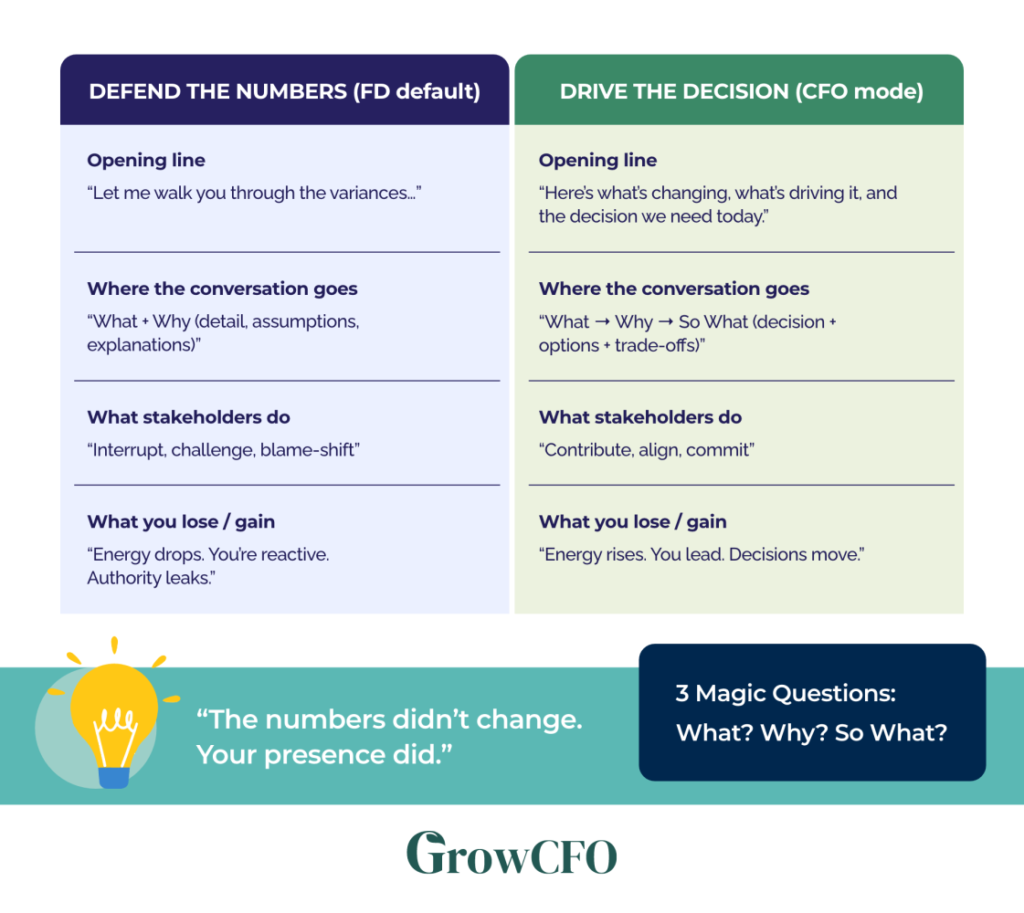
The Real Shift From Finance Leader to CFO
Most finance professionals join strategy discussions too late, often once direction is already set.
The gap? CFOs contribute earlier; they bring clarity to choices, trade-offs, and priorities.
Two Tools That Change Your Impact Fast
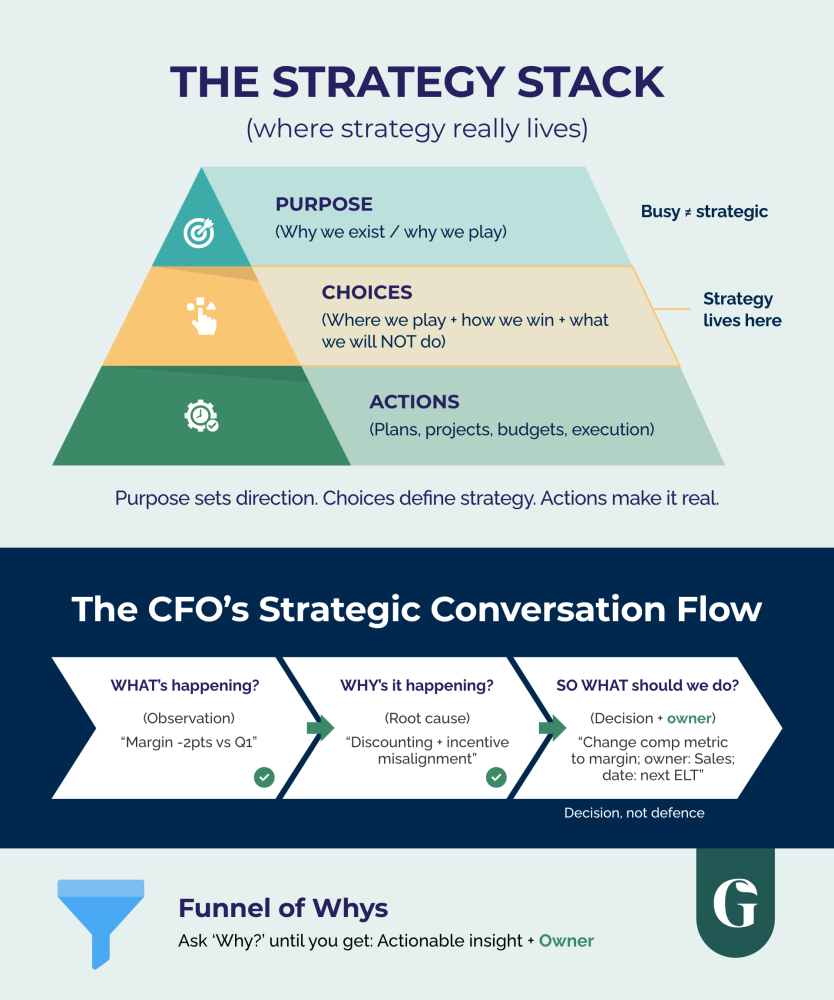
1. The Strategy Stack
Purpose > Choices > Actions
Most teams live in Actions.
Strong CFOs bring focus back to Choices:
Where will we play?
How will we win?
What are we not doing?
2. The 3 Magic Questions
What’s happening?
Why is it happening?
So what should we do?
That final question is where influence is built.
If this topic matters, GrowCFO unpacks it live in the free Future CFO Preview Event, where future CFOs explore the tools, frameworks, and thinking behind strategic leadership.
Book here.
The Capability Gap:
The skill gap is facilitating strategic conversations that end in clear choices and committed action.
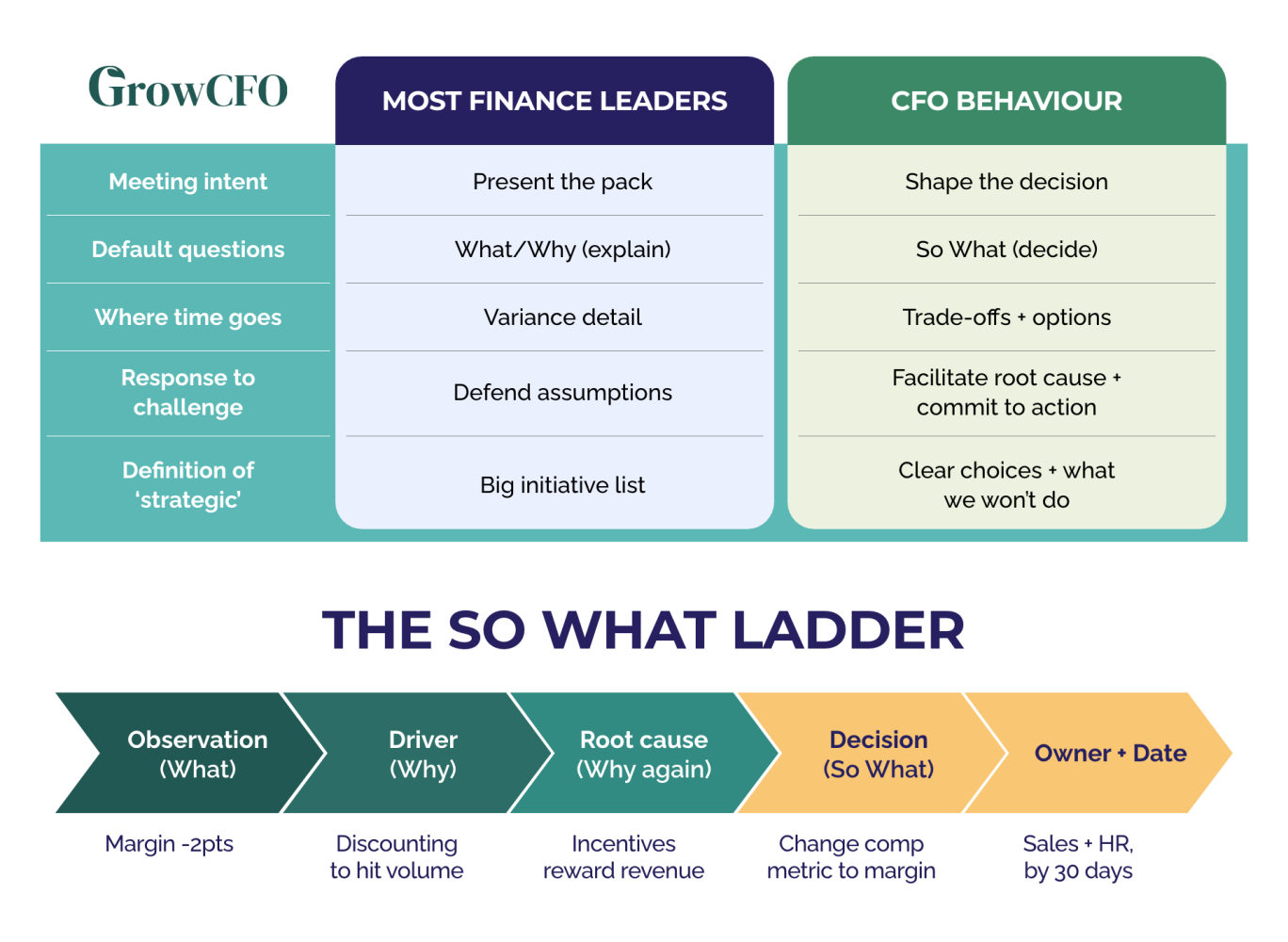
CFOs do X. Most finance leaders do Y instead.
1) CFOs clarify the choice.
Most finance leaders expand the analysis.
2) CFOs push the room up the Strategy Stack (from actions to choices).
Most finance leaders stay focused on execution details (projects, timelines, budgets).
3) CFOs use “So what?” to steer a decision and assign ownership.
Most finance leaders stop at “what happened” and “why it happened.”
4) CFOs build psychological safety to uncover the real drivers (including the uncomfortable “twist”).
Most finance leaders accept the first explanation because it’s politically easy.
5) CFOs show up strongest before the budget—while direction is still fluid.
Most finance leaders arrive once decisions are locked and try to optimize around them.
Ask three leaders separately: who do we serve, what problem do we solve, and how do we win?
If the answers differ, misalignment has been uncovered that may be slowing decisions, creating wasted effort, or weakening execution.
Bringing clarity to that gap helps finance leaders lead sharper discussions, improve alignment, and increase their strategic value to the business.
Try This This Week:
1) Run the “Strategy in a Sentence” Test (15 Minutes)
Ask three leaders separately: who do we serve, what problem do we solve, and how do we win?
If the answers differ, a gap worth solving has been identified. Bring it to the next meeting as a choice discussion.
2) Rewrite One Pack Page into What / Why / So What
Choose a page where finance leaders often get pulled into defense (margin, churn, pipeline, cash).
Add three lines at the top:
What’s happening?
Why is it happening?
So what should we do?
Lead with the decision, not slide 12.
3) Use the Funnel of Whys This Week
When vague explanations like “market conditions” or “costs are up” arise, stay curious. Keep asking “why” until reaching something actionable with a clear owner.
That is where real insight and influence begin.
WHAT’S NEXT
If this resonates, the next step is to join the Future CFO Preview Event and see how GrowCFO trains finance leaders to facilitate strategic conversations, coach change, and influence action—without waiting for the CFO title.
Book your seat here.