Why Being CFO-Ready Isn’t Enough Anymore

Like many people early in their careers, I believed something simple:
Do good work. Build a track record. Promotion will follow.
But over time I watched extremely capable finance leaders get passed over for CFO roles.
Not because they lacked skill.
Because nobody in the room could clearly explain what they stood for as a CFO.
That’s the real promotion test.
If nobody can describe your CFO value in one sentence, you are not promotable yet.
Not because you lack capability.
Because your positioning is unclear.
The Promotion Myth
We like to believe promotion is a meritocracy.
Perform well. Deliver results. Move up.
But promotion to CFO works differently.
Boards are not promoting the most technically capable finance leader.
They are choosing the lowest-risk leadership decision.
And clarity reduces risk.
When a CEO or Chair advocates for a CFO candidate, they need to answer three questions quickly:
- What does this person stand for as a CFO?
- Where have they demonstrated CFO-level judgement?
- Why are they the right leader for this business right now?
If the answers aren’t obvious, the decision becomes harder.
And uncertainty slows promotions.
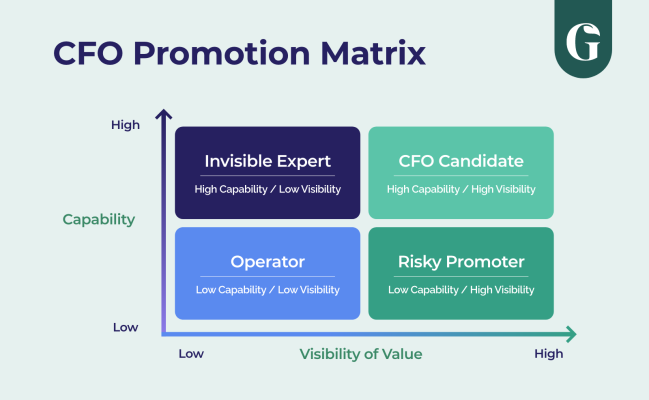
Many finance leaders assume promotions are about improving capability.
But promotion decisions depend on capability and visibility of value.
Most overlooked finance leaders sit in this quadrant:
High capability. Low visibility.
They are excellent operators.
But their CFO identity is unclear.
Boards struggle to answer the promotion question:
“What kind of CFO would this person be?”
Without that clarity, even strong candidates stall.
The Overlooked High Performer
High performers who get passed over for CFO roles rarely fail on delivery.
They fail on translation.
They assume their work speaks for itself.
It doesn’t.
When feedback arrives, it often sounds like this:
“You’re doing great work.”
“You’re very capable.”
“We just felt someone else was a better fit.”
That usually isn’t a capability problem.
It’s a positioning problem.
Experience alone does not create a promotable candidate.
It needs to be translated into a clear leadership narrative.
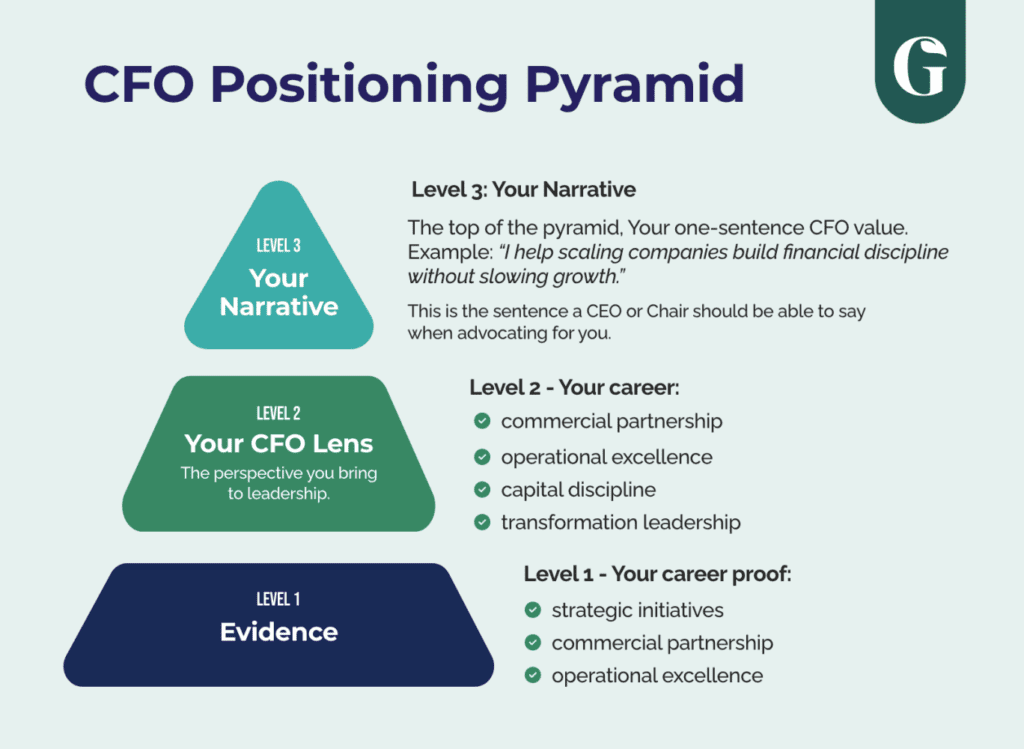
The CFO Positioning Pyramid
The finance leaders who move fastest toward CFO roles do something different.
They convert experience into positioning.
The CFO Positioning Framework
If you want to move from CFO-ready to CFO-promotable, focus on three elements.
1. Forward Signal
What does the organization need from its next CFO?
Growth discipline? Turnaround leadership? Transformation? Capital strategy?
Strong candidates translate their experience into future relevance.
2. Your CFO Lens
What perspective do you consistently bring to leadership conversations?
Pick one anchor.
Cost discipline. Commercial strategy. Capital allocation. Transformation.
Leaders who stand for everything stand for nothing.
3. Proof Moments
Identify two or three moments in your career that demonstrate CFO-level judgement.
For example:
- navigating a crisis
- reshaping capital allocation
- leading a transformation initiative
- driving strategic change
If you can’t explain these moments in 30 seconds, decision-makers won’t remember them either.
A Simple Promotion Test
If you’re aiming for a CFO role in the next 12–36 months, try this exercise.
Ask a trusted colleague or mentor:
“If someone asked you why I should be a CFO, what would you say?”
Listen carefully.
If the answer sounds like a list of competencies, the narrative isn’t clear yet.
If the answer sounds like a clear leadership identity, you’re much closer.
That clarity makes promotion easier for the CEO, the board, and the organisation.
Because promotion decisions are rarely about identifying the most capable candidate.
They are about choosing the most understandable leader.
Why We Built Support Around This
Finance leaders do not lack intelligence or work ethic.
What they often lack is structured reflection around positioning and identity.
The transition to CFO isn’t just about accumulating competencies.
It’s about integrating them into a coherent leadership story.
Inside the Future CFO Program, we help finance leaders:
- identify their leadership positioning
- develop board-level judgement
- build the narrative that supports promotion
If you recognize yourself in the “high performer, still waiting” category, it may be time to work on clarity, not capability.
You can learn more about the program here.