Contract Intelligence for CFOs Who Refuse to Fly Blind
The revenue leak hiding inside contracts is well documented. The data is hard to ignore: organizations lose 9.2 percent of annual revenue to contract mismanagement, according to World Commerce and Contracting research.
CFOs are familiar with this now. The question has shifted from “Is this a problem?” to “What do I do about it?”
Concord believes the answer comes down to a specific shift: moving from reactive contract management, where you discover problems after they happen, to contract intelligence, where AI surfaces risks and opportunities before they cost money.
Here is what that shift looks like in practice, informed by conversations with CFOs managing this transition.
What CFOs actually need from their contracts
When we talk with finance leaders about contracts, the same three priorities come up consistently, almost always in this order:
Forecasting comes first. One CFO put it plainly: “I’ve heard a lot of CFOs telling me they have forecasting coming out of accounting, but there are always gaps between what the contracts actually say and what’s in accounting.” Cash flow forecasts that do not match contractual commitments create exposure that only surfaces at quarter-end. Payment schedules, escalation clauses, and multi-year obligations get lost between the PDF and the spreadsheet.
Benchmarking is second. Finance leaders want to know whether their vendor terms are competitive. Are you paying the right price per user compared to companies your size? Without portfolio-wide visibility, renegotiation happens without data.
Renewal planning is third. One VP Finance described a scenario many will recognize: “We’ve passed an auto-renewal cut-off date, but the team was discussing whether we actually need to continue with that contract or not. And now we’re locked in.” By the time finance notices, the window to renegotiate has closed. Industry benchmarking shows contract renewals routinely take three times longer than initial approval. That timeline means renewal planning cannot start when the invoice arrives.
Why the current approach falls short for finance
Most organizations use their CLM like a filing cabinet. Documents go in. Finding them again requires knowing where to look. Getting answers, like aggregate spend or total contract value by vendor, requires export, spreadsheet work, and manual calculation.
Contract data sits in an average of 24 different systems, according to Deloitte research. Someone has to manually extract it, structure it, and put it where finance can use it. That is where value leaks.
As one contract manager reporting to a CFO told us: “We’re really using it as a repository and as a signature tool. That’s really all they care about. I’m sure it has so much more capability than what we’re using.”
The reconciliation problem is the most expensive gap. It is hard to reconcile what you see in your forecast with what is actually on your contracts, especially when it comes to cash flows. And the source of truth for any CFO is the general ledger. Contract management needs to feed the general ledger, not compete with it.
The shift from reactive to forward-looking
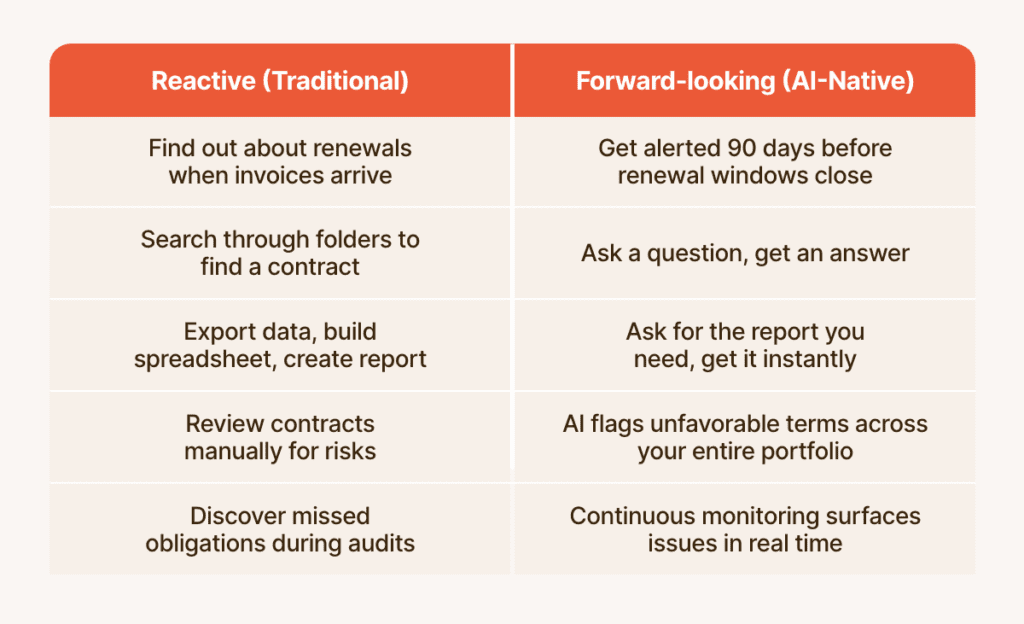
The difference between traditional contract management and AI-native contract intelligence comes down to four capabilities. Each one replaces a manual, error-prone process with something a CFO can actually rely on.
Ask questions instead of searching files
The old way: search through folders, filter by date, hope the naming convention helps, export to Excel, build a pivot table.
The new way: “Show me all vendor contracts renewing in Q2 with auto-renewal clauses.”
Finance leaders should not need to know where contracts are stored. They should be able to ask what they want to know and get an answer. AI-native platforms can reduce the manual data entry burden from 20-40 minutes per contract to under a minute, with greater consistency than manual review.
Detect risk before it hits the P&L
The old way: discover unfavorable terms when the invoice arrives or the audit happens.
The new way: AI continuously scans your portfolio and flags risks before they become problems: auto-renewal clauses approaching deadlines, non-standard liability terms, missing termination rights, contract escalations that affect forecasts.
One CFO described the blind spot: “Have we committed something to a partner that nobody remembers we’ve committed? There’s no place to look at that.” AI-native platforms provide that place. Organizations that adopt this approach consistently report one outcome first: they stop paying out contracts they intended to terminate.
Build reports on demand, not on request
The old way, described by one finance leader: “They’re going contract by contract and building an Excel spreadsheet. It’s all manual.”
The new way: describe the report you need and get it instantly. Total spend by vendor category, contracts expiring by quarter, payment schedules aligned to cash flow forecasts. These should not require data extraction projects.
With AI-powered CLM for financial operations, reports contain AI-enriched data, not empty fields waiting for someone to type in contract values. Gartner’s 2025 CFO survey found that CFOs rank metrics, analytics, and reporting as their number one priority. Contract data should be feeding that priority, not blocking it.
Get portfolio intelligence, not document storage
The old way: each contract is a separate document in a separate folder. Analysis requires pulling them together manually.
The new way: AI understands your entire portfolio and surfaces patterns, anomalies, and opportunities across all agreements. As one CFO described what he needs: “Show me all my contracts. What are my spend categories? How long have we had relationships with these vendors? What are the payment terms?”
AI-native vs. bolt-on: why the distinction matters
Not all contract management software handles AI the same way.
AI-assisted means a traditional system with AI features added on top. Search might be smarter. Extraction might be faster. But the platform was not built for intelligence. AI is a feature, often locked behind higher-tier plans.
AI-native means the platform is rebuilt around AI as the core. Natural language is the primary interface. Intelligence runs continuously, not just when you ask.
The practical difference for CFOs:
McKinsey’s CFO survey found that 44 percent of CFOs now use AI for five or more use cases, up from seven percent the prior year. The most common use: data visualizations and reports. Contract data is a natural starting point.
What contract intelligence does not solve
Contract intelligence is not a replacement for procurement strategy, vendor relationship management, or legal judgment. AI can surface that a contract has unfavorable terms, but it cannot tell you whether the vendor relationship is worth the trade-off. It can flag a renewal deadline, but the decision to renegotiate, terminate, or extend still requires context that lives outside the contract itself. The value is in giving your finance team the data to make those decisions faster and with better information, not in making the decisions for them.
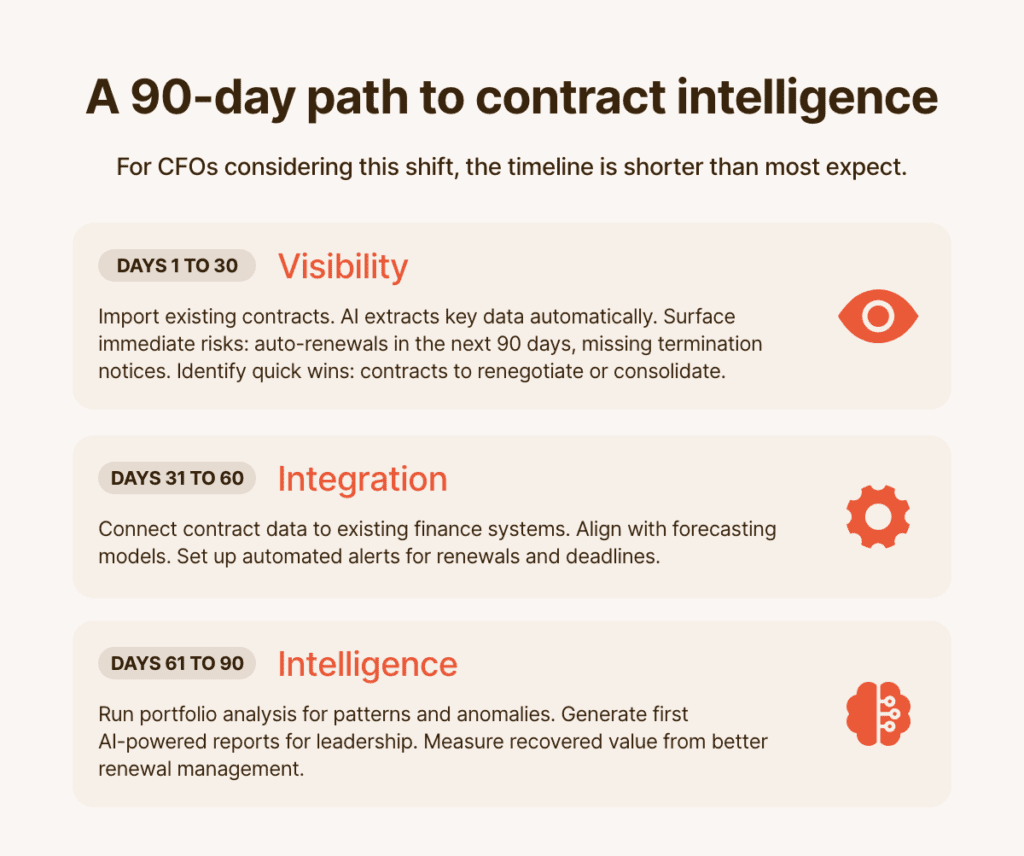
A 90-day path to contract intelligence
For CFOs considering this shift, the timeline is shorter than most expect.
The CFOs who have made this shift share a common thread. They treat contracts as a financial data source, not a legal filing obligation. The instruments to stop flying blind exist today.
This article was written in partnership with Concord, an AI-native contract management platform that helps finance teams turn contract data into forecasting intelligence.