How to Stop Reporting & Start Influencing Board Decisions
Table of Contents
Accurate numbers are expected. The CFOs who shape outcomes know how to turn insight into action, not just information.
I have seen CFOs deliver flawless analysis and still watch decisions go another way.
The gap is rarely technical.
It is influence, and it can be learned.
Most reports explain the past.
Boards decide based on future narratives.
Facts alone do not move people.
Finance is trusted, but often ignored.
That is not a data problem.
It’s a leadership one.
When CFOs build influence, three things change quickly: decisions move faster, confidence in finance rises, and the CFO’s voice carries weight beyond the numbers.
Why Reporting Alone Does Not Elevate CFOs
- Decision framing: Numbers without a point of view slow action.
- Narrative gaps: Insight dies when the story is missing.
- False objectivity: Leaders still decide emotionally, then justify rationally.
- Timing: Late insight is safe but ineffective.
- Ownership: Influence happens when leaders feel the idea is theirs.
A familiar boardroom moment: The analysis is solid. The recommendation is logical. Yet the discussion drifts, concerns surface late, and the decision is deferred—or diluted.
Nothing was “wrong.”But nothing moved.
How to go From Reporting to Influence: A practical CFO action plan
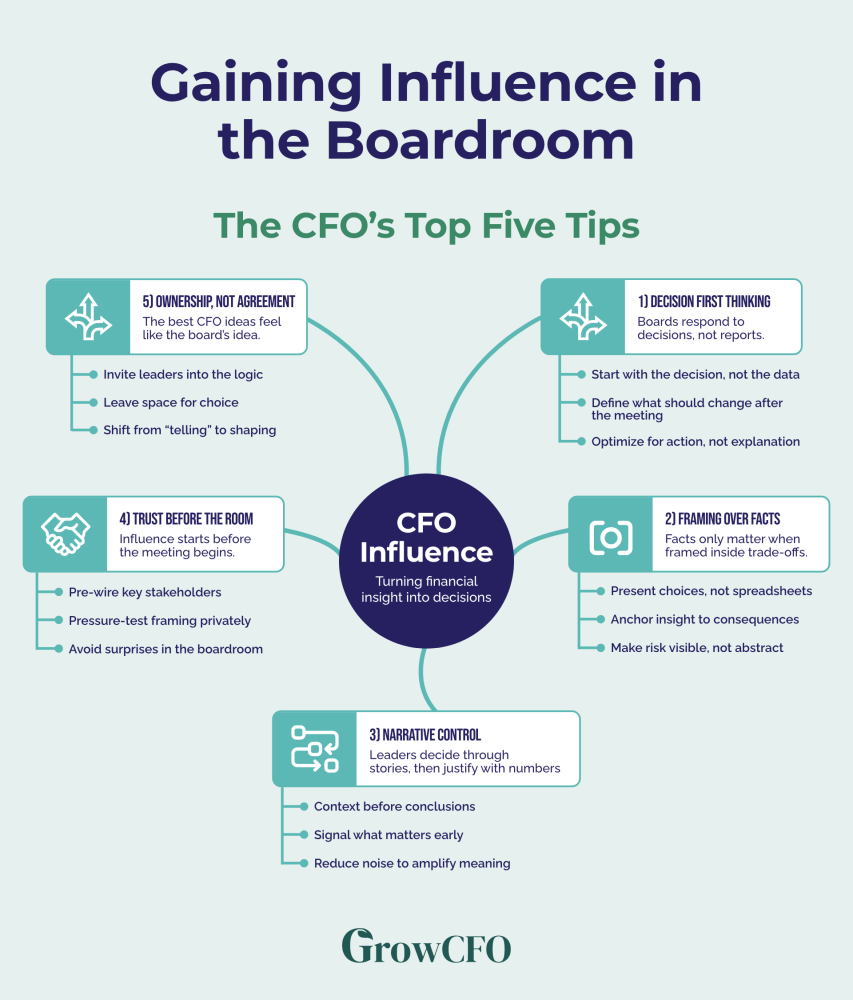
Influence is not about charisma. It is about structure. High-impact CFOs follow a repeatable process that turns analysis into decisions.
1) Define the decision, not the report
Before opening Excel, be explicit. What decision should change because of this analysis? Investment, risk, pace, or priority?
2) Identify the real constraint
Boards rarely argue with numbers. They hesitate around risk, reputation, or timing. Surface the unspoken concern early.
3) Curate inputs, not everything
Influence improves when you show less. Select the two or three metrics that actually move the decision.
4) Frame choices, not conclusions
Present a clear recommendation supported by two realistic alternatives. Avoid false precision. Leaders want trade-offs.
5) Anchor to consequences
Translate variance into outcomes. Cash impact. Strategic risk. Missed opportunity. This is where finance earns attention.
6) Pre-wire before the room
Influence starts before the meeting. Test framing with the CEO or Chair so the board discussion starts warm, not cold.
7) Summarize in one page
If the decision cannot be summarized on one page, it is not ready for the board.
Across GrowCFO programs, CFOs consistently report that influence, not technical skill, is the biggest unlock at senior level.
Why GrowCFO Focuses Here
Our leadership and board-focused modules are built specifically to address this gap, using real CFO scenarios rather than theory.
GrowCFO works with finance leaders navigating boardrooms, complexity, and credibility every day.
Join the Future CFO Preview Event
The Future CFO Preview Event is a short, practical session designed to help finance leaders assess whether the program is right for their current challenges.
In this session, you will:
- See how the Future CFO Program is structured and why it focuses on influence, leadership, and board-level effectiveness
- Hear how CFOs use the program to strengthen decision impact and executive credibility
- Meet the program creator, Dan Wells, and one of the CFO facilitators
- Connect with peers facing similar leadership and boardroom challenges
- Ask direct questions in an open Q&A
This is not a training session.
It is a chance to understand the program’s approach, decide if it fits your situation, and meet the people behind it.
Mini FAQ
Do I need to be a natural communicator? No. Influence is a process, not a personality trait.
Is this relevant outside board meetings? Yes. The same framing applies to exec teams and investors.
Does this replace technical finance skills? No. It makes them matter.