
How Do You Create Role-Based Learning Pathways for Finance Employees?
How can finance leaders create structured learning pathways that build the right skills for each role while supporting employee performance and career progression?
Creating role-based learning pathways involves identifying the competencies required for each finance role, assessing existing skill gaps, and designing structured training around specific responsibilities and career goals. Effective finance skills development combines foundational knowledge, specialist expertise, practical learning, and continuous assessment to help finance employees improve performance and prepare for future responsibilities.
Why Are Role-Based Learning Pathways Important for Finance Skills Development?
Finance teams are increasingly expected to move beyond financial reporting and contribute to strategic decision-making, risk management, and business performance. However, different finance roles require different combinations of technical expertise, commercial understanding, and leadership capabilities.
A financial accountant may need advanced reporting and compliance knowledge, while an FP&A professional requires forecasting, scenario planning, and analytical skills. A future CFO must develop strategic thinking, executive communication, and leadership capabilities.
Role-based learning pathways connect training directly to job responsibilities, skill gaps, and career progression. They help employees understand what to learn, when to learn it, and how each stage contributes to their current role or next career move.
For finance leaders, this approach makes finance skills development more targeted, helping organizations invest in capabilities that support business objectives rather than relying on generic training programs.
How Do You Identify the Skills Required for Each Finance Role?
Effective finance skills development starts with identifying the knowledge, competencies, and behaviors required for each position.
Finance leaders should work with department heads, HR professionals, and subject matter experts to define role expectations and identify the capabilities needed to achieve business outcomes.
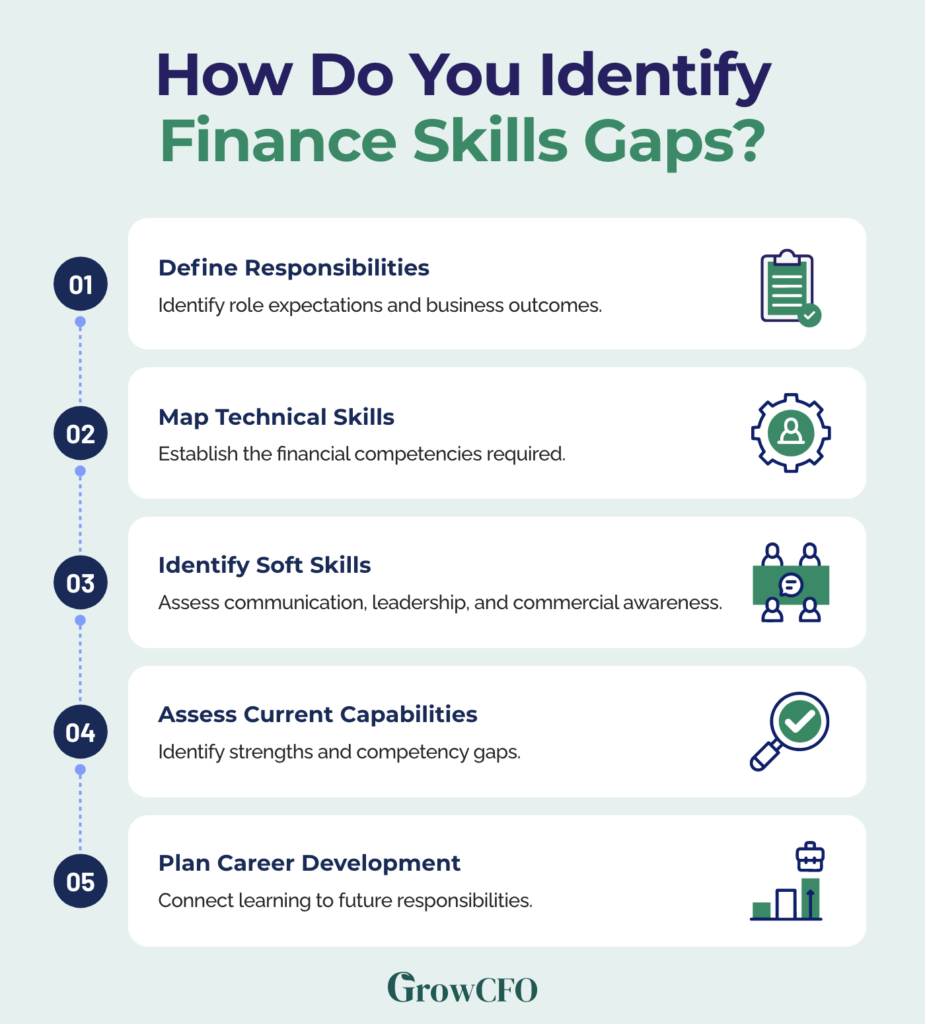
A practical approach involves five steps:
- Define responsibilities: Identify the key activities, decisions, and expected outcomes for each finance role.
- Map technical competencies: Establish requirements for financial reporting, budgeting, forecasting, financial modeling, risk management, and relevant accounting standards.
- Identify behavioral skills: Include communication, critical thinking, collaboration, commercial awareness, and leadership.
- Assess existing capabilities: Use competency assessments, manager feedback, and practical exercises to identify development gaps.
- Connect skills to career progression: Determine which additional competencies employees need to move into more senior or specialist positions.
For finance and accounting teams, technical accuracy and regulatory compliance remain essential. Depending on the organization and jurisdiction, training may include Generally Accepted Accounting Principles (GAAP), the Sarbanes-Oxley Act (SOX), internal controls, procurement workflows, and audit readiness.
However, finance skills development should balance technical knowledge with the ability to interpret information, communicate insights, and influence decisions.
What Are the Three Stages of a Structured Finance Skills Development Pathway?
A structured learning pathway should build progressively, moving employees from essential financial knowledge toward specialist expertise and advanced leadership capabilities.
Most finance skills development pathways can be organized into three stages:
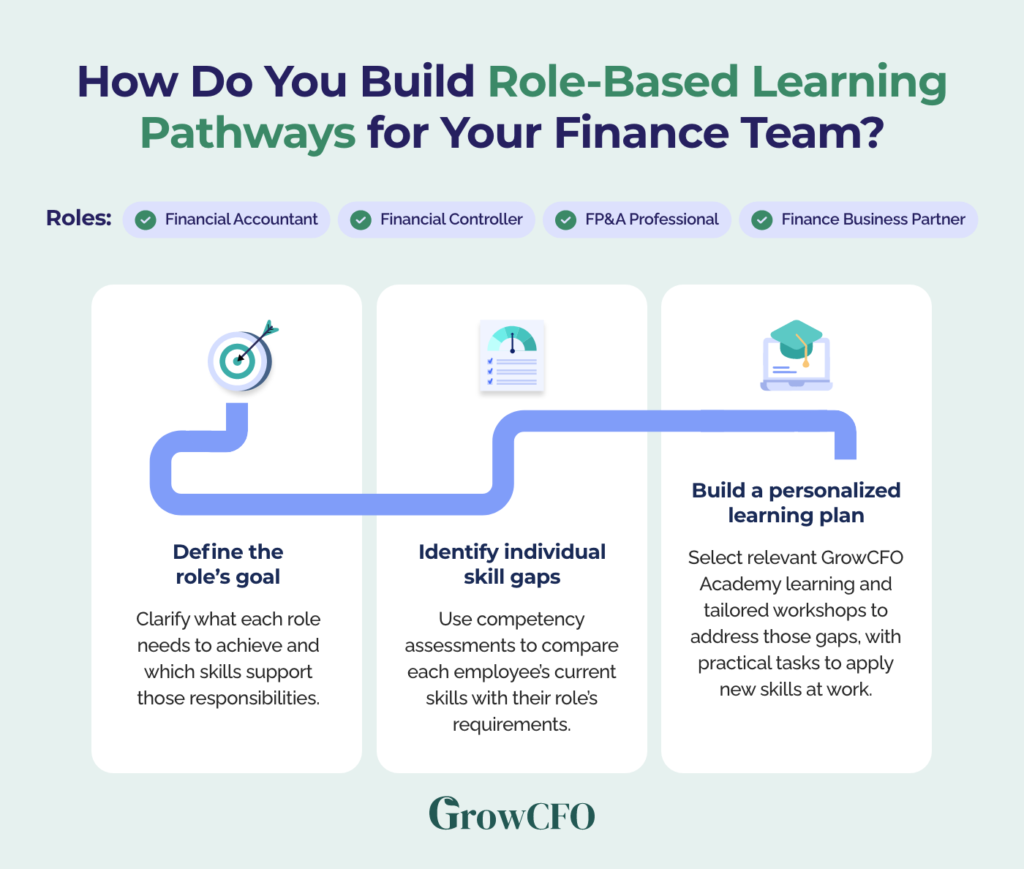
These stages should provide direction without restricting individual development.
For example, an experienced financial controller may already possess advanced technical expertise but need further development in commercial decision-making. Similarly, an FP&A professional preparing for a finance leadership role may benefit more from strategic communication and stakeholder management than additional technical training.
The objective is not to move every employee through identical training, but to build the capabilities each person needs to perform effectively and progress.
Which Learning Methods Are Most Effective for Finance Skills Development?
Different finance competencies require different approaches to learning. Technical knowledge can often be introduced through self-paced courses, while judgment, communication, and leadership benefit from practical application and feedback.
A well-designed finance skills development pathway should combine three approaches.
Blended learning combines online modules with live workshops, coaching, mentoring, and group discussions. For example, employees might learn forecasting principles independently before applying them to a financial planning exercise with colleagues.
Microlearning provides short, focused resources that reinforce knowledge. It works particularly well for compliance reminders, cybersecurity awareness, policy updates, and system changes.
Workflow-integrated learning makes training accessible during everyday responsibilities. Reporting checklists, financial modeling guidance, and just-in-time resources allow employees to apply knowledge when it is needed.
Research reinforces the importance of practical learning and workplace support. A 2019 meta-analysis published in the Journal of Management, The Role of Work Environment in Training Sustainment, found that workplace support factors collectively explained 32% of the variance in training transfer, with peer support making the largest contribution within the model.
This supports an important principle: Training becomes more valuable when employees have opportunities to apply their skills, receive feedback, and learn from colleagues.
For example, GrowCFO’s Finance Business Partner Course combines practical exercises, real-world case studies, and expert-led learning to strengthen communication, collaboration, and strategic influence.
How Can Finance Leaders Measure the Success of Skills Development?
Training completion alone does not demonstrate improved capability. Finance leaders need to determine whether employees can apply what they have learned and whether that learning contributes to stronger business performance.
An effective finance skills development strategy should evaluate progress through competency assessments, practical exercises, employee feedback, and measurable performance indicators.
Depending on the role, these indicators might include improved forecasting accuracy, fewer reporting errors, stronger stakeholder relationships, better financial insights, or greater readiness for leadership responsibilities.
Organizations should assess capabilities before and after training, then review how employees apply their new skills in real business situations.
The most meaningful measure of learning is improved workplace performance, not the number of courses completed.
How Often Should Finance Skills Development Pathways Be Reviewed?
Finance responsibilities change as regulations evolve, technologies advance, and organizational priorities shift. Learning pathways must remain aligned with these developments.
Major finance skills development pathways should undergo a formal review at least annually, with additional updates when significant changes occur.
Regulation-related and high-risk content should be reviewed whenever relevant laws, policies, or internal controls change. Technical training may also need updating when finance teams introduce new reporting platforms, forecasting tools, or AI-enabled processes.
Regular conversations between managers and employees can identify emerging skill gaps and ensure development plans remain relevant to individual career goals.
A learning pathway should be treated as an evolving development plan rather than a fixed training checklist.
How Can GrowCFO Support Role-Based Finance Skills Development?
Building a high-performing finance team requires more than access to individual courses. Employees need structured development opportunities that reflect their responsibilities, capabilities, and professional ambitions.
GrowCFO supports finance skills development through competency assessments, expert-led workshops, mentoring, and structured programs designed for different stages of a finance career.
Through GrowCFO’s Corporate Solutions, organizations can support role-based learning and professional development across their finance teams, helping employees strengthen technical expertise, commercial awareness, and leadership capabilities.
By aligning training with individual competencies and organizational priorities, finance leaders can build stronger teams, improve business partnering, and develop future finance leaders.
Ready to close finance skills gaps and build a high-performing finance team?
Explore GrowCFO’s Corporate Solutions to see how structured finance skills development can support your team’s performance, career progression, and long-term business goals.