
Why Most CFO Career Plans Fail

When you think about where you want your finance career to be in three years, you probably have a good idea of the role you want.
You might want to become a CFO, move into a larger organization, join a board, or take on a broader leadership role.
Then comes the key question: “What specifically must change about you to achieve this?”
That is where career plans often lack clarity. While finance leaders excel at strategic business planning, defining goals, identifying gaps, and tracking progress, we frequently replace structured planning with vague aspirations for our own careers.
The problem isn’t ambition; it’s the missing bridge.
A career goal defines where you want to go, but not what must evolve to make you credible for that role.
That distinction is critical.
If you want to become CFO, doing your current job exceptionally well may strengthen your reputation without necessarily preparing you for the next one.
The same applies if you’re already a CFO and want to move into a larger business, a portfolio career or a board position.
You need to identify the gap between the finance leader you are today and the finance leader your next role requires.
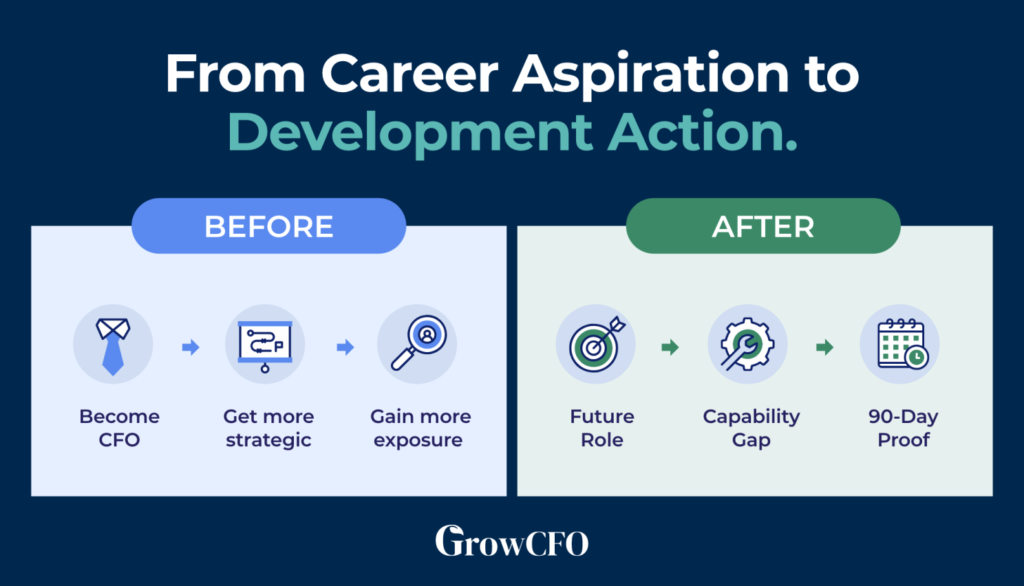
A simple way to do that is the Role → Gap → Proof framework.
The Role → Gap → Proof Framework
For every significant career ambition, answer three questions:
1. ROLE — What will the next role actually require?
2. GAP — Which of those requirements aren’t yet demonstrated strengths?
3. PROOF — What evidence can you create that shows you’re ready?
Most career plans spend too much time on Role.
The useful work happens in Gap and Proof.
Let’s look at each.
1. ROLE: Define the job beyond the title
Imagine your career plan says:
“Become CFO within three years.”
That’s not yet specific enough.
The CFO of a £30m founder-led business is a very different role from the CFO of a £500m international group.
So instead of starting with the title, define the environment.
For example:
CFO of a £100m–£250m growth business, leading a broader finance function, working closely with investors and the board, and playing a significant role in strategy and capital allocation.
Now ask:
What would someone hiring for that role expect me to have already demonstrated?
You might identify:
- Board-level communication
- Strategic planning
- Capital allocation
- Investor or lender relationships
- Leadership of a larger finance team
- Commercial decision support
- Transformation
- M&A exposure
Notice the shift.
You’re no longer asking:
“How do I become a CFO?”
You’re asking:
“What evidence would make someone believe I can succeed in this particular CFO role?”
That’s a much more useful career question.
Here’s how to start
Find three descriptions of roles you’d genuinely like to hold in two to five years.
Don’t apply for them.
Analyse them.
Create two columns:
Future role requires
Evidence I have today
Board communication
Present monthly finance update
Strategic planning
Support annual budget
M&A
None
Investor relationships
Limited
Leadership
Manage team of 12
Transformation
Led ERP implementation
Suddenly your career plan becomes much more concrete.
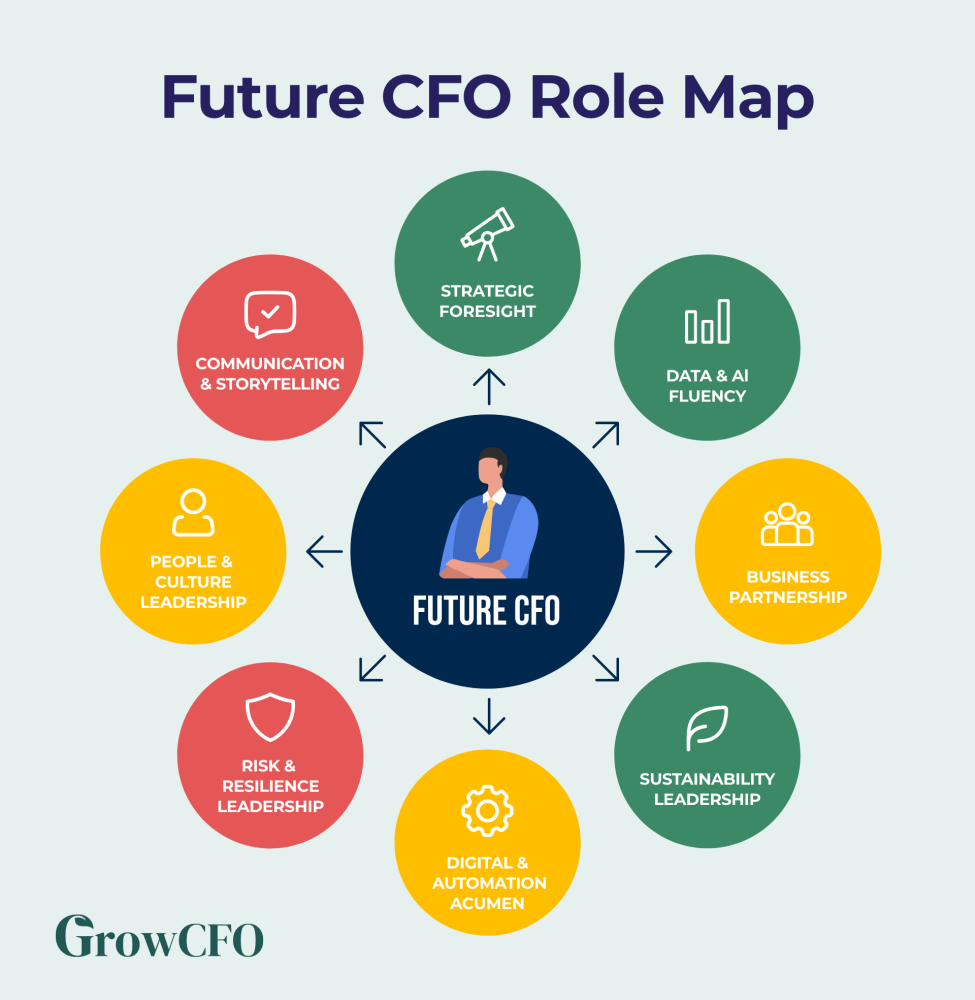
2. GAP: Separate experience gaps from capability gaps
This is where career development often goes wrong.
Suppose you identify board communication as a gap.
The obvious response is:
“I need more board exposure.”
Maybe.
But exposure isn’t necessarily the real problem.
Perhaps you already attend board meetings, but your contribution is primarily explaining historical financial performance.
The future role requires you to frame decisions, challenge assumptions and articulate commercial trade-offs.
That’s a capability gap, not simply an exposure gap.
Consider the difference:
Weak diagnosis: “I need more strategic experience.”
Better diagnosis: “I can analyse strategic options, but I haven’t yet demonstrated that I can recommend a course of action when the information is incomplete and defend that recommendation with senior stakeholders.”
The second version tells you what to develop.
For every gap, ask:
“What would someone observe me doing differently if I had mastered this capability?”
If you can’t answer that, the gap probably isn’t defined clearly enough.
3. PROOF: Turn development into evidence
This is the part I think matters most.
Don’t build your career development around courses completed or experiences accumulated.
Build it around proof created.
Imagine two candidates say:
“I’ve been developing my strategic capability.”
Candidate A says:
“I completed a strategy course.”
Candidate B says:
“I built the investment case for entering a new market, challenged the original assumptions with the commercial team, presented three scenarios to the executive team and recommended we delay the investment until two customer milestones were achieved.”
Who sounds more ready for a bigger role?
Candidate B has proof.
Courses, mentoring and reading can help you build capability.
But the workplace is where you demonstrate it.
Build a Proof Portfolio
For each important career gap, define one piece of evidence you want to create over the next 90 days.
For example:
Your 30-minute career planning exercise
You don’t need to redesign your entire five-year career plan.
Take 30 minutes this week.
Choose one role you’d like to be credible for in the future.
Then complete these three sentences:
ROLE
“Someone succeeding in this role needs to be able to…”
Write five capabilities.
GAP
“Of those capabilities, the one where my evidence is currently weakest is…”
Choose one.
Not five.
PROOF
“Within the next 90 days, I could demonstrate this capability by…”
Identify one real business situation.
Then put that opportunity into your development plan.
Better still, discuss it with your CEO, CFO, manager or mentor.
Instead of saying:
“I’d like more strategic exposure.”
Try:
“I want to develop my ability to evaluate and influence strategic investment decisions. Could I take ownership of the financial case for the upcoming expansion project and present my recommendation to the executive team?”
That’s much easier for someone to support.
Career development should work like capital allocation
There is a useful parallel here.
As CFOs, we wouldn’t approve an investment simply because someone said:
“This feels like an important area.”
We’d ask:
What outcome are we trying to create? What’s constraining us today? Where should we invest? How will we know the investment worked?
Your career deserves the same discipline.
You have limited time.
You cannot develop everything simultaneously.
So identify the capability most likely to constrain your next move and deliberately invest in creating evidence that you can operate at the next level.
That’s a career plan you can actually execute.
The One Thing to Remember
Don’t plan your career around the role you want. Plan it around the proof you’ll need to be credible for it.
Role → Gap → Proof.
That’s the framework.
And you can start using it this week by identifying the one capability where your evidence is currently weakest, then finding a real business opportunity to demonstrate it over the next 90 days.
The Future CFO Program focuses on exactly this kind of career development: helping finance leaders understand what operating at the next level requires, develop the right capabilities, and apply them in real finance leadership situations.
If you want to learn more about how the Future CFO Programme can help you build the capabilities and evidence you need for your next finance leadership role, join one of our free programme preview events:
Book a free Future CFO Programme preview event
Question: What’s the one capability you need stronger evidence of before you’re ready for your next finance leadership role?