4 Questions That Turn Finance Analysis Into Strategic Thinking
Why Strategic Thinking Feels So Vague, and How to Fix It
“Be more strategic” is one of the least useful pieces of feedback a finance leader can receive.
It sounds important, but it rarely tells you what needs to change.
Should you spend more time on long-term planning? Speak more in executive meetings? Produce fewer reports? Challenge the business more often?
Finance leaders do not lack strategic ability; the problem is that strategic thinking is often mischaracterized as a vague, subjective personality trait rather than a practical process.
In reality, strategic thinking becomes much clearer when treated as a way of making better choices instead of simply “seeing the big picture”.
Strategic thinking is not more analysis
Most finance leaders are already good at analysis.
They can explain:
- what changed
- where performance moved
- how actuals compare with budget
- which assumptions were wrong
- where risk is increasing
That information matters, but it is not automatically strategic.
Strategic thinking begins when you connect that information to four things:
- The decision
- The options
- The consequences
- The priority
Here is how to apply each one.
1. Start with the decision
A finance update often begins with information.
A strategic finance update begins with the decision the information is meant to support.
Compare these two openings:
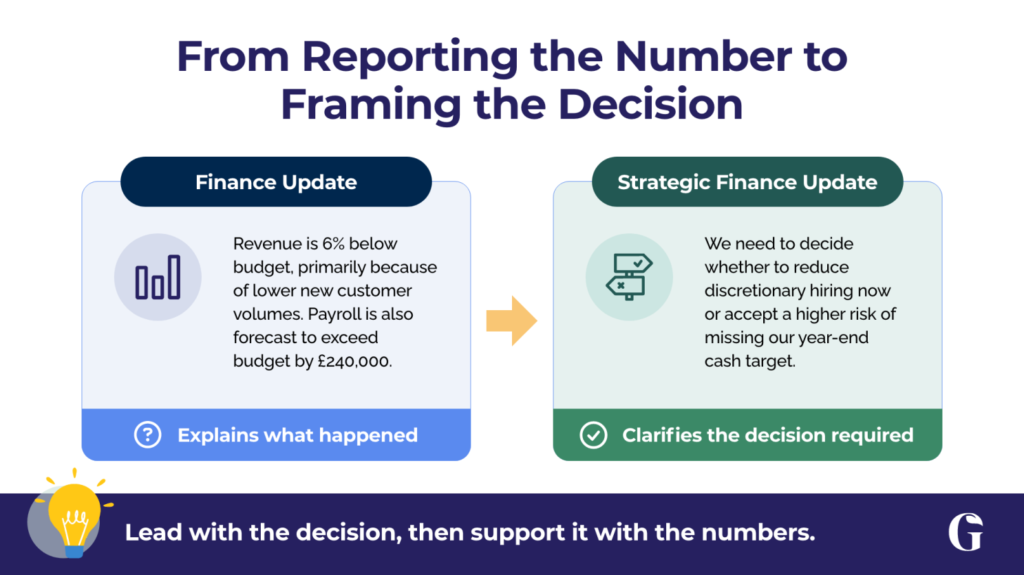
Revenue is 6% below budget, primarily because of lower new customer volumes.
Versus:
We need to decide whether to reduce discretionary hiring now or accept a higher risk of missing our year-end cash target.
The first explains what happened.
The second tells the leadership team why the discussion matters.
Before you produce an analysis, presentation, or board paper, ask:
What decision should this work help someone make?
When the answer is unclear, the analysis usually becomes longer, more detailed, and less influential.
Here’s how to start
Add one sentence to the top of your next report:
This analysis is intended to help us decide whether to [DECISION].
That one sentence forces clarity before you begin adding information.
2. Make the options visible
Finance leaders often identify a problem without clearly presenting the choices available.
That leaves the executive team to interpret the analysis and work out the options themselves.
Strategic thinking makes the trade-offs explicit.
For example:
We have three realistic options:
- Continue hiring and accept lower short-term cash headroom.
- Pause non-critical recruitment for 60 days.
- Maintain hiring but delay planned capital expenditure.
The value is not in producing a perfect list.
The value is in helping the leadership team see that a decision exists and that each option carries a different consequence.
Here’s how to start
Limit yourself to a maximum of three options.
For each option, state:
- what changes
- what it protects
- what it puts at risk
This turns a finance update into a decision conversation.
3. Explain the consequences
Finance teams often stop after describing financial impact.
Strategic leaders explain the broader business consequence.
For example:
Reducing recruitment would protect approximately three months of additional cash headroom, but it may delay the product launch and create additional pressure on the existing team.
This is more useful than simply saying:
Payroll is forecast to exceed budget by £240,000.
The number matters, but the consequence gives it meaning.
Strategic thinking requires you to connect financial outcomes with operational reality.
That may include:
- customer impact
- delivery capacity
- employee workload
- growth speed
- cash resilience
- investor expectations
- execution risk
Here’s how to start
For every significant financial movement, complete this sentence:
If this continues, the practical consequence will be…
This helps prevent finance from reporting numbers without explaining what they mean for the business.
4. State the priority
A strategic recommendation requires a point of view.
This is where many capable finance leaders hesitate; they present the information, explain the risks, and then leave the recommendation unstated because they do not want to overstep or be wrong.
But strategic thinking is not about pretending to have perfect certainty.
It is about making a clear recommendation based on the available evidence.
For example:
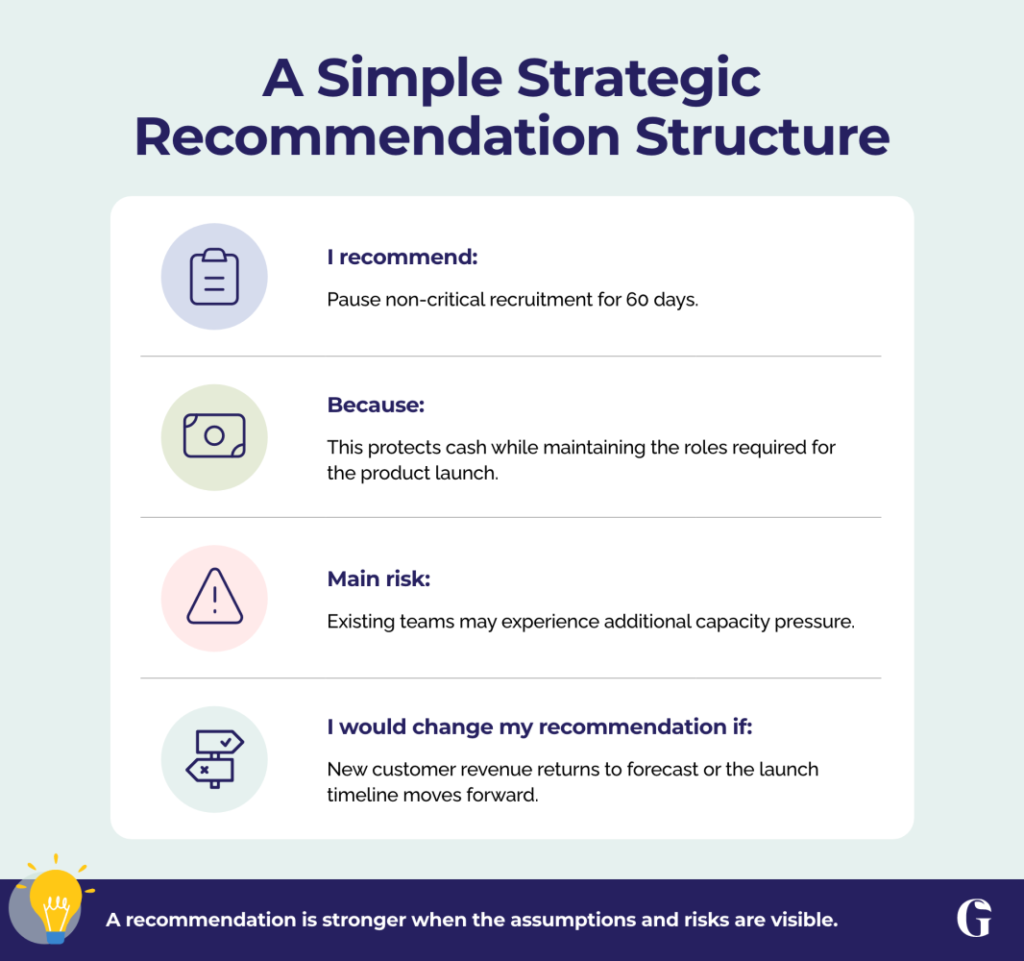
My recommendation is to pause non-critical recruitment for 60 days while protecting the roles required for the product launch. This gives us additional cash protection without placing the highest-priority growth initiative at risk.
A strong recommendation should state:
- what you think should happen
- why
- what assumption it depends on
- what would make you change your view
That final point is important.
It shows that your recommendation is considered, not rigid.
Here’s how to start
Use this structure:
The recommendation is [ACTION] because [REASON]. The main risk is [RISK]. This recommendation should change if [TRIGGER].
That is strategic thinking in practical form.
The Four-Question Strategic Thinking Test
Before your next executive meeting, board update, or business recommendation, ask:
- What decision are we trying to make?
- What are the realistic options?
- What are the consequences of each option?
- What do I recommend we prioritize?
You do not need a new planning model or another dashboard.
You need to move the conversation from information to choices.
The One Thing to Remember
Strategic thinking is not about having more ideas than everyone else.
It is about helping the business make clearer choices.
When your finance work consistently identifies the decision, frames the options, explains the consequences, and recommends a priority, strategic thinking stops feeling vague.
It becomes visible.
For finance leaders actively developing these capabilities, GrowCFO’s Future CFO Program Preview on 5 August at 4:00 PM BST helps strengthen strategic thinking, executive influence, and readiness for a future CFO role.
You will see how the program helps finance leaders strengthen their strategic thinking, executive influence, and readiness for a future CFO role.
Register for a free Future CFO Preview Event.
Which of the four questions do finance leaders skip most often?