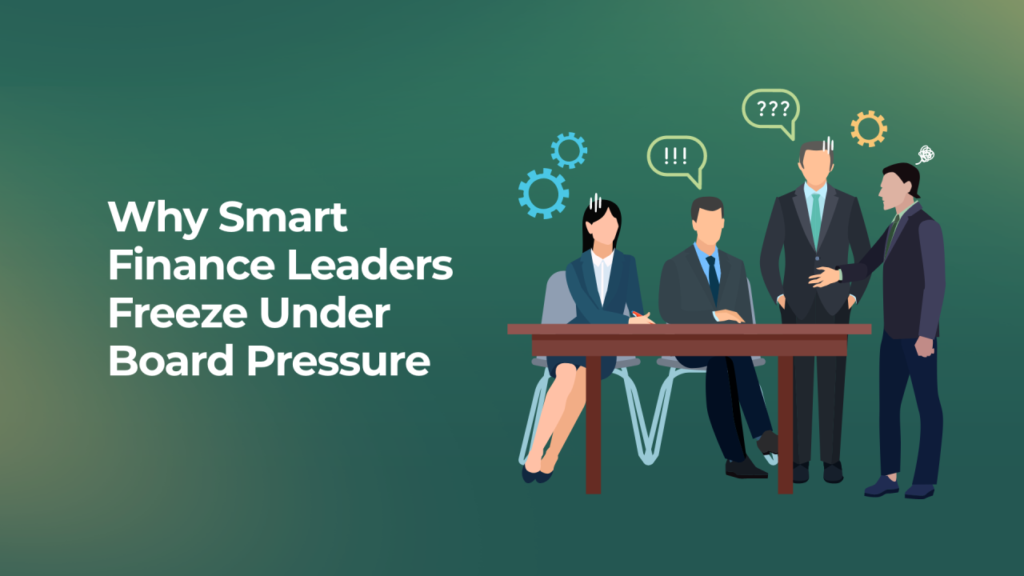
Why Smart Finance Leaders Freeze Under Board Pressure
A well-prepared board pack does not guarantee a productive board conversation.
Many Finance Directors spend hours preparing board packs and only minutes influencing the decisions that follow.
GrowCFO has observed a consistent pattern among strong finance leaders who struggle at board level: they bring finance meeting habits into a decision room that operates by different rules.
Many assume their role is to explain the numbers. but the board is judging whether you can drive the decision.
For finance leaders looking to strengthen their boardroom effectiveness, the free Future CFO Preview Event includes a live walk-through of the GrowCFO platform, business simulators, and the CFO Competency Framework.
Why Board Packs Don’t Land
- Decision: Boards want a recommendation that finance is prepared to stand behind—not a menu of options with no clear direction.
- So what: If the implications are not made explicit, the board will create its own narrative.
- Risk: Boards are rarely worried about missing a decimal. They worry about being surprised later by risks that were never surfaced.
- Time: A board pack competes with numerous priorities. If the key point is not obvious within the first two minutes, attention moves elsewhere.
- Trade-offs: CFO-level thinking makes trade-offs visible and then helps guide the room toward a decision.
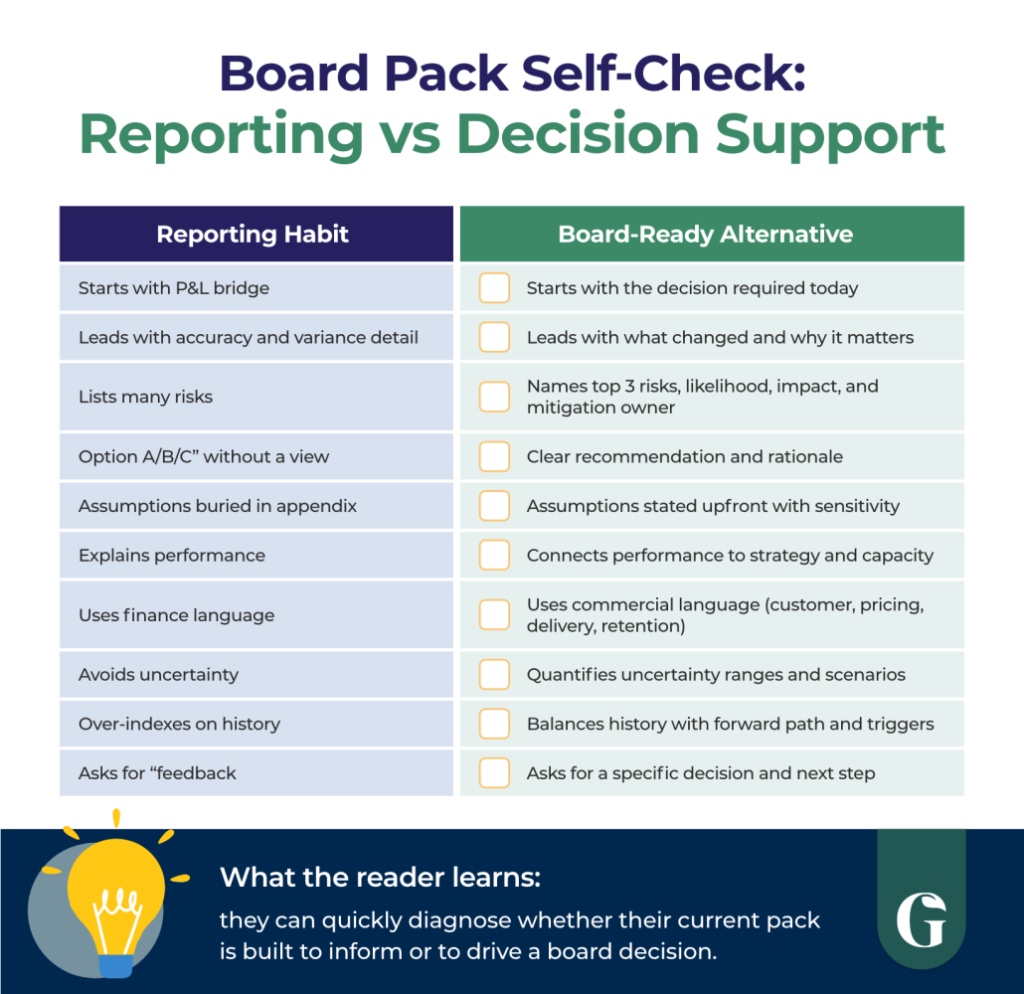
The 5-Question Framework for Board-Ready Decision Packs
Before the next board or executive committee meeting, GrowCFO recommends applying this simple filter. If the first pages cannot answer these five questions, the pack is probably not board-ready.
1) What decision are we asking for?
Write the decision in one sentence starting with a verb: approve, pause, invest, exit, hire, renegotiate. If the decision cannot be clearly stated, the board cannot make it.
2) What is the CFO recommendation?
Boards don’t pay for neutrality. Give a clear recommendation, then the two strongest reasons for it, written in plain commercial language.
3) What has changed since last time?
Start with movement, not history. Name the two or three changes that alter the decision: demand shift, margin pressure, cash timing, delivery risk, churn, covenant headroom.
4) What are the trade-offs and risks, and who owns them?
A board-ready CFO doesn’t dump a risk register on the table. They define the trade-offs, quantify the exposure, and state the mitigation with an owner and a trigger.
5) What happens next, and what will we measure?
Close the loop. State the next 30–90 days plan, the metric that will prove it’s working, and the point at which the board will come back for a re-decision if reality shifts.
Why this works: it forces finance leaders out of “presenting” mode and into “decision leadership” mode. That’s the real boardroom simulation. It’s not about performing under pressure; it’s about being useful under pressure.
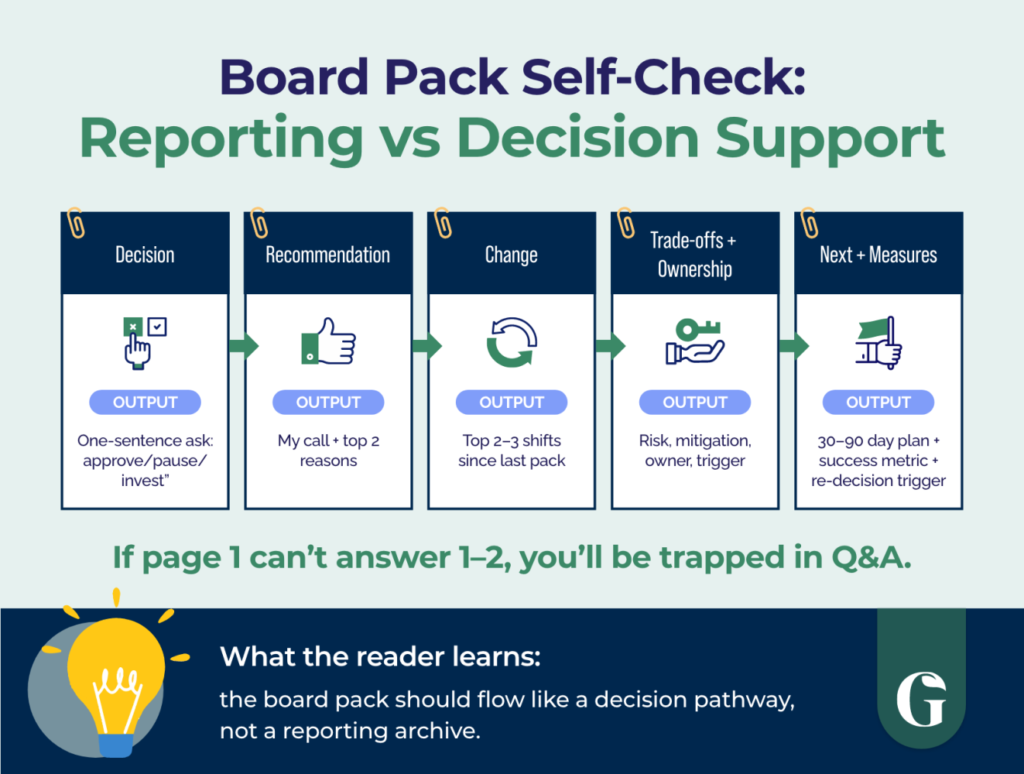
So this week, GrowCFO encourages finance leaders to take their next board pack (or Executive Committee pack) and rewrite page one so it answers two questions: What decision is required? and What is the recommendation? Set a 25-minute timer, keep it to six lines, and remove anything that doesn’t directly support the decision.
The Future CFO Program is built around practical capability shifts like this, using tools on the GrowCFO platform, including the CFO Competency Framework and business simulations designed to build decision-making confidence under pressure. Finance leaders can explore the programme structure and what’s included at growcfo.net, and see how the nine-module journey is designed to help them move from a strong finance leader to a board-ready CFO.
If gaining a clearer understanding of current strengths, capability gaps, and how the Future CFO journey supports that transition sounds valuable, GrowCFO invites finance leaders to attend the free Future CFO Preview Event.
BONUS TIPS / PS:
P.S. At the next board or executive meeting, when someone asks a detailed question, answer it, then close with “So the implication for the decision is…” Also, pre-brief the CEO on the recommendation in two minutes, so you’re aligned before the room tests you.