What to Look For in a Spend Management Solution

Software demos can be dangerously reassuring. The workflow looks clean, the dashboard looks polished, and the approval moves smoothly from one person to the next. The invoice is captured, coded, approved and posted without drama. The report is generated instantly. The process looks controlled.
But that is not usually where finance processes break.
They break when the purchase order is missing, the approver is away, the supplier changes bank details, the invoice looks suspiciously familiar, the renewal has crept up, or the cost appears in a budget nobody was actively monitoring. They break when a SaaS subscription was bought by a department, when an AI add-on was enabled without anyone understanding the usage charges, or when a business-critical tool renews automatically before finance has had the chance to challenge whether it is still delivering value.
That is why finance leaders need to watch spend management demos differently.
This is one of the practical themes behind the latest GrowCFO Tech Innovation Report on cost management. The report looks at how the spend management agenda has expanded beyond traditional accounts payable, purchase orders and invoice processing. CFOs now need better visibility over committed spend, supplier risk, approvals, renewals, SaaS subscriptions, AI usage, and the value the business is getting from its technology-enabled spend.
The GrowCFO Cost Management Tech Showcase, held on 24 June, demonstrated how modern spend management solutions can support stronger financial control. The showcase provided finance leaders with an opportunity to evaluate different approaches to spend management and consider how modern solutions can support the realities of their own finance operating model.
Do not let the vendor control the whole demo narrative
Most vendor demos are designed to show the product at its best. That is understandable. The vendor wants to show a smooth process, a clean interface and a compelling story. But finance leaders should remember that a product tour is not the same thing as a buying conversation.
The happy path is useful, but insufficient.
A typical demo might show:
an invoice arriving;
data being captured automatically;
an approval being routed to the right person;
a payment being scheduled;
spend appearing neatly on a dashboard.
There is value in seeing that. But it does not tell you enough. The real test is not whether the system can process a clean invoice with perfect data and an available approver. The real test is whether it can support the business when the process becomes messy.
That is why CFOs and finance leaders should come to demos prepared with their own scenarios. Instead of asking, “What does the product do?”, the better question is, “How would this work in our business, with our controls, our approval thresholds, our systems, and our reporting needs?”
That one shift changes the quality of the conversation.
Test the exceptions, not just the happy path
Spend management systems create the most value when they help the organisation manage exceptions properly. This is especially important because exceptions are often where cost leakage, control failure and fraud risk appear.
A useful demo should therefore include scenarios such as:
an invoice arriving without a purchase order;
a supplier changing bank details;
a duplicate invoice being submitted with slightly different wording;
an urgent payment request outside the normal process;
an approver being unavailable;
a department exceeding budget;
a new supplier being onboarded;
a spend request crossing an approval threshold;
a SaaS contract approaching renewal;
unused licences remaining active;
an AI add-on creating usage-based charges;
a business user trying to bypass the agreed process.
These are the situations that reveal whether the system is genuinely useful. Can it identify the issue? Can it route the decision to the right person? Can it apply the correct controls? Can it create an audit trail? Can it escalate risk? Can finance see what is happening before the cost has already become locked in?
The best demos are not necessarily the slickest ones. They are the ones that help you understand how the system behaves under pressure.
Look for control, not just automation
One of the mistakes finance teams can make is assuming that automation automatically improves control. It does not. Poorly designed automation can simply accelerate a weak process.
A good spend management solution should help the finance team strengthen control by making approvals clearer, exceptions more visible, policy breaches easier to identify and audit evidence easier to retrieve. It should also help finance understand where spend is being committed before the invoice arrives.
That distinction matters. If the system only improves processing speed, it may deliver some efficiency benefit. But if it also improves visibility, control and decision-making, it becomes much more strategically valuable.
When watching a demo, finance leaders should ask:
Does the solution show who requested the spend and who approved it?
Can approval thresholds be configured properly?
Can the system prevent or flag policy breaches?
Is there a clear audit trail?
Can high-risk actions be routed for additional review?
Are supplier-bank changes tightly controlled?
Can finance see committed spend before the invoice arrives?
Can the system distinguish between routine processing and genuine exceptions?
This is where the conversation moves from “Can the tool automate AP?” to “Can the tool improve the way we control spend?”
Ask what visibility the solution really provides
The latest GrowCFO Tech Innovation Report makes an important point: finance needs earlier and broader visibility over spend. Traditional AP reporting tells finance what has already happened. Modern spend management needs to help finance understand what has been requested, approved, committed, consumed and renewed.
This is particularly important as more spend moves into subscriptions, SaaS platforms, usage-based pricing and embedded AI features. The invoice may no longer be the first meaningful control point. By the time finance sees the invoice, the business may already be dependent on the tool, the renewal may already be close, or the usage may already have scaled beyond the original expectation.
In a demo, it is therefore worth asking what visibility the system provides across the full spend lifecycle. Can it show open commitments? Can it show renewals? Can it show category trends? Can it show supplier concentration? Can it identify unused licences or duplicated tools? Can it track usage-based costs? Can it help finance understand whether spend is creating value?
Dashboards can look impressive, but the question is whether they answer the questions finance actually needs to ask.
Use a CFO demo scorecard
A practical way to assess vendors is to use a simple CFO scorecard. This avoids being distracted by the most polished interface or the most impressive individual feature, and instead focuses attention on the capabilities that matter most.
The scorecard should include:
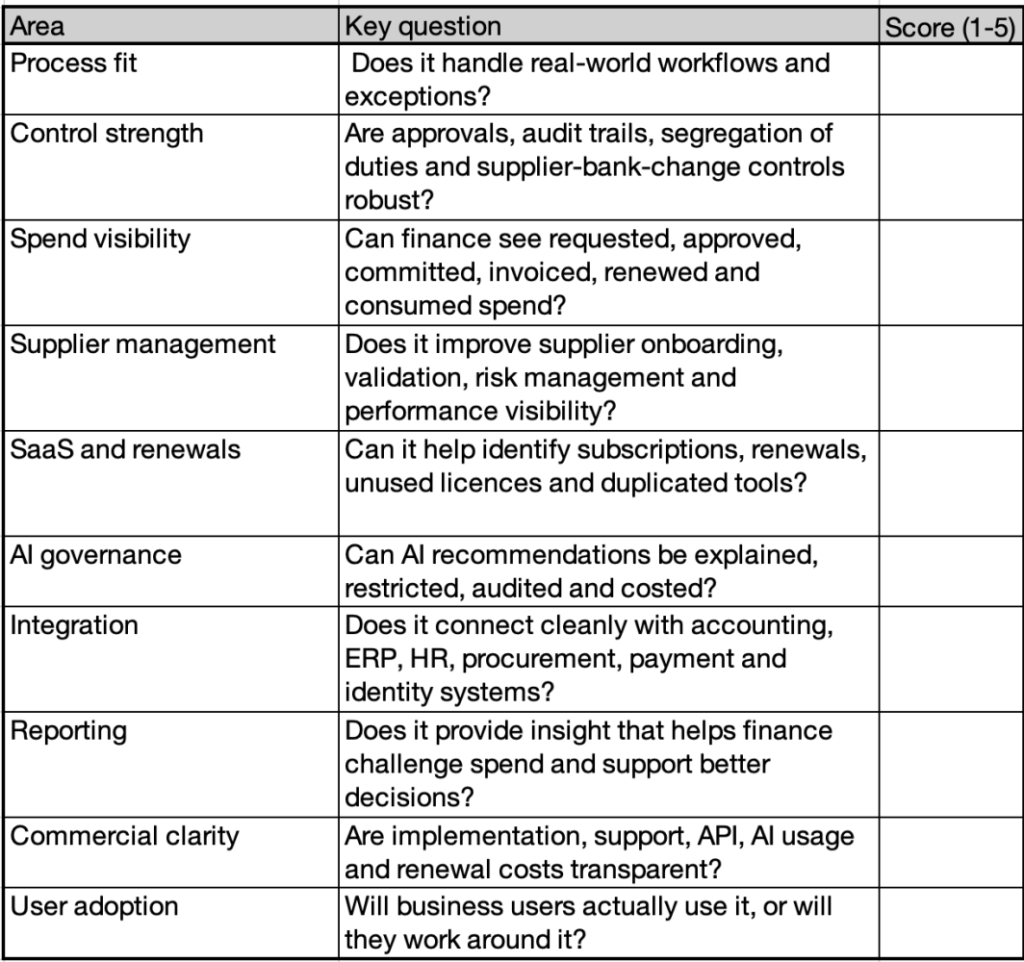
This kind of scorecard is deliberately practical. It is not about finding the product with the longest feature list. It is about identifying which solution could genuinely improve visibility, control and value in your organisation.
The GrowCFO Cost Management Tech Showcase, held on 24 June, provided a practical opportunity for finance leaders to test their thinking about what they need from the next generation of spend management tools rather than simply watching product demonstrations.
Involve more than finance in the assessment
Spend management is not just a finance process. It touches procurement, IT, security, legal, budget holders, approvers, department leaders and business users. That means the assessment of a spend management solution should not sit with finance alone.
A sensible demo review group might include:
head of finance;
accounts payable;
procurement;
IT or security;
budget holders;
operational users;
legal or compliance where relevant.
Each group will see something different. Finance will focus on control, reporting, working capital and financial visibility. Procurement will focus on supplier management, commercial terms and renewal leverage. IT will focus on integration, security, access and system architecture. Business users will focus on whether the process is easy enough to follow.
That last point matters. A system that finance likes but business users avoid will create workarounds. A system that business users like but auditors cannot trust will create risk. A system that procurement likes but finance cannot report from will create another problem.
The best solution needs to work across the operating model, not just inside one department.
Ask about implementation reality
Demos often make implementation look easier than it really is. That is not necessarily because vendors are being misleading. It is because demos naturally show the product once it has already been configured, integrated and populated with clean data.
Finance leaders need to understand what it takes to get there.
Useful implementation questions include:
How long does implementation typically take?
What internal resources are required?
What data needs to be cleaned before go-live?
Which integrations are standard and which are custom?
How are approval workflows configured?
How are supplier records validated?
How are users trained?
What happens after go-live?
What reporting is available from day one?
What ongoing administration is required?
What costs are not included in the headline licence fee?
These questions often reveal whether the buying organisation is looking at a manageable implementation or a hidden transformation project. They also help the CFO understand the true cost of ownership, not just the subscription price.
Ask about AI carefully
Many spend management solutions now include AI, or will include more AI over time. That can be valuable. AI can support invoice capture, coding suggestions, anomaly detection, duplicate identification, supplier risk monitoring, approval routing, spend analysis and forecasting.
But finance leaders should be careful about vague AI claims. The question is not simply whether the system has AI. The question is what the AI is doing, how it is controlled, and whether the outputs can be trusted.
Useful questions include:
What exactly is the AI doing?
Is it recommending, approving or automating?
Can users override it?
Is there an audit trail?
How is accuracy monitored?
What data is used?
Are recommendations explainable?
Are there additional AI usage charges?
Can usage be capped?
How does the system prevent inappropriate automation of high-risk decisions?
The point is not to reject AI. The point is to understand how it is governed.
For CFOs, this is particularly important because AI can create both opportunity and risk. It can improve productivity and insight, but it can also introduce new cost models, new control questions and new dependencies. That is why AI capability needs to be assessed through a finance, governance and commercial lens, not just as a product feature.
Pay attention to commercial clarity
A polished demo can hide a complicated commercial model. Finance leaders should therefore pay close attention to pricing and total cost of ownership.
That includes the licence fee, but it also includes implementation costs, integration costs, support costs, API costs, payment costs, additional modules, premium features, AI usage charges, renewal uplifts and any costs associated with scaling usage.
The questions to ask are straightforward:
What is included in the base price?
What is charged separately?
What happens as transaction volumes grow
What happens as user numbers increase?
What AI costs could emerge?
What support is included?
What implementation work is chargeable?
What are the renewal terms?
How easy is it to exit?
This is particularly important in the current environment, where CFOs are under pressure to control spend but also need to invest in better systems. A solution that helps control cost elsewhere still needs to have a clear and defensible cost model of its own.
The best demo question
If there is one question finance leaders should ask during a spend management demo, it is this:
Show us exactly how this would work in our process, with our controls, our approval thresholds, our systems and our reporting needs.
That question changes the conversation. It moves the demo away from generic functionality and towards operational fit. It forces the vendor to show how the solution would handle real decisions, real controls and real exceptions.
Consider whether to give each supplier a scenario taken from your own business to demo, this is particularly useful if you are considering using the software in process areas that might be unique to your business
It also helps the buyer avoid a common mistake: buying a product because the demo looked good, then discovering during implementation that the organisation’s actual process is more complicated than the product story suggested.
Use the showcase to sharpen your own thinking
The GrowCFO Cost Management Tech Showcase on 24 June is a chance to see technology in action, but it is also a chance to sharpen your own thinking about the future of spend control.
The latest GrowCFO Tech Innovation Report sets out the wider context: spend management has moved beyond AP automation alone. CFOs now need to think about committed spend, supplier risk, approval controls, renewals, SaaS sprawl, AI usage, technology-enabled spend and the value being created across the business.
The showcase brings that discussion to life. It gives finance leaders the opportunity to compare different approaches, listen to the questions other CFOs are asking, and consider which capabilities matter most in their own organisation.
The aim is not to find the flashiest system. It is to identify which solutions could genuinely improve visibility, control and value in your finance operating model.
Closing thought
Modern spend management is not just about workflow automation. It is about whether finance can see commitments earlier, control risk better, manage supplier relationships more effectively, challenge renewals, understand SaaS and AI costs, and help the business make better spending decisions.
That means demos need to be tested against real business scenarios. The happy path is useful, but the exceptions are where the truth usually sits.
If you are reviewing spend management technology, the latest GrowCFO Tech Innovation Report provides a useful framework for the questions finance leaders should be asking. The GrowCFO Cost Management Tech Showcase, held on 24 June, demonstrated how modern solutions can help finance teams move from reactive spend reporting to earlier visibility, stronger control and better decision-making.
If you missed the live showcase or would like to watch the sessions again, you can view the replays here:
https://learn.growcfo.net/cost-management-tech-showcase/
The best demonstrations are not the ones that simply show what the software can do. They are the ones that help finance leaders understand whether the solution can work in the reality of their business.