You Have 7 Seconds to Prove Your Confident in the Boardroom

Finance leaders can be 100% right on the numbers and still lose credibility in the room if they cannot make the call.
Not because they are unprepared.
But because finance careers train professionals to protect accuracy, not to own decisions.
For years, finance rewards being correct, complete, and defensible. Executive leadership rewards something different: judgment under uncertainty, communicated clearly, with consequences attached.
GrowCFO sees this shift repeatedly in leaders transitioning toward the CFO seat.
Confidence at CFO level is not a personality trait. It is a behaviour.
CFOs take a position, make the trade-offs explicit, and ask for a decision while naming the risk they are actively managing.
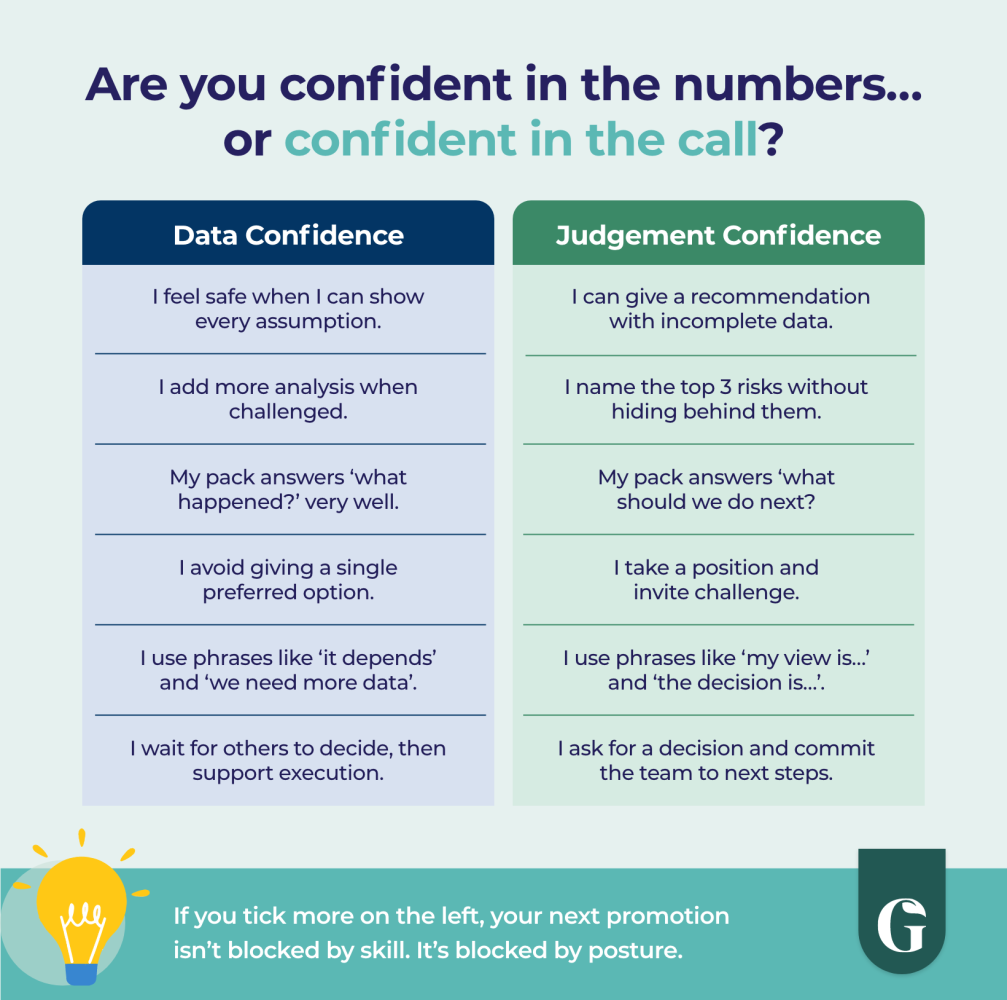
What most finance professionals do:
- They try to earn confidence through certainty.
- Analysis continues until every angle feels defensible, and recommendations are softened into “balanced” options to avoid being tied to a single view. Technically, this feels safe. But leadership teams are often left with the same problem: they still do not know what finance actually thinks should happen.
What CFOs actually do:
- They earn confidence through judgment.
- They take responsibility for a point of view, show the trade-offs clearly, and make it easier for CEOs and boards to decide. Perfect information rarely arrives on time, so waiting for certainty becomes a liability.
The shift finance leaders need to make is this: Treat recommendation as part of delivery, not as personal risk.
One practical framework GrowCFO teaches is the 1–3–1 Recommendation:
- 1 decision that needs to be made (approve / pause / stop / invest / change)
- 3 reasons that matter most
- 1 risk being actively managed
A finance leader brings analysis. A CFO brings a call that moves the business. The analysis still matters, but it must serve the decision.
THE CAPABILITY GAP:
The gap is rarely technical knowledge.
It is the willingness to stay accountable for the call in front of senior stakeholders without hiding behind more work or more analysis.
CFOs behave differently:
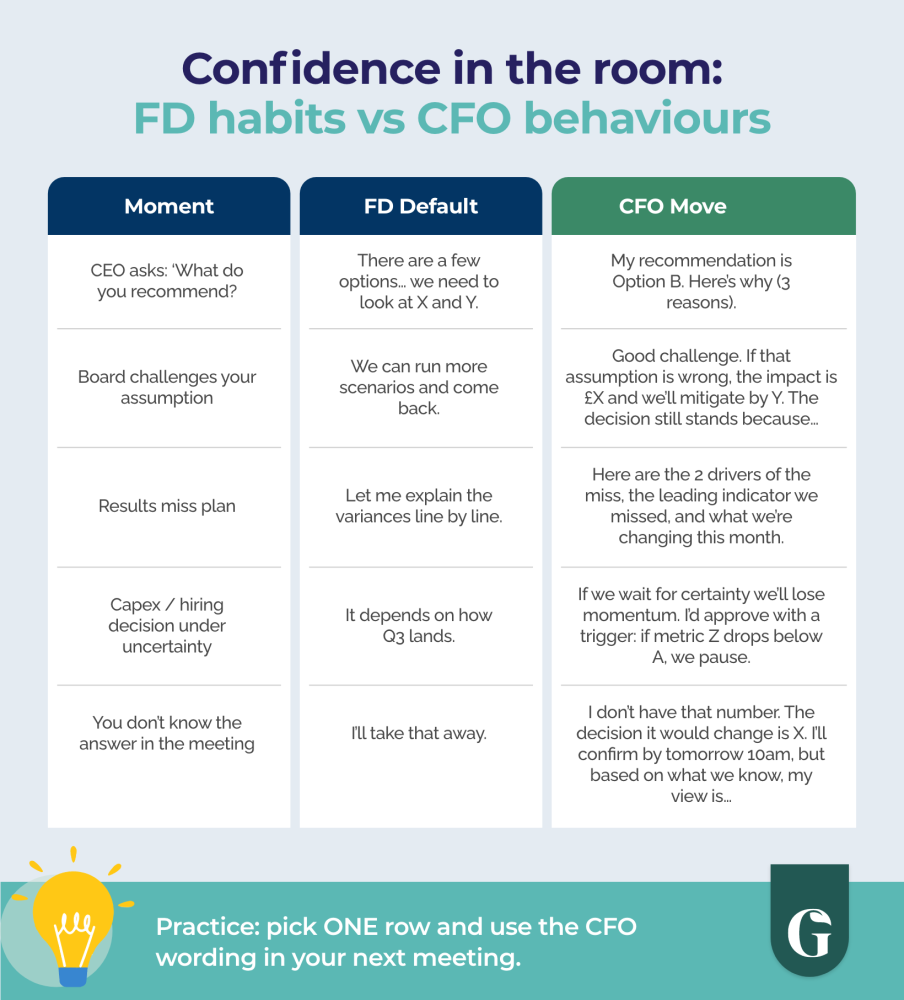
1.) CFOs take a position early. Most finance leaders wait until the analysis feels bulletproof.
2.) CFOs simplify to what matters. Most finance leaders add detail to feel safe.
3.) CFOs name trade-offs explicitly. Most finance leaders present options with no real weighting behind them.
4.) CFOs speak in decisions and consequences. Most finance leaders speak in variances and explanations.
5.) CFOs invite challenge and remain steady. Most finance leaders interpret challenge as a signal to retreat back into analysis.
If finance leaders recognize themselves in the second half of those comparisons, that is normal. Those behaviours are exactly what most finance careers reward for years: accuracy, completeness, and control. The CFO seat rewards something different: clarity, judgment, and decision leadership.
This does not require a different personality. It requires a different posture: “Here’s my view, here’s the risk, and here’s the decision I’m asking you to make.”
What to do NOW:
1.) Rewrite one real message as a 1–3–1 Recommendation
Choose one decision currently in play this week: pricing, headcount, cash protection, capex, or forecast changes.
Write:
- The decision that should be made
- Three reasons that matter most
- One risk being actively managed, including mitigation
Then deliver it in under 60 seconds. If it cannot be explained clearly in under a minute, the thinking is not clear enough yet.
2.) Do a 10-minute “challenge rehearsal”
Before the next senior meeting, ask a peer to challenge the recommendation aggressively.
The objective:
- Stay anchored on the decision
- Change direction only if the challenge genuinely changes the call
- Keep the risk and mitigation plan explicit
If the outcome is ten more slides, the exercise missed the point.
3.) Replace two phrases that leak authority
For the next seven days, avoid using: “It depends” and “We need more data” unless immediately followed by the decision impact.
Instead, use this structure:
“My view is X. The decision is Y. The risk is Z, and we’ll manage it by doing A.”
For finance leaders who want to build CFO-level confidence through repetition, challenge, and real-world scenarios, GrowCFO explores these capabilities in depth during the Future CFO Preview Event.