The CFO Method for Creating Independent High Performing Teams

Your team can execute without you.
High performing CFOs use coaching to build teams that think clearly, take ownership, and deliver impact independently.
For years I believed great leadership meant having every answer. It worked until my team stopped growing. Everything changed once I shifted from directing to coaching.
Most finance teams lean on the CFO too often.
Every decision.
Every clarification.
Every escalation.
Execution happens, but leadership does not grow.
Secure your free spot at the Future CFO Program Preview Event to learn how top CFOs build teams that excel without constant direction.
The Core Shifts That Build Self Sufficient Teams
-
Ownership: People move faster when they understand the outcome, not just the task.
Clarity: Coaching builds repeatable thinking structures teams can use independently.
Resilience: When people make decisions without fear, their confidence compounds.
Escalation Rules: Clear thresholds prevent bottlenecks at the CFO’s desk.
Leadership Pipeline: Coaching turns strong performers into emerging leaders.
Consistency: Frameworks make performance predictable even under pressure.
The CFO Coaching Blueprint That Builds Self Sufficient Teams
Leadership capacity does not grow through more instruction. It grows through better conversations.
Here is a structure designed for CFOs who want teams that think for themselves and deliver without constant oversight.
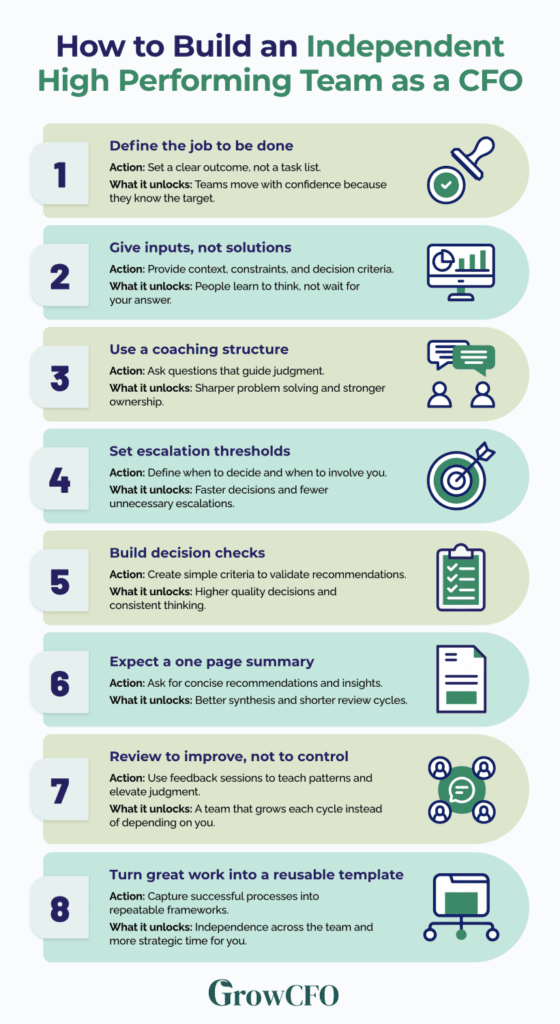
1. Define the job to be done
Focus on the outcome, not the task list. For example: “Present a cost savings recommendation with quantified impact and risks.” This gives your team a target they can run toward.
2. Give inputs, not solutions
Share context, constraints, data sources, and decision criteria. Resist the urge to outline the answer. The more space they have, the stronger their thinking becomes.
3. Use a coaching structure
Ask questions that create clarity and ownership.
Examples:
“What is the core problem here”
“What two options do you see”
“What would you recommend if you had to decide now”
Each question strengthens judgment.
4. Set escalation thresholds
Define when they should make the call and when they should involve you.
Example: “Escalate only when risk exceeds £50k or impacts the board narrative.”
5. Build decision checks
Create simple criteria they can use to validate solutions.
Examples: alignment with strategy, cost impact, timing, risk exposure.
Checks remove uncertainty and reduce bottlenecks.
6. Expect a one page summary
Ask for concise recommendations. This forces synthesis and raises the quality of thinking across the team. It also streamlines your review time.
7. Review to improve, not to control
Use your review sessions to teach patterns, not rewrite work.
Show what good looks like.
Show how they can refine.
Show how to scale this thinking next time.
8. Turn it into a reusable template
Once a process works, capture it.
Your team gains independence.
You gain strategic time.
Hundreds of senior finance leaders across GrowCFO report the same pattern.
Teams become more accountable.
Decisions move faster.
CFOs regain strategic time.
Join the Future CFO Preview Event for live demos, real CFO case studies, and practical coaching frameworks you can use immediately. Save your seat today.
MINI FAQ
Do I need a large team for this to work No. Coaching structures work with teams of any size because the goal is clarity, independence, and repeatability.
Will this slow down decision making No. It speeds it up. Once your team learns the structure, they make decisions confidently without waiting for you.
Is this relevant if I already have strong performers Yes. High performers grow fastest with coaching. It elevates them into future leaders.